How to Fight a Freeway 101
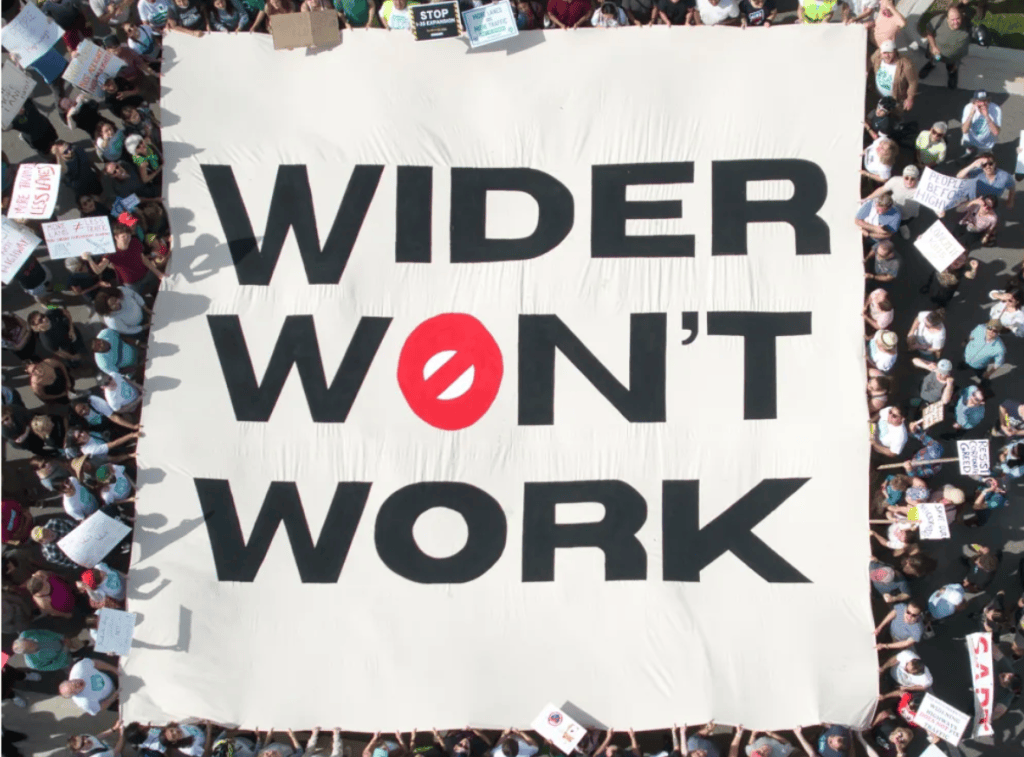
A new guide for would-be freeway-fighters aims to give the next generation of transportation reform advocates the tools to organize against harmful infrastructure in their communities, even when they face daunting odds.
Just in time for the newly-blue Congress, advocates at America Walks have published the “Communities Over Highways Playbook” to help US residents oppose and defeat dangerous interstates — though the guide will also help in fights against deadly arterials, too-fast rural roads, and just about everything in between.
Developed in partnership with the Freeway Fighters Network, which the group helped launch, the guide offers insights for seasoned advocates in search of new tactics to win difficult battles. And as Washington gears up to pass the next federal infrastructure bill, its authors say it’s more important than ever for urbanists to stop talking about how much highways hurt their communities and start taking action.
“‘One more white paper’ is like ‘one more lane,’ — it’s not really going to make a difference,” said Mike McGinn, America Walks’ executive director and one of the lead authors of the playbook. “The highway-building lobby has got more money. They’ve got more power … [But] organized people can beat organized money. That’s the history of America, and we need to do that right now.”
The changeover in Congress isn’t the only reason why the freeway-fighting movement is poised for a big moment.
McGinn and his co-authors stress that communities across the country are still awash in money from the Infrastructure Investment and Jobs Act, which doled out historic levels of money for auto-centric projects. The law initially contained significant funding to reconnect communities and invest in new transit infrastructure too, but the Trump administration of clawed back much of it; roadway dollars, though, remained largely intact.
With that eviscerated version of the IIJA extended through December 11, advocates now must fight back not just against the highways it’s helping to build, but against the even worse bill that’s poised to replace it, BUILD America 250. But the midterms’ stunning victories for transit and its champions could signal that change is afoot — if advocates seize the moment.
“As bad as it’s looked at the federal level with this administration, we can see the pendulum swinging … This is the exact right time to build organizing muscle and build capacity and build skills on how to do it,” added McGinn. “Because when the moment comes where we can make big gains, we need to be as ready as we can be.”
That preparation, the guide argues, must begin with advocates specifying why their highways must be defeated, both to power their own fight and make the case to the media and their larger communities. Policy Director Ben Crowther recalls one member in Ohio who was inspired by a neighbor with disabilities, whose accessible home is threatened by an interstate expansion.
“That’s what motivates this person to continue their campaign forward,” Crowther adds. “Establishing those shared values really helps people stick in the long term for an incredibly hard and asymmetrical fight.”
The playbook helps flatten those asymmetries with a quick and dirty, 101-level field guide to organizing in general, teaching advocates the basics of building coalitions that can challenge powerful interests, identifying decision-makers to target for campaigns, developing allies in government and media, and building a “theory of change.”
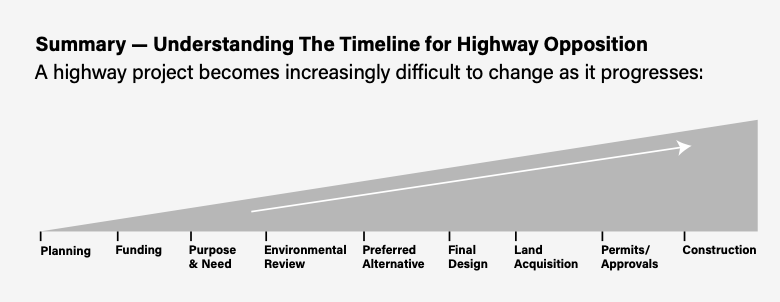
It also decodes not just who the power-players tend to be in highway projects, but the many phases those projects tend to follow, which Crowther says are often deliberately difficult to track.
State and regional transportation improvement plans are notorious for offering the public little transparency, even when they launch harmful projects that result in people losing their homes — but if advocates are willing to get in the weeds, they can stop the destruction before it happens.
“The moral is, the earlier you start contesting one of these projects, the easier it is to stop it,” he added. “These expansion projects are put in incredibly dense transportation improvement plans that [fly] under the radar — so by the time the public is truly becoming aware of what’s going on, there’s a lot of momentum behind this project.”
Still, both Crowther and McGinn emphasize it’s never too late to stop a bad road project — particularly if advocates get creative.
Much of the guide is essentially a menu of advocacy strategies and case studies to inspire every stage of a campaign. That includes tried-and-true tactics like lawsuits and candidate questionnaires, alongside more colorful ones, like block parties, billboards, rogue town halls, and chili cook-off fundraisers.
Because at the end of the day, freeway fighting isn’t just about saving communities from harmful infrastructure — it’s about building new communities of activists who can band together in the ongoing fight against car dependency.
“Always have a party at the end — win or lose,” McGinn added. “Your goal in organizing around campaigns is not just to win the immediate [objective], but it’s also to be stronger at the end, to have more volunteers, to have penetrated further into the public [dialogue], so you’re ready for the next one.”