D.C. Advocates Sue To Save Key Bike Lane From Trump Teardown
Advocates in the nation’s capital are suing the Trump administration to prevent the removal of a critical bike lane — but also to send a warning about the White House’s ongoing assault on human-scaled infrastructure.
The Washington Area Bicyclist Association sued a constellation of federal agencies earlier this week after signs abruptly went up along 15th Street NW indicating that portions of the bike lane between Constitution Avenue and the Jefferson Memorial would be removed by the federal government — without any advance notice, explanation, environmental review, or opportunity for public comment, all of which are required by federal law. Unlike many other D.C. bike lanes, the portions targeted for teardown are sited on land overseen by the federal National Park Service.
The signs confirmed rumors sparked by a leaked January memo first reported by Streetsblog, which signaled that the Federal Highway Administration was exploring removing several key cycling corridors throughout D.C. based on dubious estimates of how much time drivers waste in traffic because of “lost” road space.
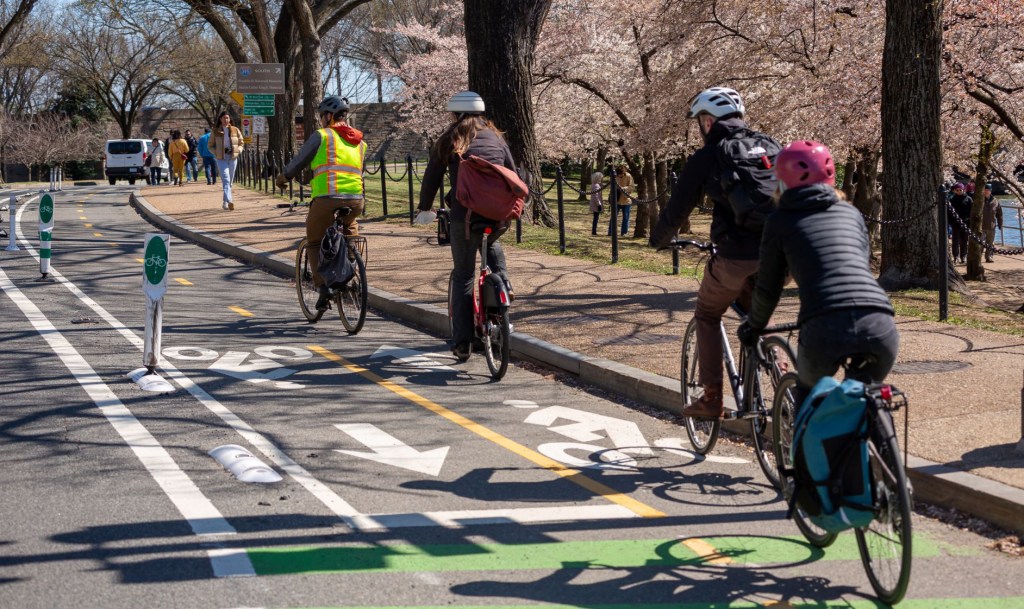
The loss of the 15th Street cycle track, though, would be particularly painful for D.C. residents, both because it serves roughly 4,000 riders a day and because of its unique place in local history. Technically the first protected bike lane ever installed in the capital back in 2009, it begins at the northeastern edge of the National Mall and connects residents and visitors alike with some of the nation’s iconic destinations and events, including the Washington Monument and the spring cherry blossom festival.
Today, thanks to a recent extension, it’s the only low-stress route across the Potomac River to neighboring Virginia, where many D.C. commuters live.
But FHWA spokeswoman Melissa Braid told the Washington Post that the nearly two-decade-old bike safety measure had “dramatically reduced roadway capacity” for drivers — and that the Trump administration had no choice but to “restore common sense into city planning,” starting with removing it, since it’s located on land over which the Department of the Interior has jurisdiction. (Neither agency responded to requests for comment from Streetsblog.)
Braid’s statement, though, is directly contradicted by a local analysis, which found that that installing the cycle track had actually caused a 17-percent increase in vehicle speeds, while slashing crashes across all modes 46 percent and bicycle crashes by 91 percent. And without a better explanation of why the lane is being targeted, advocates have no choice to assume the reasons were ideological.
“I think we’ve seen from a number of angles that this administration doesn’t value or respect cities, and doesn’t understand how cities work or why people would want to live in them,” said Colin Browne, deputy director of the Washington Area Bicyclists Association. “This notion that people get around without cars all the time, and that’s normal and fine and part of city life — it’s foreign to them at minimum, and anathema at worst.”
Browne is particularly alarmed with how suddenly plans were put into practice to demolish the 15th Street lanes, which were the result of years of tireless advocacy by his group and others. Some of those same advocates held a preemptive rally to protect their cycling infrastructure on the National Mall in February; others have been patrolling the threatened cycle tracks on two wheels since the signs first went up, fearing that the federal government will rip them out when no one is looking, even though the Department of the Interior has agreed to hold off until March 30.
“We went through an extensive public input process to put these lanes in. … That extensive process should have happened for removing the bike lanes along the Mall as well, and it didn’t,” he added. “This is not altogether surprising; we all saw what happened to the East Wing of the White House. … So that’s why the lawsuit is happening.”
D.C.’s Vision Zero initiatives are under attack in other arenas, too, including by those who are following the proper channels. Because D.C. is not a state, Congress has a unique ability to micromanage the region’s urban policies, which House Republicans recently took advantage of when they advanced a bill to restrict the District’s authority to operate a speed camera program and ban right turns on red — even as those policies remain on the books in several of those representatives’ home communities.
Some District advocates say the attempted removal of the 15th Street cycle track is part of that larger pattern of overreach — and they aren’t mincing words about it.
“They want to take the bike lane because they want to run our capital so that they never have to leave,” said Keya Chatterjee, Executive Director of Free DC, at the February rally.
Win or lose, Browne hopes the suit will help save the other proposed lane removals listed on the leaked memo, too. A group of Democratic Congresspeople lead by D.C. delegate Eleanor Holmes Norton and Virginia Rep. Dom Beyer are pushing for the appropriations bill to include language that would prohibit the federal agencies to remove D.C.’s cycling infrastructure; WABA has also launched a petition.
But they know winning won’t be easy.
“That’s kind of why we’re fighting so hard right now, is that if they think they can get away with it, they will certainly try to do it in other places well,” he added. “It’s part of [a set of] broader attacks on active transportation … If they figure out that they can get away with it here, they’ll try it elsewhere.”

Streetsblog has migrated to a new comment system. New commenters can register directly in the comments section of any article. Returning commenters: your previous comments and display name have been preserved, but you'll need to reclaim your account by clicking "Forgot your password?" on the sign-in form, entering your email, and following the verification link to set a new password — this is required because passwords could not be carried over during the migration. For questions, contact tips@streetsblog.org.