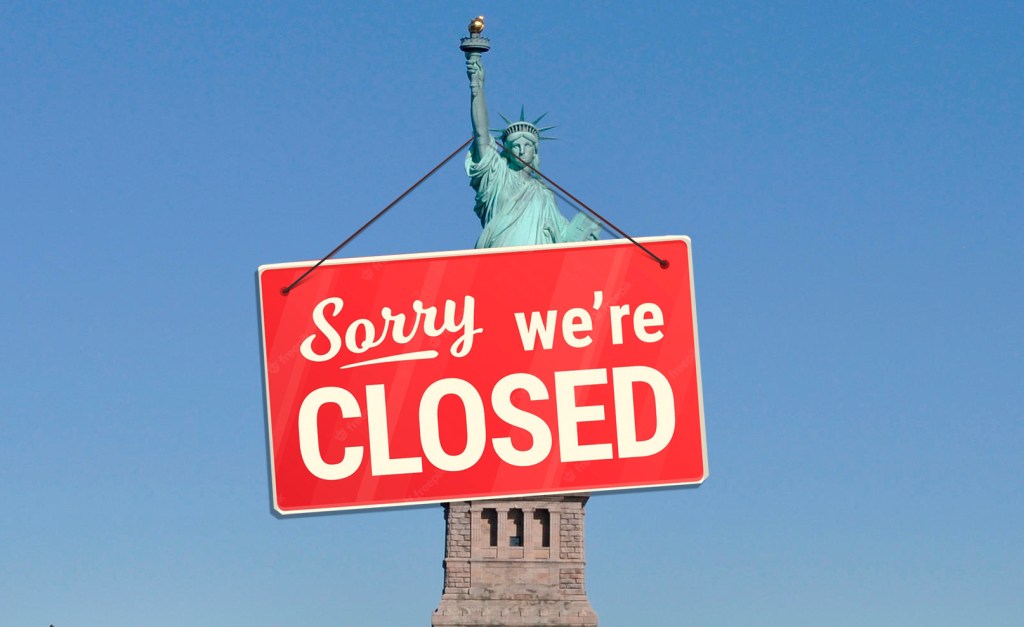
The Talk of D.C.: Rumors Flying that Trump Admin Wants to Undo Bike Lanes in Capital
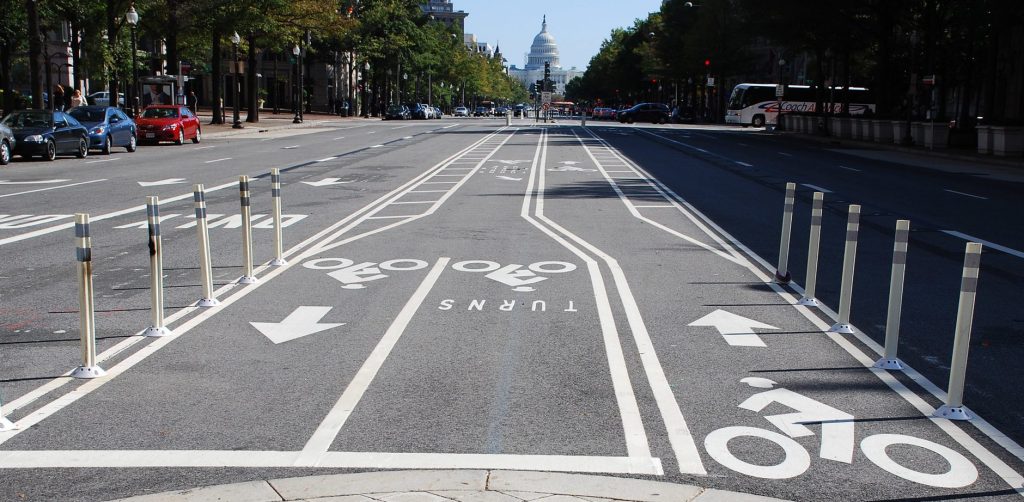
The federal government is hunting for a justification to eliminate key bike lanes in the nation’s capital, sources say — and if the feds are able to push that controversial agenda through, some fear it could set a disturbing new precedent for federal interference into active transportation projects across the nation.
According to documents obtained by Streetsblog and interviews with several government employees, the Federal Highway Administration has been analyzing congestion patterns along several critical Washington D.C. corridors outfitted with bike lanes, with an eye towards an unspecified “reallocation” of lane space — which sources say likely means giving it back to drivers. (The FHWA acknowledged an inquiry from Streetsblog but did not provide a comment for this story.)
The analysis appears to rest on a series of dubious calculations that claim D.C. drivers are losing hundreds of thousands of hours per year in traffic along those corridors, with the implication that the bike lanes themselves are responsible for the gridlock. Even roadways that did not lose a full lane for car drivers when bike lanes were installed were listed as costing drivers hundreds of thousands of hours lost to additional traffic.
Transportation Sec. Sean Duffy believes, as he stated in April, that “you see more congestion when you add bike lanes and take away vehicle lanes” — though he cited no evidence.
The Federal Highway Administration’s own website, though, notes that “studies have found that roadways did not experience an increase in crashes or congestion when travel lane widths were decreased to add a bicycle lane” (emphasis ours) — and experts say that even outright removing driving lanes to make space for other modes typically has a negligible impact on traffic for motorists, or even reduces congestion in some cases.
Moreover, advocates warn that myopic analysis ignores all the other benefits of bike lanes, which are recognized around the world as a critical tool for safety, affordability, access, and more. And it also ignores how profoundly the proposal would undermine D.C.’s freedom to build the transportation system its residents want — even as Republican leaders in Washington emphasize the “freedom” of state DOTs to build highways.
“The whole political trajectory of the new transportation authorization is [being framed around] the devolution of responsibility and deference to state and local governments to manage their own transportation systems, at least within certain policy [guidelines],” said one government employee, who was granted anonymity to avoid professional retaliation. “It’s the express goal of Project 2025. But this [proposal] would run completely counter to [that idea] — and it would also run counter to all the research and guidance and best practices DOT has been putting out there for 20 years.
“If you wanted to address congestion downtown, I think the answer would be something like signal timing and reconfiguring turn lanes,” that source continued. “[I suspect this proposal] is really about somebody having an axe to grind with bike lanes — it’s not really about congestion at all.”
‘Uniquely vulnerable’ — but maybe not the last
Of course, the rumored bike lane removal proposal wouldn’t be the first time that D.C.’s transportation network has been the target of federal interference.
Because of the principle of “Limited Home Rule,” D.C.’s budget and laws are subject to the approval of Congress, even as the District itself — which has a population larger than both Vermont and Wyoming — doesn’t have a Congressional representative of its own to protect its transportation interests. In March of last year, for instance, Republicans in Congress passed a budget that forced the District to slash municipal spending, including major cuts to its transit funds.
Even under Limited Home Rule, D.C. still theoretically maintains control over most street design elements like bike lanes on District-owned roads. In practice, though, District leaders have a history of capitulating to pressure to alter the built environment when federal leaders threaten their funding more broadly, as Mayor Muriel Bowser did when she preemptively ordered the removal of a “Black Lives Matter” street mural after Duffy questioned it.
And some advocates argue that similar dynamics could play out in other communities across the country if the rumored bike lane removal proposal succeeds in the nation’s capital — especially as the White House increasingly threatens to withdraw transportation grants if states don’t comply with the rest of its agenda.
“DC’s lack of statehood means it’s uniquely vulnerable to federal interference, but we’ve seen that what the Trump administration tests out in DC doesn’t necessarily stay in DC,” said Chelsea Allinger, executive director of GGWash. “Bike advocates across the country should view the feds’ interference in local DC matters as a signal that they may have a broader goal of reducing transportation options for all Americans.”
Moreover, the federal government actually does have direct influence over an unusually high proportion of D.C. bike lanes, trails, and cycle tracks, many of which are technically cited on land controlled by the National Highway System and the National Park Service — even as they’re used by every day Washingtonians who have no idea that their daily route is technically a federal road.
And those routes include some massive arterials, all users of which have benefited from the addition of bike lanes, — including pedestrians and motorists.The D.C. Department of Transportation estimates, for instance, that installing protected bike lanes on 9th street NW reduced all roadway crashes by 43 percent, while increasing bicycle use a stunning 365 percent. Average peak hour travel time, meanwhile, actually went down by 30 seconds after the lanes were installed — including for drivers who opted not to get in the saddle.
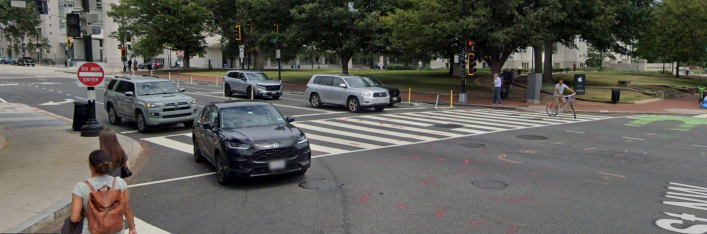
“These are arterials that were incredibly dangerous for pedestrians to cross [before the bike lanes went in and narrowed the road],” said an anonymous government employee. “When you reduce the crossing distance, you also slow down vehicle speeds, [too]. This is what state DOTs and municipal DOTs should be doing across the country to address the high rate of pedestrian fatalities. Without this tool, I’m kind of at a loss.”
‘Nobody will be better off’
Even if the federal government insists putting vehicle throughput before everything else, experts still say the insinuation that D.C.’s bike lanes are responsible for D.C.’s traffic jams is bunk.
Multiple people we reached out to for this story poked holes in the kinds of formulas the FHWA appeared to be using to calculate the time D.C. drivers are wasting in traffic, even if you do believe the (bogus) idea that giving cyclists safe space to ride is responsible for all that idling. That’s because those formulas tend to wildly overvalue the “lost productivity” of motorists who spend a few extra minutes on their commute sitting in traffic, while radically underestimating the value of time savings to people on other modes who sail by in a protected lane.
Many conventional traffic analyses of bike lanes also fail to account for the value of increased access for people on all modes, and the opportunities and quality of life that come with it. They also don’t typically factor in avoided crashes; decreased emissions; increased land values on adjacent properties; the role of congestion itself in discouraging driving and all the harms that come with it, and much more.
“Any measure of ‘success’ that fails to actually measure everyone using a street is not a measure that serious professionals should be considering,” explained Steve Davis of Transportation for America. “You simply can’t determine the ‘success’ of streets with high quality bike facilities, wide sidewalks, or bus-only lanes by measuring vehicle delay. That’s like measuring the success of my diet and exercise by just checking my weight and not my cholesterol or blood pressure.”
Moreover, Kalli Krumpos of the Washington Area Bicyclist Association emphasizes that reclaiming space from cyclists to cure congestion doesn’t even work over the long term — for the same reason that adding new lanes to a highway doesn’t, either.
“Study after study shows that adding lanes to roadways leads to induced demand, encouraging new driving trips and eventually returning the roadway to similar or even worse congestion,” added Krumpos. “Wider roads also encourage speeding, making it less safe for every road user. … What we need is a transportation system that gives people good alternatives for getting around safely and conveniently, especially by improving options to walk, ride a bike, or take a train or bus.”
Some advocates also pointed out that the Metropolitan Washington Council of Government’s 2025 State of the Commute report released just last week shows that there has been no significant change in travel times for drivers in the D.C. region recent years, even as commute levels have returned to pre-pandemic levels. That casts even more doubt on the idea of ripping out bike lanes to cure a so-called congestion crisis in D.C. — and lends credence to the possibility that the analysis has other motivations, like pleasing Trump donors from the oil and automotive industries.
“We’ve already tried allocating all our roadway space to motor vehicles,” said Cheryl Cort, DC & Prince George’s Policy Director for the Coalition for Smarter Growth. “It doesn’t help relieve the burden of congestion … If the only option is to drive, [then] everyone will be forced to drive, generating even more traffic, and nobody will be better off.”
‘Your community next’
Perhaps what’s most chilling about the rumored proposal to rip out D.C. bike lanes, though, is the message it will send to communities across the country: that the federal government doesn’t care about complete streets, and will resurrect long-debunked myths to justify proposals aimed at demolishing them. And if they’ll do it in one of the first communities in the country to embrace Vision Zero, they will do it anywhere.
“States and cities are looking to [the Federal Highway Adminstration’s] expertise and knowledge as they address the same challenges of creating successful streets in their own backyards,” added Davis of Transportation for America. “FHWA should be the ones modeling to the rest of the country the most modern, most complete measures of transportation success — not attempting to turn back the clock to 1955 when vehicle delay was the best that engineers could do.”
Krumpos of the Washington Area Bicyclist Association was even more blunt.
“This is a demonstration of power and a statement about priorities,” she said. “Faster, wider roadways are more dangerous for everyone and don’t support the needs of all road users. DC has been a testing ground because we don’t have the same ability to protect ourselves from federal threats. If changes are implemented here, they could be targeting your community next.”

Streetsblog has migrated to a new comment system. New commenters can register directly in the comments section of any article. Returning commenters: your previous comments and display name have been preserved, but you'll need to reclaim your account by clicking "Forgot your password?" on the sign-in form, entering your email, and following the verification link to set a new password — this is required because passwords could not be carried over during the migration. For questions, contact tips@streetsblog.org.