Bus Companies Say There’s a Better Way to Take a ‘Great American Road Trip’ This Summer
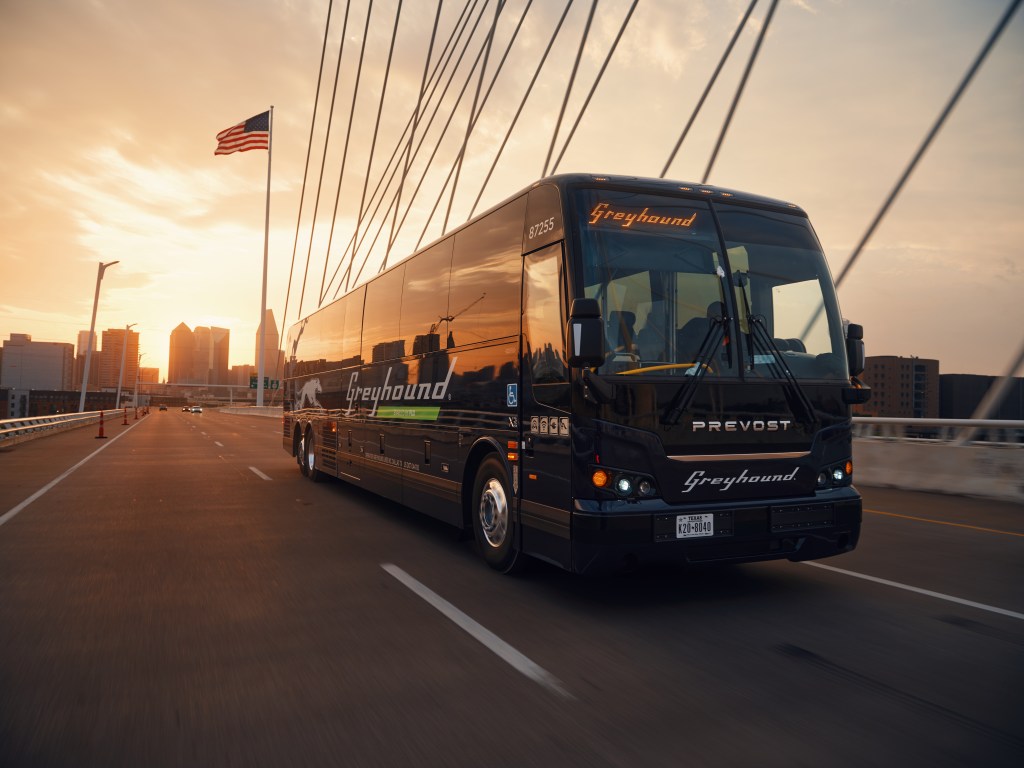
As spring-breaking Americans start planning their summer vacations to celebrate the nation’s 250th birthday, the country’s largest inter-city bus operator is challenging them to leave their cars at home — and connecting those who don’t have cars at all.
The iconic Greyhound Bus company recently launched a new resource to help car-free patriots plan trips to attend America 250 events in cities across the country this summer.
Transportation Secretary Sean Duffy kicked off the celebrations last July with an event at U.S. DOT headquarters where he encouraged Americans to “get in the car and [go] see your country.” But Duffy conspicuously left buses out of his remarks — while explicitly encouraging attendees to buy one of 40 vehicle models parked on the department’s lawn during his speech.
Greyhound and its parent company Flix, by contrast, point out that millions of Americans don’t, can’t afford, choose not to or are physically unable to take a “Great American Road Trip” via car — including many of the 66 million Americans who live in rural areas poorly served by rail and air travel.
No real celebration of our nation would be complete if those people can’t participate, Greyhound and Flix say.
“Having a personal vehicle these days, is a luxury for a lot of people, and inter-city bus is a much more affordable form of transportation,” said Sara Tohamy, Flix’s senior manager of public affairs. “What we really pride ourselves on is our ability to provide service to the under-connected, [like] folks who live in rural towns and small cities. And we’re really excited to be helping these people access America 250 celebrations.”
Greyhound has come a long way from the days when it was stigmatized as a mode of last resort, Tohamy argues. The company reports steady ridership growth across the 1,800 destinations it serves. System upgrades, meanwhile, have made the mode a “much more comfortable, modern, reliable and even tech-enabled experience,” she said.
With more support to bring buses directly to desired destinations, or at least address the infamous “last mile” problem, Tohamy hopes the humble bus will be broadly considered one of the jewels in America’s transportation crown.
“Inter-city bus travel is experiencing a bit of a renaissance. We see these elements of inner city bus only continuing to evolve,” she added. “Our eventual goal is to make inter-city bus travel every American’s first consideration when they think about how to get from one city to the next. We want it to be up there with passenger rail; we want it to be up there with air travel. And we’re doing that day by day.”
Taking the inter-city bus “renaissance” to the next level, of course, will require some federal support — and much of it won’t come until after the semiquincentennial.
When the Infrastructure Investment and Jobs Act expires this fall, Tohamy and her colleagues want Congress to prioritize buses in the bill that replaces it — by protecting and expanding the Rural Intercity Bus Program and enforcing the “reasonable access” requirement that allows companies like hers to more reliably use federally-funded transportation hubs.
“Today, operators are at times denied access or charged excessive fees at transportation facilities, despite the law’s intent to support multimodal connectivity,” she said.
Until then, though, Tohamy is focused on Greyhound and Flix’s role in making America’s birthday party the best it can be — and maybe, help U.S. residents connect with one another along the journey, in a way they’d never be able to in private cars.
“Bus travel has always been about more than getting from one place to another,” she added. “The journey itself creates space for connection between people, communities, and the places that shape our stories. On a bus, you see families heading home, students chasing new opportunities, friends setting off on adventures, strangers sharing a moment of the same road. There’s something uniquely human about that experience.”
Read More:
Streetsblog has migrated to a new comment system. New commenters can register directly in the comments section of any article. Returning commenters: your previous comments and display name have been preserved, but you'll need to reclaim your account by clicking "Forgot your password?" on the sign-in form, entering your email, and following the verification link to set a new password — this is required because passwords could not be carried over during the migration. For questions, contact tips@streetsblog.org.