New Bill Would Help ‘REPAIR’ America’s Worst Infrastructure — By Reimagining It For People
The concept of "reconnecting communities" torn apart by federal infrastructure has come under fire by GOP leaders in Washington. This Senator says it's time to renew the program anyway — and more than triple its funding.
Streetsblog provides high-quality journalism and analysis for free — which is something to be celebrated in an era of paywalls. Once a year, we ask for your tax-deductible donations to support our reporters and editors as they advance the movement to end car dependency and strengthen our communities.
If you already support our work, thank you! If not, can we ask for your help?
Together, we can create a walkable, bikeable, equitable and enjoyable USA for all. Happy holidays from the Streetsblog team!
It’s time to triple down on reconnecting communities.
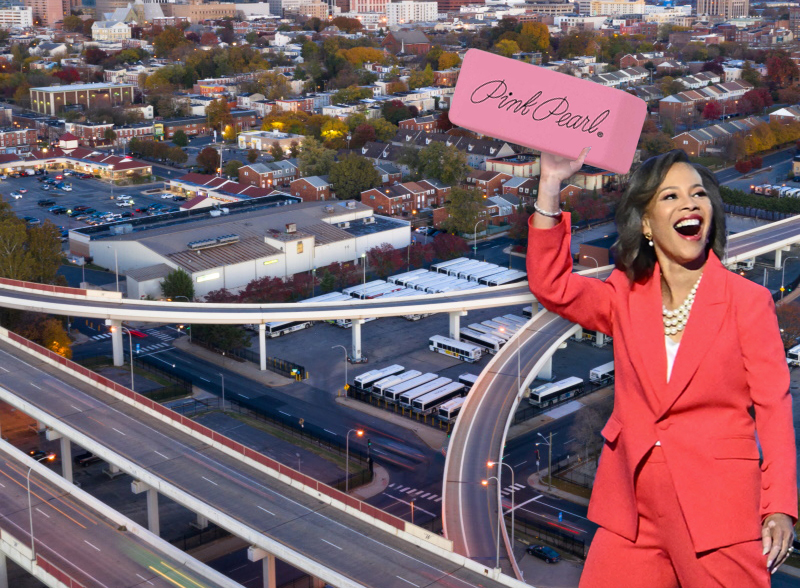
Senator Lisa Blunt Rochester (D–Delaware) recently introduced the “Restoring Essential Public Access and Improving Resilient Infrastructure Act — known as simply as the “REPAIR Infrastructure” Act — which would reauthorize the federal Reconnecting Communities and Neighborhoods pilot program, and increase its funding to $15 billion, even as GOP-lead attacks on the current iteration of that program continue.
Under the Biden administration, the Reconnecting Communities program — and its virtually identical companion effort, the Neighborhood Access and Equity Grant program — received a collective total of roughly $4 billion The majority of that money, though, was rescinded by a GOP-led congress as part of the so-called “One Big Beautiful Bill,” with much of the remainder still held up by the Trump administration’s DOT.
Despite fierce headwinds in Washington, though, Blunt Rochester’s office points out that the concept of “reconnecting communities and neighborhoods” remains wildly popular across America — as clearly evidenced by the fact that in each of the five years it was active, RCN alone received an average of $4.6 billion in unmet requests.
And if the right messaging can remind lawmakers of how much they stand to gain from updating aging infrastructure for a modern age, she hopes the REPAIR Infrastructure Act can attract supporters from both sides of the aisle.
“This program is a proven winner for Delaware and communities across the country,” the senator told Streetsblog in a statement. “And while this administration attacks policies that strive to support equity, this program is about more than that. It’s good policy for communities, no matter how you frame it.”
Despite the clear benefits of Reconnecting Communities policies, GOP officials have seized on the framing of those efforts as a reason to dismiss them as a liberal lark — particularly as words like “equity” have become openly anathema in Washington.
Some GOP officials have mocked both Reconnecting Communities and Neighborhood Access and Equity’s emphasis on mending Black and brown neighborhoods torn apart by federal infrastructure as little more than Democratic grandstanding about “racist roads” — or decried them as progressive distractions from building “traditional infrastructure” like highways, as Rep. Sam Graves (R–Mo.) put it in November.
In reality, more than a million U.S. residents were displaced by the construction of the federal highway system alone, and those residentsdiddisproportionately belong to communities of color, whose residents and descendants are still suffering from the loss of family homes, businesses, intergenerational wealth, increased air pollution, traffic violence, and so much more.
But turning downtown highways into boulevards and re-routing poorly sited railroad tracks isn’t just about righting historic wrongs; it’s also about charting a better future for everyone.
Rochester, for instance, succeeded in creating more than 500 housing units after converting a segment of the Inner Loop highway into a boulevard, helping to address a housing affordability crisis which communities across America are scrambling to address. The removal of San Francisco’s Embarcadero Freeway, meanwhile, sparked a 23-percent increase in jobs as a dense, mixed-use neighborhood sprouted in its wake.
Of course, rural communities were badly damaged by bad federal infrastructure decisions, too — and still face higher rates of traffic violence,travel burden in order to access jobs and basic services, and other harms as a result.
That’s why the REPAIR Infrastructure Act explicitly calls on US DOT “to grade applications based on how well they would support development along rural main streets — which is key, as nearly 20 percent of awards went to rural communities in the FY 2023 round of awards,” Smart Growth America’s Corrigan Salerno recently wrote.
Some of those awards went to Blunt Rochester’s own constituents, who won over $2.3 million from the two programs in 2023 alone — including a $100,000 grant to the town of Georgetown (pop. 8,063) to study “pedestrian safety improvements at eight intersections that cross a rail line owned by Norfolk Southern Railroad Company.”
Delaware grantees were among the lucky few whose 2023 awards were spared under the “One Big Beautiful Bill” — but other communities weren’t so fortunate. GOP leaders in Congress stripped an estimated $2.4 billion from the Neighborhood Access and Equity Grants program under that legislation, including many in communities led by members of their own party.
“The places that lost that funding were not just blue districts, or even blue states,” said a transportation policy aide for Blunt Rochester’s office. “Red states lost grants, too, and those communities are hurting for those opportunities and for that funding. This bill is a strong attempt to bring in folks who have been left out of the conversation. No community should have to deal with these barriers, from our rural main streets to our urban cores.”
For now, the REPAIR Infrastructure Act is only co-sponsored by Democrats, with Sens. Jeff Merkley (D-Ore.) and Raphael Warnock (D-Ga.) and Reps. Pat Ryan (D-N.Y.) and Shomari Figures (D-Ala) signing on.
With a long road ahead for the surface transportation reauthorization, though, Blunt Rochester hopes that advocates of all political backgrounds will call on their legislators to support it – and take the opportunity to show why repairing America’s broken neighborhoods can help make communities more affordable, safe, and fiscally responsible, without undermining the equity and accessibility impacts that inspired these efforts in the first place.
“We have an opportunity to take stock of our current infrastructure system, recognize and repair mistakes — some of which were intentional — and lift up neighborhoods that have been cut off from opportunities,” added Sen. Blunt Rochester. “Ultimately, that benefits everyone.”
Kea Wilson is Senior Editor for Streetsblog USA. She has more than a dozen years experience as a writer telling emotional, urgent and actionable stories that motivate average Americans to get involved in making their cities better places. She is also a novelist, cyclist, and affordable housing advocate. She lives in St. Louis, MO. For tips, submissions, and general questions, reach out to her at kea@streetsblog.org, or on Bluesky @keawilson.bsky.social.
Streetsblog has migrated to a new comment system. New commenters can register directly in the comments section of any article. Returning commenters: your previous comments and display name have been preserved, but you'll need to reclaim your account by clicking "Forgot your password?" on the sign-in form, entering your email, and following the verification link to set a new password — this is required because passwords could not be carried over during the migration. For questions, contact tips@streetsblog.org.
Toronto might be in the center of the fight to resist bike lane teardown today. But if some far-right politicians have their way, this fight won't be the last.