Streetsblog provides high-quality journalism and analysis for free — which is something to be celebrated in an era of paywalls. Once a year, we ask for your tax-deductible donations to support our reporters and editors as they advance the movement to end car dependency and strengthen our communities.
If you already support our work, thank you! If not, can we ask for your help?
Together, we can create a walkable, bikeable, equitable and enjoyable USA for all. Happy holidays from the Streetsblog team!
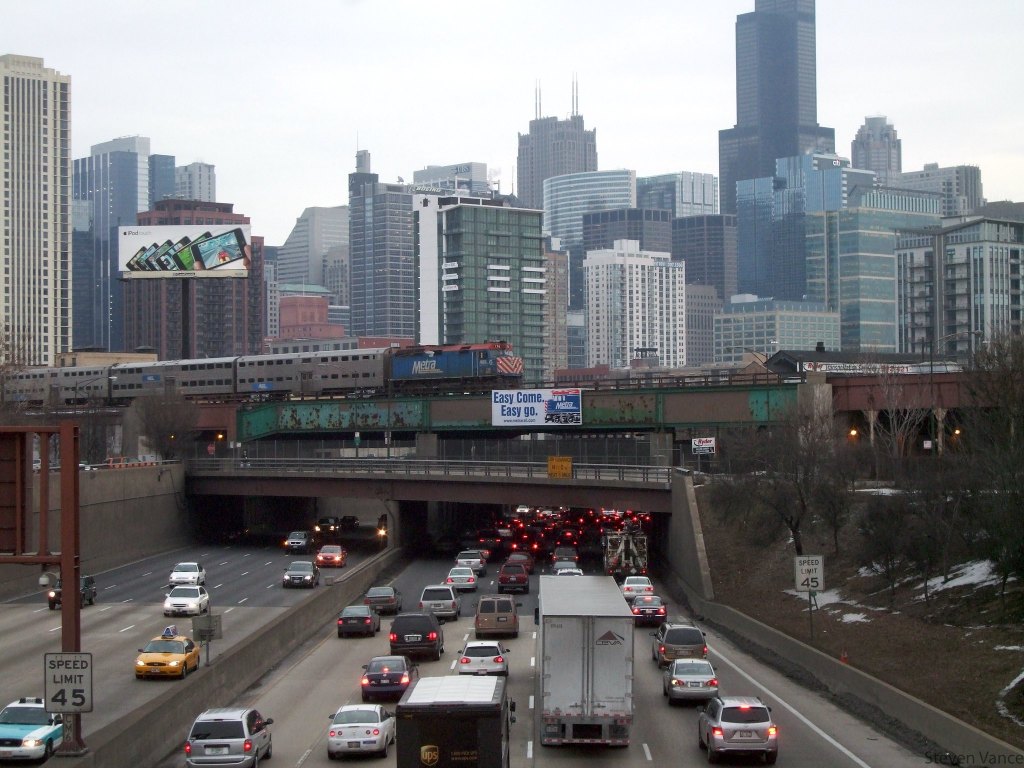
This advocate is mapping exactly what downtown highways cost cities across America — and how much we all could gain if we tore them out.
As part of an ongoing project he’s calling “The Atlas of Inner-City Highway Impacts,” Dallas-based planner and urban designer Patrick Kennedy is analyzing the highway footprint in more than two dozen U.S. cities, as well as the redevelopment potential if all that land were devoted to other, better uses. Soon, he plans on tackling about150 cities — and equipping advocates in all of them to answer questions not enough decision-makers are asking about the harm those highways cause.
“What does [the downtown highway] cost to the local economy?” Kennedy wonders. “How much tax base did that erase from the local municipal coffers? How much does it actually cost to be car dependent? Because we’ve spent over $11 trillion at the state and federal level over the last several decades strictly on building that kind of monopoly.”
As a built environment professional and founder of the consultancy practice The Human Ecosystem, Kennedy credits authors such as Erick Guerra, Megan Kimble, and Peter Norton for exposing the troubled history of the U.S. highway system, which generations of transportation officials have built out under the premise that it would bolster local economic development and increase travel speeds. Researchers have challenged both thosemyths on aggregate, but advocates still struggle to put hard numbers behind how much highways harm their specific communities — and how those harms differ between diverse landscapes.
For instance, Kennedy says that traffic flies by in depopulated Rust Belt cities like Detroit, but they’ve traded fast cars for countless lost homes and businesses that never returned when residents pulled up stakes for the suburbs.
“Places where the highways work ‘well’ also have the worst economies — and to me, that’s pretty telling; we’ve fundamentally gotten this wrong,” Kennedy adds.
Big southern cities like Austin, meanwhile, still enjoy robust business and residential districts, but their car-dependent transportation network is gridlocked and moving “about 12 miles per hour for 12 hours a day,” he says.
“The true believers in the Bureau of Public Roads — the forerunner of Federal Highway Administration — believed they could use that money to solve essentially every problem in the world,” he adds. “And of course, what we now know is that putting highways through the center of cities has one of two impacts: they either destroy the local economy, or they fail at their one job, which transportation.”
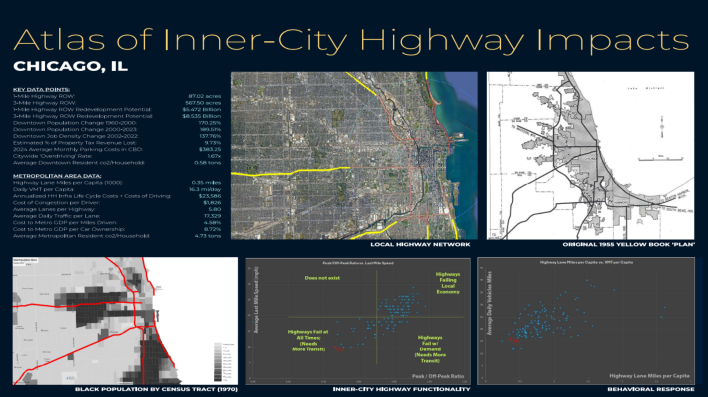
To help advocates illustrate the collective costs of their specific city’s highways, Kennedy developed a one-sheet list of fast highway facts about each community (which are too numerous to explain in full here), and invites advocates to contact him for more granular data.
Some of the most interesting data points draw on a 2019 Philadelphia Federal Reserve study, which found that beyond a three-mile radius of the downtown’s center point, “a highway’s presence goes from disamenity to amenity, in that it devalues property up to a half-mile away within that three-mile radius, and it adds value outside of that three-mile radius,” Kennedy explains.
Put another way: by tearing highways out of their innermost downtown cores or converting them to boulevards, cities can unlock billions of dollars of redevelopment potential, increase badly-needed property tax revenues, and reduce individual households’ commute costs, often to the tune of tens of thousands of dollars per household per year, at least when the costs of maintaining shared infrastructure are added to the costs of owning and maintaining a personal vehicle.
Kennedy was even able to estimate precisely how muchmoney each city stood to gain from ditching their autocentric asphalt habit, by calculating the total acreage sacrificed to highway uses, subtracting out the hefty amount of land that would likely be devoted to tax-exempt uses like schools, parks, and city streets, and multiplying the remaining space by recent development assessments averaged across a range of different uses.
In Chicago, for instance, reimagining those right-of-ways could open up nearly $8.3 billion in redevelopment potential within three miles of the Windy City’s epicenter; in Boston, it’s $16.3 billion.
And in both cities, the annualized household costs of maintaining infrastructure over its lifestyle and paying the costs of driving are north of $23,000 a year — a price so few residents are willing to actually pay that local governments are struggling to fill their potholes.
“What we typically hear in the press is that congestion costs us billions of dollars a year,” Kennedy adds. “But whatever the number might be, it’s usually a scare tactic that’s multiplied by the entire population. When you start breaking that number down per household or per capita, the number is actually not that big — and it’s dwarfed by the overall costs of having to own and operate several vehicles per household, as well as all the infrastructure to go with it.
“We need to get some numbers out there that [show] why our municipalities are effectively broke, why the roads are so bad, and why we have to continually cut services and raise taxes just to tread water as a municipality,” he continued.
When he finishes the 150 cities on his list — he’s working alphabetically, and Akron through Durham are already on his website — Kennedy hopes that advocates in most U.S. cities will be able to make use of this new tool to bust the economic myths around the costs of highway expansion in their unique place. And most of all, he hopes they can illustrate to their fellow residents what relying on an automobile costs them personally — and how much more financially better off they’d be if they supported an alternative.
“[We need to answer the question], ‘What’s the cost of car dependence and how much we have to drive?'” he added. “Because to me, if you can get to all of your destinations without having to own and operate a car, that’s money that could go to better housing, could be saved, could be invested into a business or something else. Essentially, transportation choice equals choice with your dollars.”
Kea Wilson is Senior Editor for Streetsblog USA. She has more than a dozen years experience as a writer telling emotional, urgent and actionable stories that motivate average Americans to get involved in making their cities better places. She is also a novelist, cyclist, and affordable housing advocate. She lives in St. Louis, MO. For tips, submissions, and general questions, reach out to her at kea@streetsblog.org, or on Bluesky @keawilson.bsky.social.
Streetsblog has migrated to a new comment system. New commenters can register directly in the comments section of any article. Returning commenters: your previous comments and display name have been preserved, but you'll need to reclaim your account by clicking "Forgot your password?" on the sign-in form, entering your email, and following the verification link to set a new password — this is required because passwords could not be carried over during the migration. For questions, contact tips@streetsblog.org.