Trump’s Funding Freeze Has Derailed Transit, Undermining Growth and Economic Opportunity For All Americans
The second Trump administration has yet to sign a single contract to build new transit rail lines under a key grant program — and it’s deepening a crisis that’s already pushed America out of the ranks of the top rail-builders in the world, a new analysis finds.
More than a year into his second term, the self-described “builder president” hasn’t authorized any new subways, elevated rails, monorails or automated light metro under the Capital Investment Grant program, one the largest sources of federal matching funds for shared modes.
Trump’s Department of Transportation has also clawed back, threatened, or delayed funding for Biden-era transit grants across countless programs, including three grants from the Capital Investment Grant program itself; most famously, the Gateway Tunnel project only got its funding restored after its architects sued the federal government.
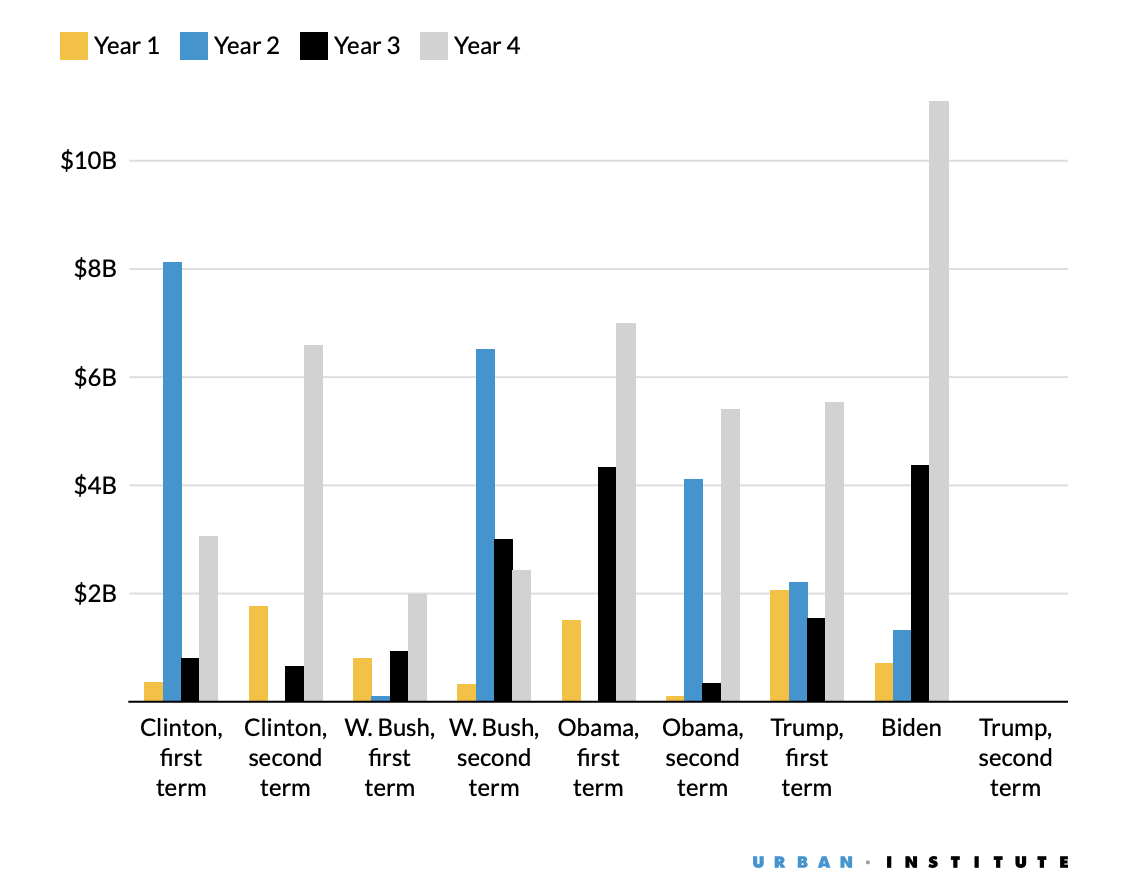
According to the Urban Institute, which conducted the analysis, the Trump-era drought is having downstream effects nationwide. Because rail projects are complex, expensive, and require years more intricate planning than bus upgrades, cities and states often can’t build them without federal matching funds — which means that projects don’t happen at all.
The Urban Institute found that state and local support for rail projects ebbed to just $7 billion in 2025, down from $16 billion in 2021 — “the lowest level in at least 15 years,” author Yonah Freemark wrote.
That’s an astonishing falloff considering that 2021 also ushered in the passage of the Infrastructure Investment and Jobs Act, which was billed at the time as “largest federal investment in public transportation in the nation’s history.” Critics of the bill have long pointed out, though, that it was also among the largest investment in highways in the nation’s history, and that state DOTs were granted the ability under some programs to “flex” what could have been transit dollars to road projects instead.
Add in a hefty dose of federal interference — and a pandemic that slowed state and local revenues, making it even harder for communities to build rail on their own — and Freemark says that “overall U.S. public-sector spending on non-highway projects has remained flat since 2021, while investment in roads and highways has expanded.”
Of course, America’s rail-building efforts didn’t just get derailed when Trump took office for the second time — or even when the highway-heavy Infrastructure Law was passed.
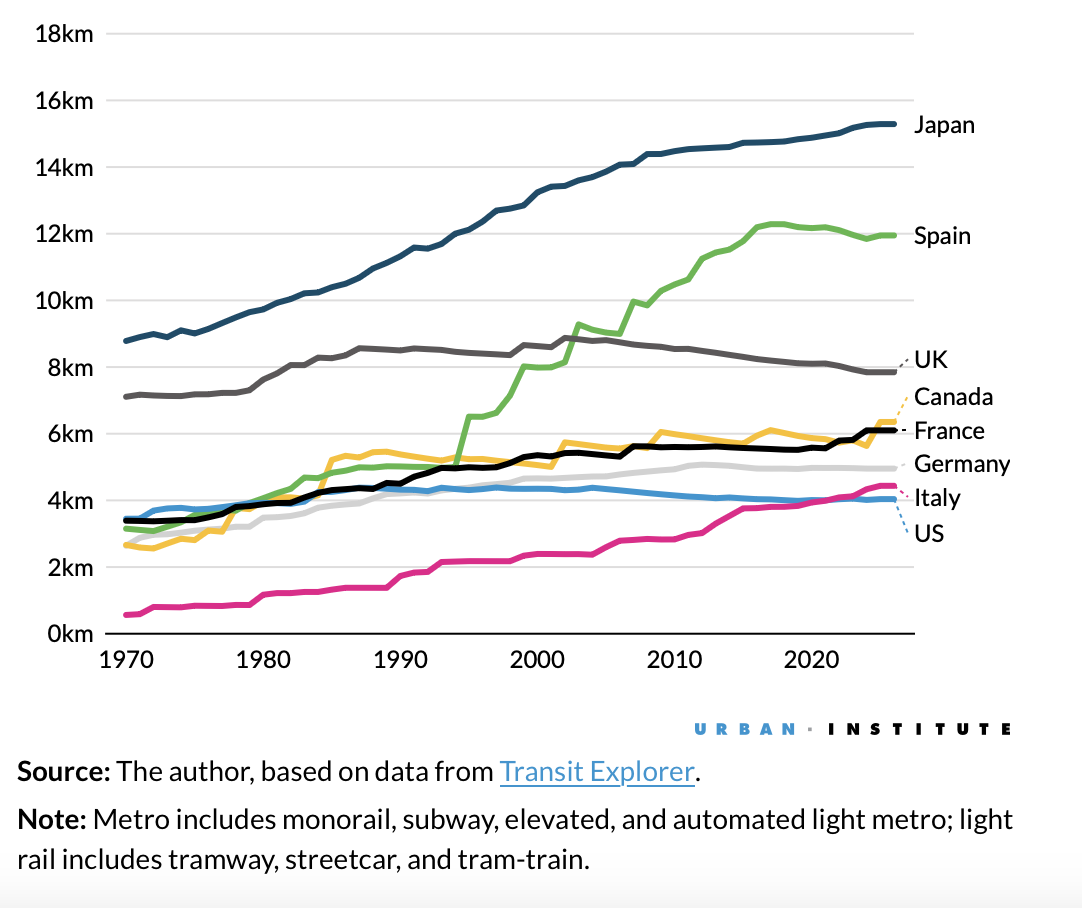
The Institute points out that American cities have fallen off the list of global transit leaders largely “because the US has steadily reduced its investments in subways and elevated lines.” As a result, we recorded 7-percent fewer kilometers of operating metro lines per capita today than we did in 1990, even as our peer nations’ networks grow.
Twenty-six years ago, New York City, Chicago, Washington, and the San Francisco Bay Area all ranked among the top 14 global cities with the greatest mileage of metro rail lines per capita; today, all of those U.S. cities have fallen off the list, and many have been replaced by cities in China. At a national scale, meanwhile, the country of France has almost three times as many kilometers in operation than the U.S. does.
To be fair, the Institute notes that the US has invested more in light rail like trams and streetcars than some of our peer nations. Those modes, though, are “typically slower and carries fewer people than metro lines,” the analysis says — which could mean they attract fewer riders.
Freemark emphasizes that it’s not too late to get American rail development back on track — and the most important moment to do it is now.
With the Infrastructure Investment and Jobs Act expiring in the fall, Congress has a golden opportunity to “emphasize investment in new rail transit” by expanding programs like the Capital Investment Grant program. First, though, Congress needs to ensure that projects that already inked grant agreements with the FTA “have their funding restored quickly to help projects open for service as soon as possible,” and that the FTA gives applicants without signed funding agreements the technical support they need to make it past the finish line.
State and local governments, meanwhile, could take action to make themselves less reliant on fickle federal funds, by mimicking programs like “California’s long-term revenue commitment to high-speed rail through the cap-and-trade program, potentially without involving federal funding,” Freemark suggested.
However they do it, Freemark says, America needs to act now to take our rightful place among the world’s leading transit providers, and that our residents deserve to reap all the benefits that having more travel options provides.
“To connect more Americans to economic opportunities, provide affordable travel options, and reduce carbon emissions, funding for better rail investments is needed,” he wrote. “As Congress renegotiates federal transportation funding this year, it should renew its efforts to improve the nation’s transit options, including through the construction of new urban and other rail services throughout the country.”

Read More:
Streetsblog has migrated to a new comment system. New commenters can register directly in the comments section of any article. Returning commenters: your previous comments and display name have been preserved, but you'll need to reclaim your account by clicking "Forgot your password?" on the sign-in form, entering your email, and following the verification link to set a new password — this is required because passwords could not be carried over during the migration. For questions, contact tips@streetsblog.org.