How to Tell the Story of a Highway Teardown
Highway teardowns are messy, multi-decade projects that spark countless debates and competing narratives — even among livable streets advocates who broadly agree that replacing auto-centric infrastructure is a good idea. But in his Peabody Award-winning podcast, “The Big Dig,” Ian Coss was able to do the impossible by encapsulating the Boston project of the same name into nine astonishing, thought-provoking episodes — and now, he’s telling the story of similar projects in cities across the America.
In October, Coss embarked on what he’s calling the Highway Teardown tour, which has already taken him to four cities that either have, or are trying to, reimagine their worst infrastructure.
And with eight more cities to go and follow up podcast of tapings from those shows forthcoming this spring, the tour has become an opportunity to reflect on the larger freeway fighting movement across America, how advocates are pushing forward even under Trump, and how to do these projects even better.
The following excerpt has been edited for clarity and length. For a full version (with AI typos), visit Otter.
Kea Wilson: What was “The Big Dig” podcast and what made you decide to take it on the road?
Ian Coss: “The Big Dig,” for listeners who don’t know, is the notorious Boston infrastructure project, where basically the city tore down an elevated highway and replaced it with a tunnel. This was something that played out through the 1990s into the 2000s. I grew up in Massachusetts, so [the Big Dig] was this thing that was going on in the background that everybody complained about endlessly, and that’s really all I knew about it.
So fast forward to a few years ago. I make documentary podcasts, and I got interested in going back and revisiting what [the Big Dig] was, why people were so angry about it, what it was trying to do, and what it actually accomplished. That turned into this nine-part saga of a podcast. [But] really for me, it turned out to be a very rich story with a lot of lessons and insights for all public works projects in America — the challenges, the opportunities, the complexities.
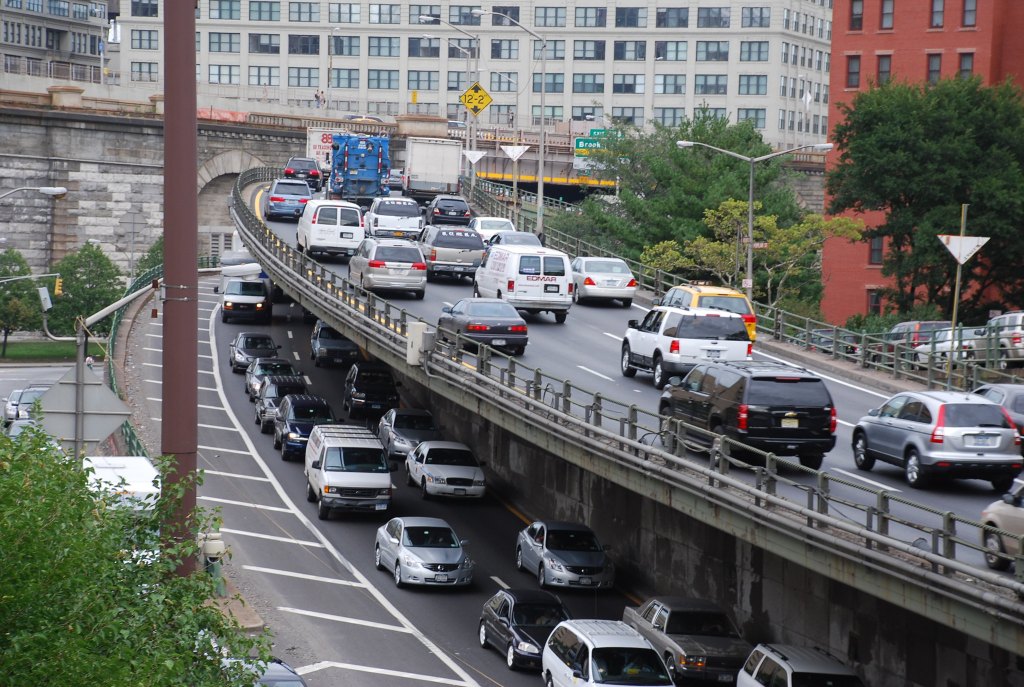
That series came out in 2023, so a couple of years ago now. And after it came out, I would just hear from people in other parts of the country like, “Oh, do you know about the Highway to Nowhere in Baltimore?” “Do you know about the Embarcadero in San Francisco?” “Have you heard about this highway project in Toronto?” And it it just reinforced for me this core challenge of the Big Dig: What do we do with this old, crumbling, congested, urban elevated highway right through the middle of our city that divides us from the waterfront that everybody hates, but no one can imagine what to do with what do we do with it?
It just struck me that every city — certainly, every city in the United States of America — has some version of that problem. And a lot of those cities are dealing with it right now, because a lot of those downtown elevated highways were built around the same time in the ’50s, ’60s, ’70s. They’re all aging out, [they’re having] all of these problems, and everyone’s trying to figure out what to do with them.
So that was really the genesis of the tour to say, “OK, we saw what Boston did with the Big Dig. Let’s take that question on the road and look at what some other cities are trying.”
Wilson: As you mentioned, pretty much every major urban area in the United States is dealing with this problem in some way, form, or fashion. How did you select the specific cities that are on this list? How did you decide what to platform, both in terms of past projects and companions to the Big Dig that made it all the way across the finish line, and also cities that are in the process of considering a future highway teardown, or are in the thick of it right now. Basically:why these cities?
Coss: I think the key for me was I wanted some variety. I didn’t want to just go and tell the same story over and over again. Because, sadly, there are many facets of these stories that repeat in terms of how the highways divide communities and how the opposition to them played out.
So I was looking for different cities with different kinds of stories. For example, I’m going to Rochester, New York later this spring, where they’ve actually gone really far in totally removing, filling in, [and] building on top of an old elevated highway. But I’m also going to go to Louisville, where there have been activists organizing around trying to remove an urban highway for decades now, and have really not gained much traction and have struggled. I’m also going to go to Austin, where there’s a very ambitious capping project; they’re trying to build a deck over part of an urban highway that project is underway.
So really, what I was looking for was just different kinds of projects, different challenges — so that ideally, when we put those stories all together in the feed for listeners, regardless of where you are, it’ll offer kind of a panoramic view of what different cities are trying, and a sense of what the options are. If you are interested in this issue in your city and you’re trying to figure out, what could we do about that elevated highway, this will give you some ideas.

Read More:
Streetsblog has migrated to a new comment system. New commenters can register directly in the comments section of any article. Returning commenters: your previous comments and display name have been preserved, but you'll need to reclaim your account by clicking "Forgot your password?" on the sign-in form, entering your email, and following the verification link to set a new password — this is required because passwords could not be carried over during the migration. For questions, contact tips@streetsblog.org.