What You Missed in the Transportation Reauthorization This Summer

If you took a break or simply lost track of Congress’s efforts to craft America’s massive new federal transportation law this summer … well, so did we. And with the Infrastructure Investment and Jobs Act set to expire in just a few months, it’s more important than ever that advocates rally together to make our next core infrastructure bill the best it can be.
We sat down with Beth Osborne of Transportation for America to catch up on what we missed, and help us all plug back in to the fight for a better reauthorization. Here are the highlights from our conversation.
The big picture on where things stand
Back in the spring, a lot of members of congress swore up and down that this was finally the year they would deliver America a shiny new national infrastructure bill on the day the old one expires — despite the fact that no congress has ever reauthorized America’s core national transportation programs on schedule.
The House Transportation and Infrastructure Committee took its first stab at a accomplishing that ambitious goal in late May with the Build America 250 Act … which was roundly panned by advocates as even more expensive, highway-focused, and unlikely to accomplish its goals than the (also car-centric and deficit-fueled) megabill we have now, the Infrastructure Investment and Jobs Act.
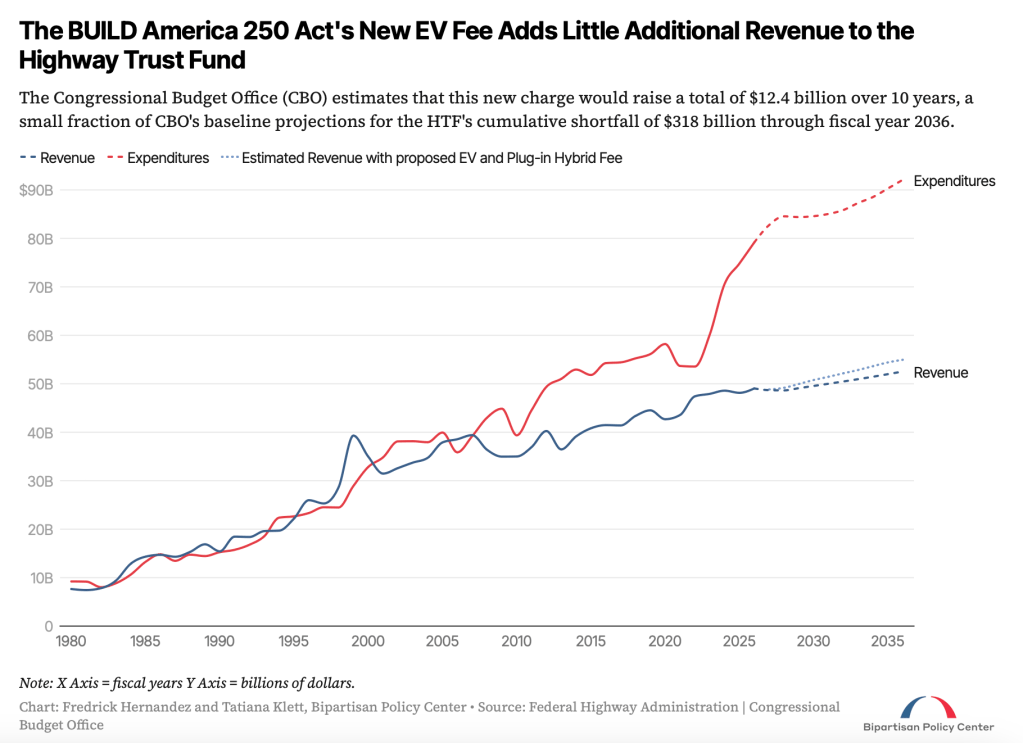
Build America 250 would place a new fee on electric vehicles — but organizations like the Bipartisan Policy Center warn it wouldn’t be anywhere near enough to bridge the gulf, especially since the Trump administration is doing everything it can to “end the EV mandate” and get Americans into gas-powered cars.
“There’s not enough money coming in through [funding streams like] the gas tax and diesel tax and tire taxes to cover the cost of maintaining the program where it is,” Osborne said. “In fact, there’s not enough to cover just the highway formula funds. We haven’t even gotten to that part of the conversation yet — and that’s always the most painful part.”
Rather than explain to election-year voters why they were burying the country in even deeper debt, Congress was forced to pass a temporary extension of the IIJA until December 11, to keep America’s mobility funding flowing and punt sticky questions about future funding until after the midterms.
That “extension”, though, used some budgetary tricks to work in a 20 percent cut to public transit compared to fiscal year 2026, and a staggering 83 percent cut to passenger rail — and the money for the latter wouldn’t even be guaranteed. Highway programs remained untouched.
Worse, Build America 250 isn’t dead — and the pressure is on from the Trump administration to deliver a bill like it that “prioritizes motor vehicle travel over bicycle lanes” no matter what it costs, as Secretary Sean Duffy wrote in a July letter to Congress.
“Apparently making it safe for a kid to bike to school is somehow weird left-wing propaganda now,” added Osborne. “I thought it was traditional, and something that we all aspired to go back to – but [according to the Trump administration,] apparently not. [They think] bike lanes are horrible. Slowing down traffic to the actual posted speed by using design? That’s horrible [to them], too.”
Why extending the IIJA is probably our best bet — even if it sucks
Of course, pushing backwards ideas about bike lanes isn’t the only way that the Trump administration is interfering in our country’s transportation future — or its present.
Osborne notes that the executive branch has strained the limits of the current transportation law by freezing, rescinding, running out the clock on and otherwise slashing money for programs and projects it simply doesn’t like, all because they supposedly “violate” broad executive orders against vaguely-defined concepts like “sustainability” and “equity.” Communities struggling to build things, meanwhile, don’t exactly have the money they need to fight those decisions in court, even if they think they’re illegal.
Congress, though, happily passed a new government funding bill earlier this month without any significant provisions to restore transportation funding to communities that lost it — or any new guardrails to prevent Trump from stomping on the spirit of the IIJA going forward.
“I think the real issue is the fact that this administration has not only felt comfortable, but has actually been left to implement the last surface transportation program any way it wanted to — whether it was connected to the law or not,” Osborne added. “And in response to that, the House passed a bill giving them more money … Why wouldn’t [Trump] just continue violating the law?”
That’s why Osborne says advocates should call on Congress to extend the IIJA for at least a year, until Trump and his ilk prove they can follow the law for any meaningful period of time — even if the IIJA is making our communities worse.
“I mean, if you if you ask me, the IIJA was not a good authorization at all,” Osborne said. “It didn’t make our roads safer. It didn’t focus on bringing our infrastructure into state of repair. It didn’t make it easier for people to get to work or other destinations. It didn’t lower emissions. It accomplished zero of its goals … I wish we lived in a world where someone [in Congress] would engage in that conversation with us.”
Why electing more Democrats probably won’t set America up for a better bill (and what will)
With the mid-terms coming up fast, Osborne knows some advocates might be tempted to think that simply electing more ostensibly climate-focused Democrats is our best bet to pass a better transportation law.
She warns, though, that even the deeply harmful Build America 250 passed the House transportation committee with broad bipartisan support — and getting a better bill across the finish line will take a full court-press on both sides of the aisle.
“If anyone is under the impression that that if Democrats take control of the House that they will get a better bill, let me disabuse you of that now,” she added. “What will happen is the Democrats will take up the bill they negotiated this Congress, point out that it was passed through a committee almost unanimously, and so why wouldn’t we just copy and paste that sucker and move forward? That’s where we are.”
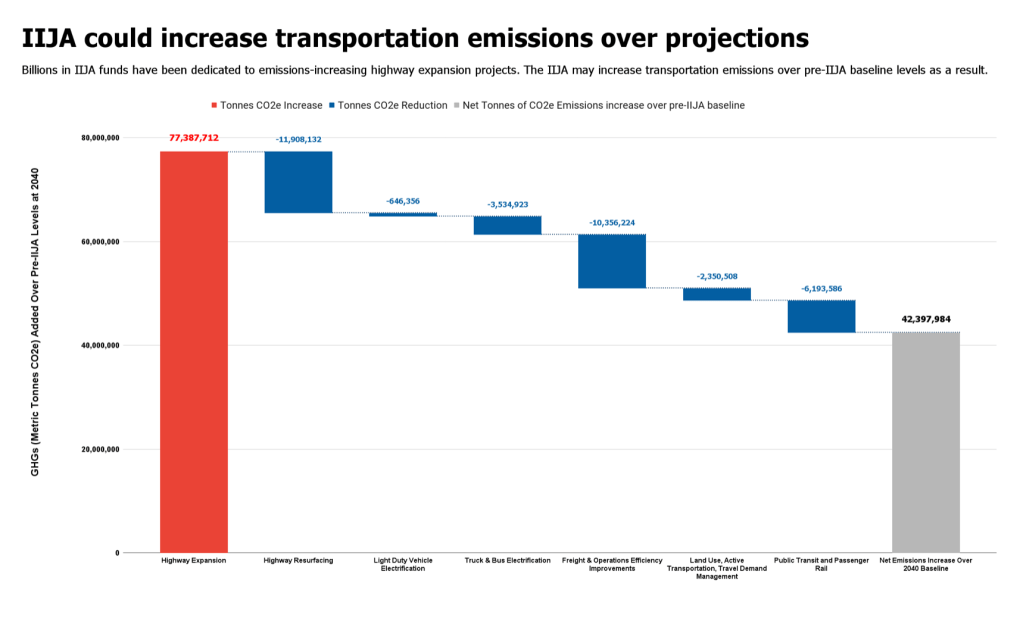
Advocates’ real challenge now, Osborne argues, is a fundamental one: to get elected officials on both sides of the aisle to realize about just how thoroughly auto-centric policies are failing to achieve any of the goals they might have for our transportation system.
And then we have to get them to care about it — and refuse to fund the endless construction of harmful highways just for the sake of notching an easy bipartisan win.
“What often happens is [advocates] get to Capitol Hill, and they are told by their leadership … that [transportation funding] is bipartisan, and anything is good,” Osborne added. “And if there’s a problem with the program, it’s lack of funding — and there is absolutely nothing we need to do on policy, we just need to spend, spend, spend. I think it’s important … to say no: actually, the problem is we have been spending gobs and gobs of money, and not getting the results promised.”
To have an impact, Osborne argues that advocates need to make noise to their legislators about the failings of the IIJA, and why doubling down on the same car-focused strategies in Build America 250 is a terrible bet.
“People in Congress do not understand what is not working in the transportation program,” she added. “Advocates need to speak up and let them know where their concerns are — and how that is different than just pouring more money down the same rabbit hole.”

Streetsblog has migrated to a new comment system. New commenters can register directly in the comments section of any article. Returning commenters: your previous comments and display name have been preserved, but you'll need to reclaim your account by clicking "Forgot your password?" on the sign-in form, entering your email, and following the verification link to set a new password — this is required because passwords could not be carried over during the migration. For questions, contact tips@streetsblog.org.