Walkable Cities Can Make Life Better for Drivers, Too

Believe it or not, walkable cities are even better for drivers than ones designed with only the needs of motorists in mind — and in order to win, advocates for livable streets must embrace targeted strategies that make driving better without sacrificing access to other modes, a new report argues.
In the provocatively named new guide, “How to Design for Cars in People-Centered Places“, a team of researchers and designers broke down why drivers often enjoy shorter, more predictable, all-around less-miserable journeys when they travel in multimodal paradises like Paris, even though auto-dominated American cities are ostensibly built just for them.
That’s because transportation leaders who prioritize people over cars also tend to lean on a handful of simple design strategies that make motoring more pleasant, too — and with the right recipe, any city can replicate their success.
“What people don’t realize is [places like the Netherlands are] also great for driving,” said Nick Falbo, senior transportation planner with Mobycon, a Dutch-international firm that contributed to the report. “You have more access to jobs in 30 minutes by car in Amsterdam than you do in Atlanta. And part of the Dutch story isn’t just how they’ve made it great for people walking, biking, and taking transit; it’s how they’ve actually made it work for people driving as well.”
Why ‘walkable city’ advocates need drivers to win — and vice versa
Falbo explains that while blanketing cities in asphalt promises fast speed limits and convenient parking in theory, auto-centric strategies almost never deliver that in reality.
Instead, motorists end up stuck in gridlock traffic for hours and circling downtown blocks for an unpredictable supply of spots, all while the destinations they’re trying to reach grow further and further apart as car dependency rises. And needless to say, adding one more lane, bro never seems to fix the problem.
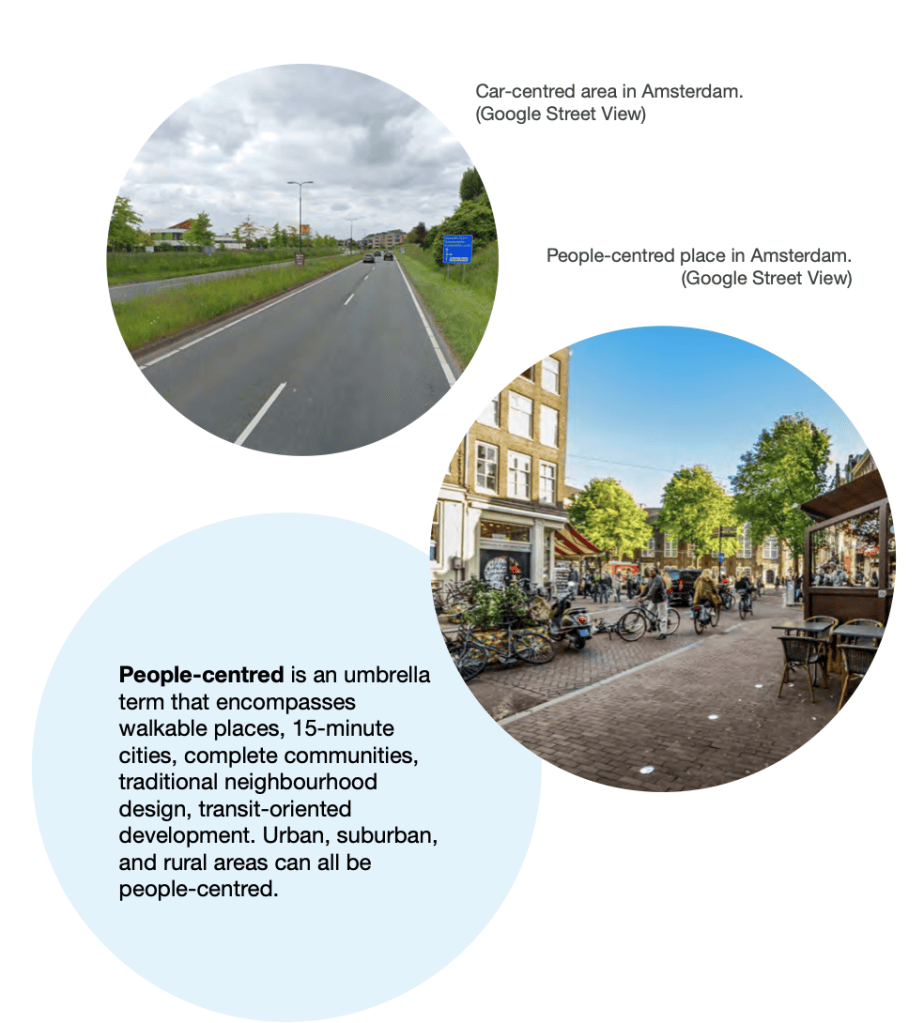
Multimodal transportation advocates, though, tend to leap straight to strategies that radically decenter cars — without meaningfully reckoning with how many people will always rely on driving, even in cities with robust mobility alternatives. And when they do, they often draw the ire of a motoring majority, which gets projects cancelled before they begin.
“When you’re in the work of building people-centered places, one of the biggest challenges is the backlash that you get from drivers,” said Houssam Elokda, managing principal at Happy Cities, which co-authored the report. “The project either never makes it to getting funded, or never gets approved. Or if it does get built, the second one doesn’t get built, and the third one doesn’t get built, because the needs of drivers were not effectively met. You create this alienation … but it doesn’t have to be that way.”
Rather than watering down the livable streets vision, though, Elokda and Falbo both argue that welcoming drivers into the transportation reform movement can actually make more ambitious city transformations possible, by building meaningful coalitions between multimodal advocates and a driving public that vastly outnumbers them.
Put another way: no more getting shouted down at the community meeting for an isolated bike lane project just because it requires removing some parking.
“It becomes this sort of ‘cars versus people’ discussion,” added Falbo. “[But] you can support driving in a way that doesn’t compromise the integrity of the place for people walking and biking and taking transit.”
How to do it
Elokda says the first step to breaking the stalemate between drivers and livable streets advocates is to rethink the standards and categories that underlie our transportation decision-making.
And that isn’t just about throwing out much-maligned performance metrics like “level of service”, which incentivizes designing streets for fast driving speeds. It also means rethinking the traditional classifications of roads themselves — like “arterial,” “collector”, and “local” streets — to instead focus on what each street is actually meant to do.
In the report’s vernacular, there are really only two options. “Flow streets,” the guide says, primarily exist to move cars at steady speeds with few interruptions; “place streets,” meanwhile, encourage people to bike, walk, shop, dine, linger, and in short, do everything else.
Most crucially, Falbo says that no street can simultaneously prioritize both “flow” and “place” — because when we try, no one’s needs get met.
“We’re not trying to do everything everywhere,” he added. “In fact, that’s really the heart of the problem we’ve run into so far. [We tend to treat] every street [like it] needs to be both good at moving cars and good at being a place for people — and as a result, we end up with these streets that do not succeed at either of those goals.”
When the concept of “flow” streets and “place” streets are untangled, the report argues that cities are better empowered to create complete, connected networks of both types of thoroughfares, with only brief “transitional zones” between them.
But first, they must abandon the fantasy of building complete streets that attempt to serve all users, but end up not working for anyone.
“There’s been so much effort to bring walking, biking and transit access to these big arterials, and in the end, you end up creating a street that’s not actually a great place to be,” Falbo added. “You’ve actually created a street where you don’t want to sit down and get that cup of coffee — or where even with a protected bike lane, it still feels like a hostile environment to be walking and biking.’
Both Falbo and Elokda acknowledge that this idea might be controversial to US advocates who consider the “complete streets” framework a gold standard — and that it might be challenging for cities awash in stroads and fragmented sidewalk networks to imagine any alternative.
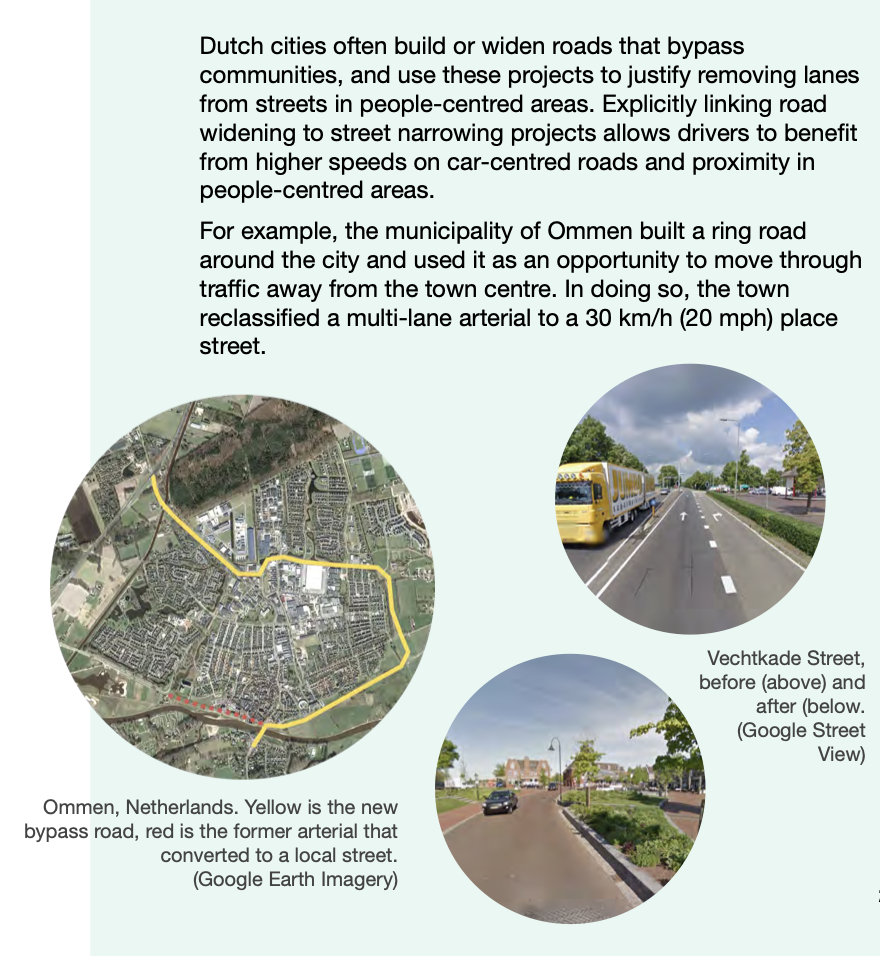
Still, they say many cities are already doing it. Barcelona’s famed “superblock” pilot, for instance, successfully banished most vehicle through-traffic from “place”-centered neighborhoods where the innovative strategy was deployed, but only by creating a “flow street” every 400 meters to prioritize car travel.
The Netherlands, meanwhile, frequently builds or widens car-centered “ring” roads around downtowns, bypassing people-centered areas and transforming the neighborhoods inside the ring into even better havens for non-automotive movement.
Elokda acknowledges that US advocates might reflexively resist any proposal to widen a road in the name of safety, never mind build a whole new one just for drivers. But in limited situations, both can be critical tools.
“When you [connect flow streets] at the network level, it allows you to be uncompromising on place streets,” he added. “Because [then you can say to drivers’] ‘I’ve met your needs there — but here, we’re not going to compromise. We’re going to build the people-centered streets that we want and we deserve.'”
Of course, dense land-use policy and incentives are particularly critical to the success of any people-centered place — and even the most die-hard drivers will benefit from it.
The report counsels cities to focus on land-use strategies that shorten the average trip rather than focusing on increasing the speed of the average vehicle. And when they engage with the public, they need to ensure drivers understand that bringing destinations closer together will almost always save them more time than speeding cars up.
“There’s a Dutch saying that translates to roughly, ‘Going slower is faster,'” said Falbo. “[Because] when you’ve created the conditions where you have that proximity of destinations, you can actually get between them faster in the end.”
Elokda adds that as land use densifies and people naturally shift to other modes, driving trip lengths also even out throughout the day — which makes it way more pleasant for motorists sick of the rush-hour slog.
“One of the things we found out in our research on this is that drivers value consistency significantly more than speed … If you offer people a drive that is 20 minutes every time, they’ll take it over a drive that’s like 10 minutes one day and 35 minutes the next,” he added.
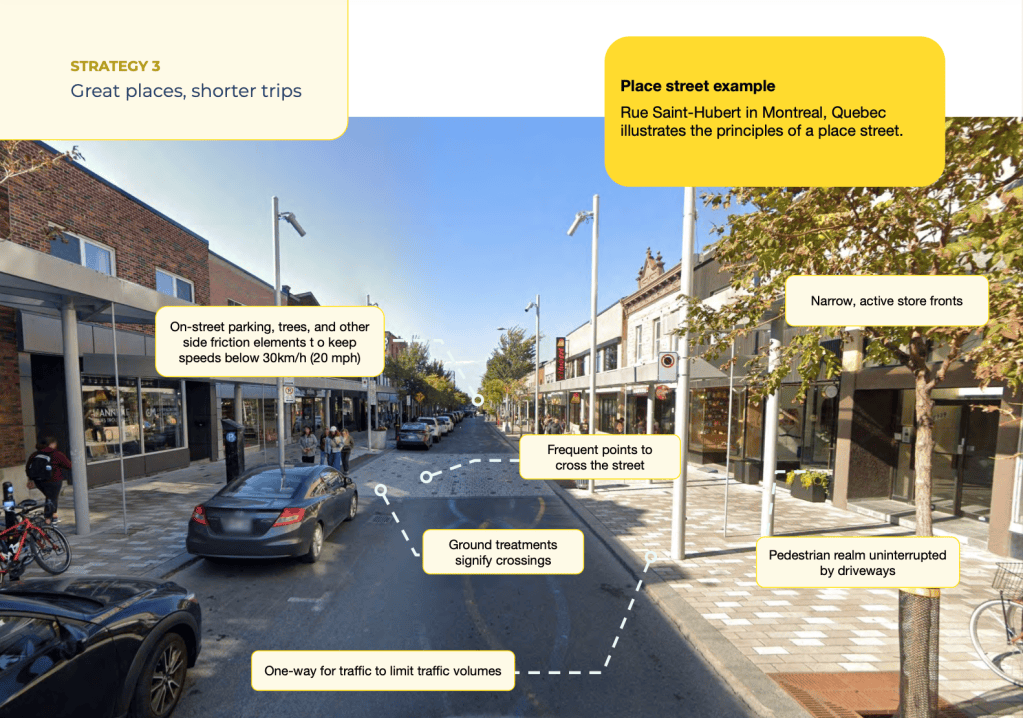
Perhaps most provocatively, the report argues that walkable cities can and should make parking easier — not by blanketing cities in asphalt, but by locating lots in strategic places where motorists can predictably stash their vehicle, without interrupting the pedestrian experience.
In some cases, that actually means allowing ubiquitous and accessible on-street parking, at least on single-lane, slow-speed roads that are too narrow for a bike lane to make sense, and where parked cars provide a welcome buffer between walkers and passing traffic. In others, though, it means siting a cleverly-hidden or underground garage at the edge of the shopping district.
And if drivers have to hoof it a couple extra blocks along a delightful street with shops to browse along the way, they may not actually mind.
“One of the misconceptions that people have about the needs of drivers is that all of them want parking right in front of their destination,” he adds. “That’s not actually the case; they just don’t want to spend 10 minutes circling around to find a spot. … People are willing to walk when it’s a great environment. They’re just not willing to walk when they’re in a giant, big-box parking lot.”
No matter where they are on their journey to create a transportation network that works for everyone, both Falbo and Elokda say that there’s always something cities can do to make their streets more livable — including for drivers, who aren’t being served particularly well by the auto-centric status quo, either.
First, though, they need to abandon their adversarial assumptions and get everyone under the same tent.
“[Initially,] it’s just about bringing people together around a shared vision for a people-centered place,” Falbo added. “And then you can say, ‘okay: how do we make this happen’?”

Read More:
Streetsblog has migrated to a new comment system. New commenters can register directly in the comments section of any article. Returning commenters: your previous comments and display name have been preserved, but you'll need to reclaim your account by clicking "Forgot your password?" on the sign-in form, entering your email, and following the verification link to set a new password — this is required because passwords could not be carried over during the migration. For questions, contact tips@streetsblog.org.