‘All-Out Assault’: Crucial Federal Transit Grants Could Go Up in Smoke If Congress Doesn’t Act Now

The Trump administration is hobbling the program America relies on most to grow its public transit networks — and unless Congress takes back its power, long-awaited expansions could grind to a halt, advocates warned.
A massive phalanx of transportation organizations, thought leaders and lawmakers sounded the alarm this month about Trump’s latest attack on the Capital Investment Grants program — or CIG, as it’s colloquially known — for which countless agencies across the country compete to secure the dollars they need to launch new rail, bus and streetcar lines.
The Federal Transit Administration’s proposed new guidance would move the goalposts for project eligibility so far that almost nothing would qualify, according to critics. The new rules would apply retroactively, putting at risk nearly all of the 47 projects at various stages of the notoriously arduous CIG pipeline, including those its final stages.
Because transit has so little guaranteed money from other sources — in sharp contrast to highways, which benefit from heavily-subsidized federal trust funds whose expenditures are subject to far less scrutiny — local agencies will struggle to find new funding for canceled grants and be forced to cancel projects, experts said.
“The new guidance is a part of the Trump administration’s systematic campaign to reduce or eliminate funding for new transit projects,” said Yonah Freemark, principal research associate at the Urban Institute. “It’s basically a crisis for transit agencies.”
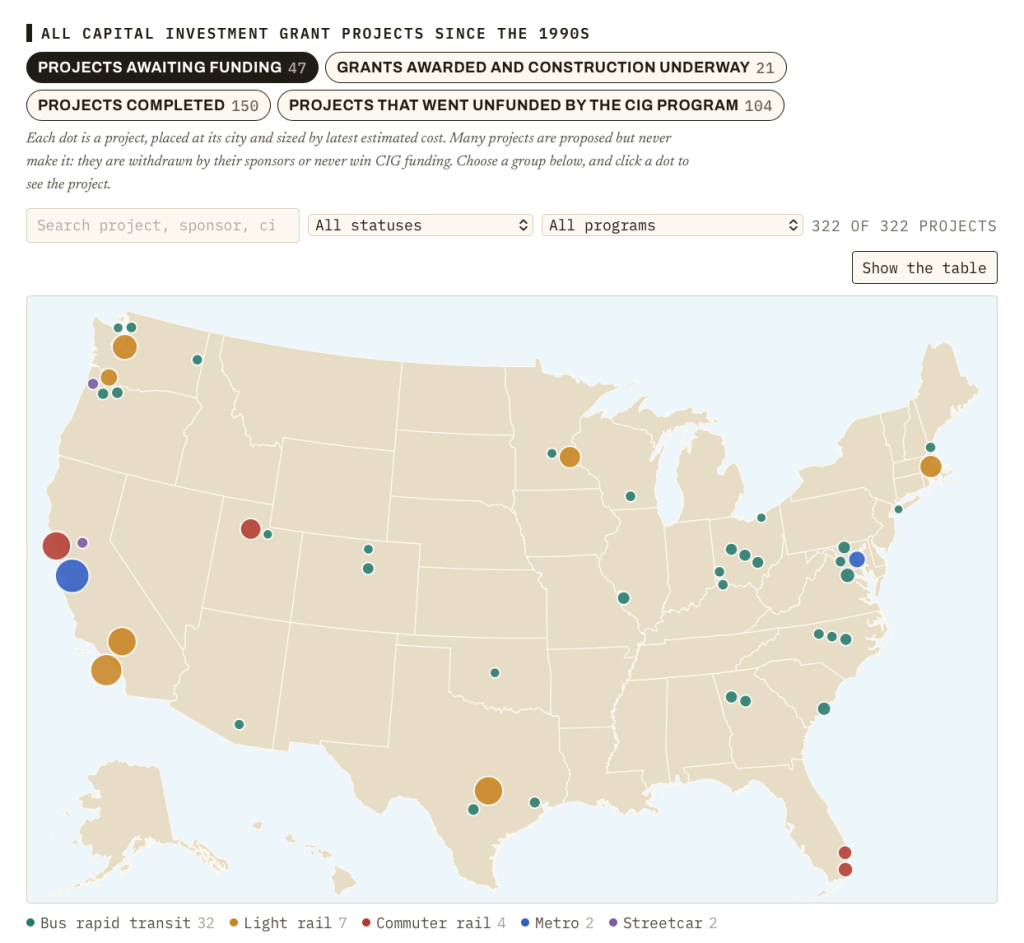
What CIG is — and How The Trump Administration Has Been Functionally Dismantling It
Since it was first launched in the 1970s, the Capital Investment Grants program has been both a critical and deeply challenging fixture of the nation’s transit landscape.
Even before the Trump administration’s new guidance raised the bar into the stratosphere, the American Public Transportation Association compared the program to a “bureaucratic maze” freighted with statutory and regulatory requirements that can stall projects by decades and make costs balloon. Because there’s so little money for major transit projects anywhere else, though, many agencies have no choice but to run that rat-race if they want to even modestly expand their footprint.
“[Without CIG], you could do small advancements, but you would never be able to provide even the levels [of new transit service] we’re providing today — which [themselves] are wholly insufficient,” said Ward McCarragher, vice president of public affairs for APTA.
America caught its first glimpse of what a world without the CIG would look like when the President Trump returned to office in 2025 and proceeded to make history by failing to advance even a single grant under the program for a staggering 20 months — longer than any other president in recent memory. To date, only one project has been released from limbo so far: a bus rapid transit route that’s key to mobility plans for the 2028 Los Angeles Olympics, and has drawn controversy for omitting bike lanes.
The White House didn’t say why it kicked the CIG can so far down the road, and neither the Federal Transit Administration nor the Office of Management and Budget responded to a request for comment from Streetsblog, but the conservative movement’s notorious Project 2025 initiative proposed eliminating the program entirely.
Of course, CIG isn’t the only transit program that Project 2025’s authors encouraged Congress to slash — and it’s certainly not the only one that the Trump administration has stonewalled since.
A swath of other federal transit programs have faced similar clawbacks and soft cancellations in the form of rescissions, illegal pocket rescissions, failure by Congress to extend advanced appropriations, failure by the Office of Management and Budget to allocate funding and a dizzying flurry of other legislative tricks that even the most engaged advocates struggle to follow.
All of those gambits, though, have had the same result: the administration abusing the complexity of the legislative process to hold transit projects hostage, until costs balloon out of reach and the mobility options Americans want most finally go pop.
“All of this evidence is pointing in one direction: A systemic effort within the administration is underway to undermine the CIG program,” wrote Kristina Curtiss of Transportation for America.
How the new ‘guidance’ makes all this worse
Trump and Secretary of Transportation Sean Duffy have dealt blows to the CIG program for almost two years, but advocates fear the proposed new guidance could functionally deal it a knock-out punch — particularly when you take a hard look at the specifics.
While Duffy’s focus on marriage and birth rates drew headlines last year, the new guidance proposes giving “cost effectiveness” five times more weight in project selection by “break points” at which, for instance, a project’s cost per trip is no longer considered worth spending taxpayer money, as well ratcheting up the level of non-federal dollars communities would need to secure to get higher levels of federal funding to match them.
Given rampant inflation and soaring transportation costs, those wonky moves would be more than enough to shove most projects off the CIG eligibility list, Freemark said.
“The reality in our economy is that costs are only going up and up,” he said. “But that’s not the fault of the transit agencies … The cost effectiveness guideline change is by far more damaging [than] the marriage and birth rates stuff. That stuff is stupid, and has no relationship to the performance of transit agencies, but it will have much less of an effect on whether projects are able to get funded.”
Many advocates say that the executive branch making these kinds of sweeping changes that Congress never requested is flat-out illegal, particularly when it comes to projects that played by the old rules and are now stuck in CIG purgatory.
McCarragher of APTA said that dozens of member agencies he’s spoken to are terrified they could be forced to start from scratch — and many won’t be able to.
“This is contrary to law and it exceeds the agency’s authorities,” he said. “It makes fundamental changes to the program that move the goalposts for all of the projects that are in the pipeline today. It will result in massive delays and uncertainty, increased cost to taxpayers, and in essence, stop these projects in their tracks and threaten their future.”
What to do about it
To stop CIG from going up in smoke, advocates say Congress must finally stand up to Trump and defend the program it created — and then take steps to insulate future transit dollars from similar attacks.
At the bare minimum, lawmakers could include a line in the next appropriations bill they’re set to pass in December, essentially blocking the new guidance from going into effect — something they actually did in response to past proposals to make CIG harder to qualify for back in 1989, 2007 and 2018.
“For better or worse,” Freemark said, Congress might even “just ignore the CIG program entirely and give these projects the money that they need … because right now, waiting for the Trump administration to do something doesn’t seem to be working.”
While that sort of pork-barrel spending can set a bad precedent, some advocates argue it may be necessary to protect transit dollars that agencies earned fair and square under the normal process — and to send a signal that if the executive branch is going to steal their power of the purse, Congress will do everything in its power to take it back.
“Folks need to be contacting their Congress members and telling them that the Trump administration is on an all-out assault against transit investment — and it’s not just these regulations,” Freemark added.
More importantly, though, all the advocates who Streetsblog interviewed for this story said Congress must finally confront the root reasons why federal transit programs like CIG are so vulnerable to executive interference — and take steps to give shared modes the kind of durable, guaranteed funding that highways already enjoy.
As the next reauthorization looms, Freemark noted that few road projects are subject to any meaningful “cost effectiveness” or other potentially-disqualifying evaluations, despite decades of evidence and widespread public knowledge that adding lanes doesn’t decrease traffic jams – and that states can’t afford to maintain the overbuilt roads they already have.
Notably, the American Association of State Highway Transportation Officials — an organization which, despite its name, is supposed to represent all all transportation modes including transit — did not object strongly to the proposed new CIG guidance in its comment, except to argue that existing projects should be grandfathered in under the old rules. The Association did not reply to a request for comment from Streetsblog.
“Transit projects have to go through this years-long, or sometimes decades-long intensive, competitive process to get federal support for their new transit lines … [But] highway projects don’t have that at all,” Freemark added. “And that’s part of the reason why we have so much more highway construction than transit construction in the U.S.”