Petitions Push Democrats to Ditch Dangerous New Transportation Bill
A growing chorus of transportation reform advocates is urging the House transportation committee to abandon the massive road funding bill it passed when Republicans had control — even as a key Democratic leader pledges to push it through anyway.
Shortly after the “blue wave” crashed over U.S. shores in this month’s midterms, advocates at Transportation for America launched a petition to urge the House Transportation and Infrastructure Committee to abandon the five-year, $580 billion BUILD America 250 Act it passed last May, which the group said “utterly failed to rethink or reform our country’s broken and bankrupt approach to transportation funding and policy.”
Organizations and individuals across the country echoed that call to action, pressing House Democrats to seize a historic opportunity to orient America’s single most important transportation law around policies that actually save lives, reduce emissions and fix “crumbling roads and bridges” — and abandon a bill that experts say would do the exact opposite.
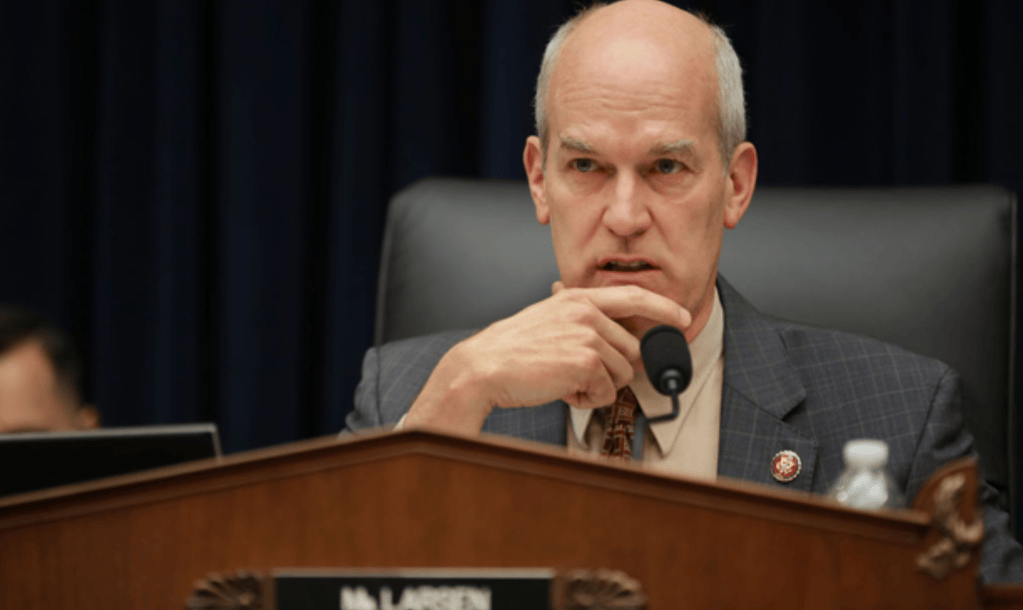
Almost as quickly, however, those calls were dismissed by U.S. Rep. Rick Larsen (D-WA), the likely incoming chair of the House committee that oversees reauthorization negotiations.
Larsen told Politico last week that he and his colleagues would “not [be] starting from scratch” in its next round of transportation talks, because “we just don’t have the time” amidst competing concerns, like funding the Federal Aviation Administration in the wake of last week’s nationwide ground stop. (Larsen’s office did not respond to a request for comment from Streetsblog.)
In the midst of a decades-long transportation crisis on the ground, though, the authors of the petition say that response is simply unacceptable – and America simply cannot afford for any version of BUILD America 250 to become law.
“BUILD America 250 … favors the building of highways over the needs of everyday Americans who need a better transportation system,” said Kristina Curtiss, Transportation for America’s senior policy manager. “Now is more important than ever to tell Ranking Member Larsen that he’s wrong.”
What’s wrong with BUILD America 250
Curtiss’s organization isn’t the only one that’s been pushing back against BUILD America 250 since before it passed out of committee in May — which it did, by the way, with broad bipartisan support, and only a single lawmaker from each party voting “no.”
Transportation reform advocates across the political spectrum have been speaking out against the bill for months, which they say doubles down on the worst qualities of its predecessor, the Infrastructure Investment and Jobs Act, by slashing billions in guaranteed transit, rail, and multimodal safety funding. The bill also falls short on a number of vehicle safety measures, including undermining truck safety standards and paving the way for the rapid rollout of untested AVs.
Guaranteed highway funding, meanwhile, would actually increase under the law, pushing the national transportation coffers even further into debt than they already are. That’s despite arbitrary new hybrid and EV fees, which experts say aren’t nearly big enough to make a dent in the shortfall — at least while the gas tax remains stubbornly low and highway-building costs remain shockingly high.
Taken together, an analysis by the Georgetown Climate Center this summer projected that the policies in BUILD America 250 would generate an additional 14 to 22 million metric tons of annual carbon dioxide emissions, and result in the deaths of more than 1,050 additional people in car crashes each year, too.
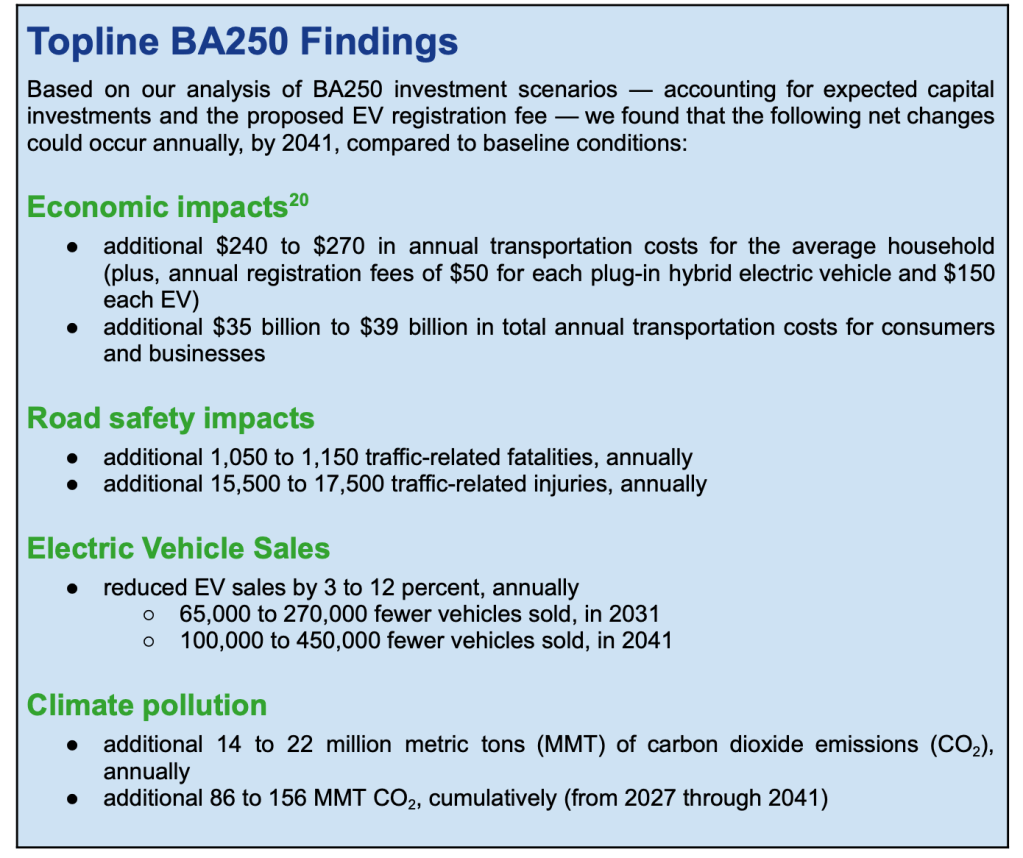
The average American household, meanwhile, would be hit with $270 in new annual transportation costs, even if they don’t drive EVs — in sharp contrast to the $14,170 the American Public Transportation Association says they’d save if they had access to shared mobility options that allowed them to give up their private vehicles altogether.
“All across the country, demands for affordability and accountability rang out louder and clearer than ever [this midterms]” wrote a coalition of 11 New York-based advocacy organizations* in a letter to Democrat leaders. “[This is an] urgent matter that will have lasting cost of living and time savings impacts on millions of New York families for decades to come.”
For Curtiss, though, the biggest problem with BUILD America 250 is simply that it keeps the highway money flowing, even when states keep building expansions that are directly responsible for making congestion, safety, and other transportation outcomes worse.
That fundamental flaw means that a few tweaks and funding shifts won’t be enough to save the legislation. Congress could look to models like 2020’s proposed INVEST Act for a better alternative. That bill did require states to measure how their investments would impact access to jobs and services, and adjusted core funding levels to accelerate the transit, biking, and walking projects that are most likely to improve it.
BUILD America 250 does neither of those things.
“[This bill] is built on a foundation that allows states flexibility for how much transportation money they spend, without accountability,” Curtiss added. “Line item edits to this bill won’t be enough to change the fact that it upholds a process that fundamentally values how much money we spend — and doesn’t answer the question of why are we spending this money to begin with.”
A political morass
Still, some advocates say House Democrats will struggle to negotiate a better alternative to BUILD America 250 – even after the historically-blue 120th Congress takes office in January.
Because the bill passed out of committee with such broad bipartisan support, Curtiss said, standing members will face political pressure to stick to their votes, unless a groundswell of constituents urges them to reverse course. And because lawmakers often sacrifice transportation as a bargaining chip in the name of larger bipartisan collaboration, Curtiss fears even incoming committee members will feel pressure to follow their caucus’s deeply flawed approach.
Still, she’s hopeful that change may already be underway — and an organized opposition could push holdouts over the edge.
“Since the markup in May, we’re hearing committee members change their minds,” Curtiss said. “The tide in the public is shifting, and people are starting to recognize many parts of this bill are bad.”
Even if Larsen does scrap BUILD America 250 and comes up with a better alternative, though, Curtiss said the next transportation bill will face another daunting challenge: getting the executive branch to actually follow that law.
Since resuming office in 2024, the Trump administration has repeatedly hamstrung the nation’s current core transportation bill — the Infrastructure Investment and Jobs Act — using every legal trick in the book and a few illegal ones to cancel or delay policies it didn’t like. That includes holding hostage one of the nation’s largest transit funding sources, by flat-out refusing to sign a single Capital Investment Grant since taking office.
The fight over BUILD America 250 will prolong that messy fight even more by forcing Congress to pass yet another extension to the IIJA after its current one expires on December 11. Even worse, the last extension used even more legal tricks to kill key transit and rail programs — forcing advocates to mount a parallel campaign to get the money restored in the midst of negotiations over the next bill.
“One question we often have is, ‘What is the point in writing a new reauthorization bill giving them more money, in a world where they’re not going to even spend the money they already have?'” Curtiss added. “Congress [needs to] use its oversight authority to ensure that the past bill and the future bill are implemented in a way that people can trust … [and that] create outcomes in transportation projects that people are excited for.”
Still, Curtiss argues that Congress can walk and chew gum at the same time – and it can certainly hold Trump accountable on transportation today, while fighting for a bill that will deliver better mobility outcomes tomorrow. And since the next transportation bill will last for at least five years, it’s essential that this Congress level up their ambitions while they can.
“This bill shouldn’t be written by an old Congress,” she added. “We’re looking forward to working with new committee members, who deserve a voice in how we write this reauthorization. It’s unfair to freshmen coming onto district to be handed an old bill that’s going to set them up for failure when they go back and people ask them why they didn’t invest in bike lanes.”
*Disclosure: the signatories of this letter include Open Plans, the parent organization of Streetsblog USA and NYC.