Congress Gave States Enough Money to Fix Every Road in America; Some States Set It On Fire Instead
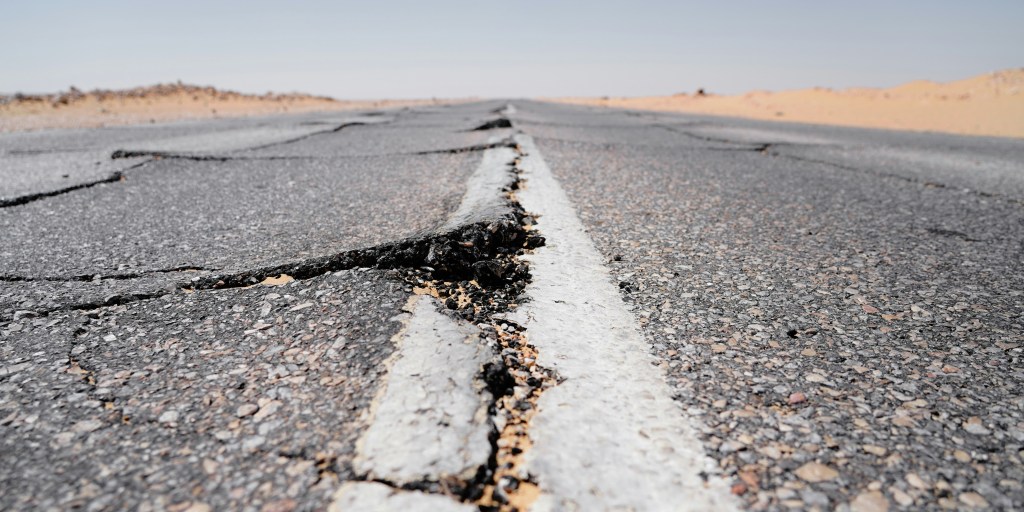
The last federal transportation law gave states more than enough money to fix every crumbling highway and bridge in America — but a disturbing share of departments of Transportation sunk that windfall into expanding highways instead, a new report found. And unless Congress learns from its mistakes and finally requires transportation officials to “fix it first,” we will continue to set billions of taxpayer dollars on fire.
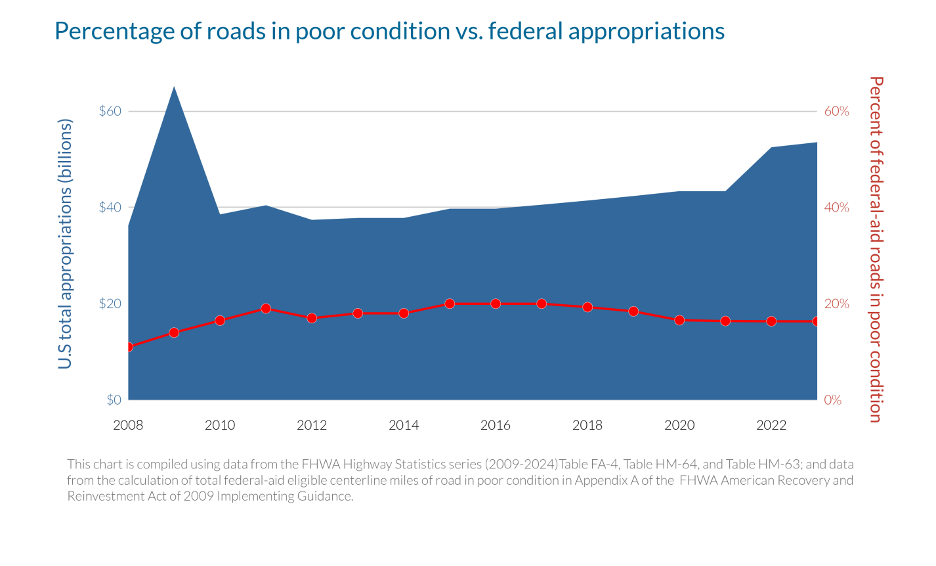
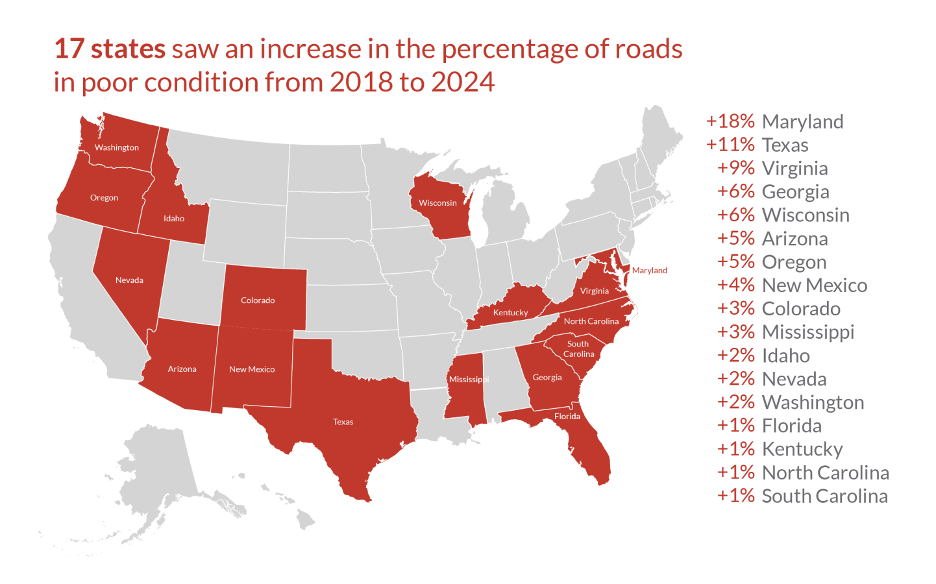
A stunning 16.3 percent of U.S. roads that were eligible for federal money were still rated in “poor” condition in 2024, according to a recent Transportation for America analysis — despite Congress providing state DOTs with $56.8 billion in largely unrestricted transportation funds that year alone, and nearly $1.5 trillion over the 30 years prior.
Experts say it would take $43.2 billion per year to maintain all of the country’s existing roads in “acceptable” condition, or roughly 23 percent less than Congress authorized annually under the Infrastructure Investment and Jobs Act.
And the authors of the report say the waste may be even worse than it seems.
Because increasingly lax reporting standards conceal broken roads from public view, and DOTs routinely mis-categorize expensive expansion projects as simple “maintenance” or lump them into a mysterious “other” category, Transportation for America suspects the national highway network is actually even more drastically overbuilt than it appears on paper.
That means that even a steep increase federal dollars may not be enough to repair our rapidly expanding transportation network — at least without using that money to shift people onto modes other than driving and take pressure off our battered asphalt.
“We’re still adding to the system faster than we’re able to take care of it,” said Mehr Mukhtar, the group’s senior policy associate. “We’re still seeing inconsistencies and a lack of transparency in reporting standards. And all of this just leads us to the conclusion that until we see a meaningful shift in our priorities, and in how we’re tying our spending to our outcomes, the backlog of roads in poor conditions is going to persist — and likely it’s going to worsen.”
Mukhtar traces much of America’s pothole crisis to a long-standing tradition of giving states broad latitude over how they spend their federal “formula” dollars, or grants doled out to DOTs based on a pre-determined government calculation.
In the absence of federal rules to rein them in, many states pick ribbon-cuttings for new and “improved” — i.e., widened — highways over the unsexy work of repaving the lanes they already have, even if those lanes are falling apart.
A whopping 24 states chose to spend less than $2.35 on maintenance for every dollar they spent on expansion — a ratio that Transportation for America says is alarming — despite the fact that those states have a higher share of roads in poor condition than the national average.
Worse, experts say those expansions won’t come close to accomplishing the goals they’re theoretically supposed to achieve. Decades of research has shown that widening roads does nothing to fix traffic jams over the long term, encourages drivers to fill newly added lanes, and saddles communities with compounding long-term maintenance obligations that they can’t keep up with.
It’s a little like adding a ballroom to a house when the roof is so leaky that rain is pouring in — except that ballroom is somehow accelerating a traffic violence crisis that claims nearly 40,000 lives a year, super-charging climate change, and amplifying income inequality by reducing access to jobs, rather than, say, hosting waltzes.
“That’s fiscally irresponsible, and it’s a burden on taxpayer dollars,” Mukhtar added.
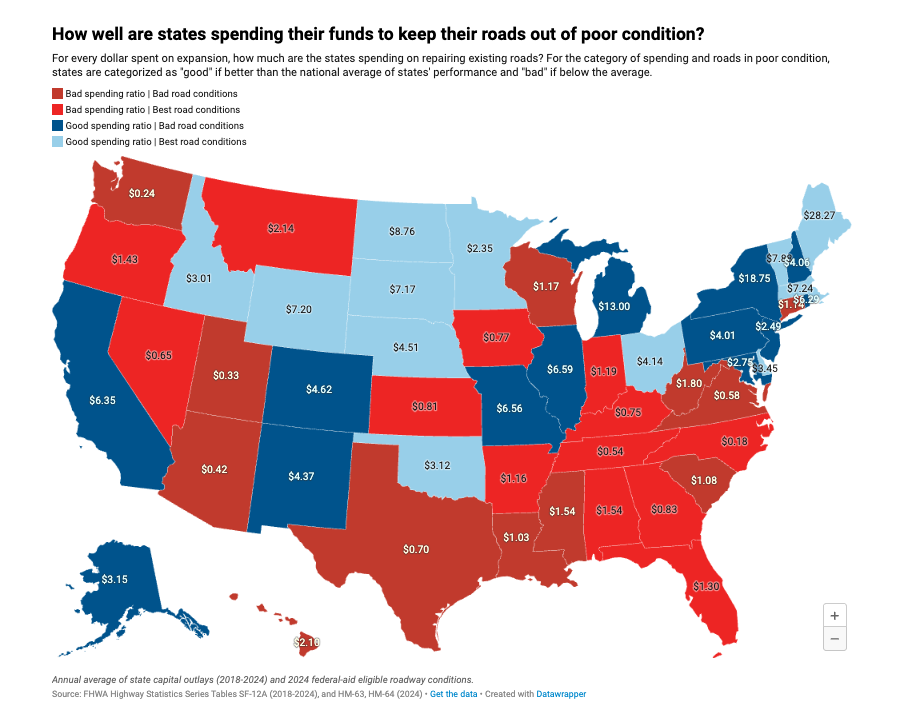
Of course, not all states are neglecting their maintenance backlog in favor of climate arson — and some of them are even offsetting the worst offenders.
Communities like North Dakota, South Dakota, Minnesota and Vermont won applause from the report’s authors for strong repair-to-expansion ratios, which helped bring their average road conditions above the national average — though, to be fair, many of those states have a high share of depopulated rural roads that need less-frequent maintenance than highly trafficked urban arterials. Still, Mukhtar credited those communities with lowering America’s total share of roads and bridges in poor condition by three percentage points between 2018 and 2024.
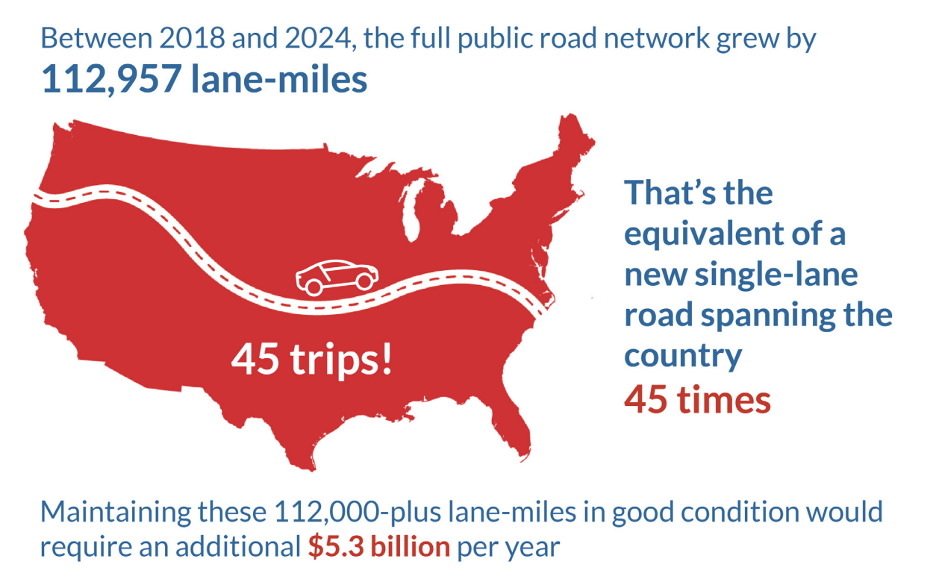
But she warned that extremely modest progress won’t be enough to outrun America’s looming maintenance obligations. The report says every new lane-mile of highway built will cost future taxpayers $47,300 per year to maintain in good condition — roughly the cost of a year’s out-of-state tuition at a decent public university — and America built 119,257 of them in the six years the researchers analyzed.
Worse, even some of the “good” states are still delaying maintenance until its bridges are on the brink of collapse, driving maintenance costs well above the average. Mukhtar pointed to Michigan, whose maintenance spending, which looks impressive on paper, actually masks the fact that the Wolverine State tends to postpone repaving until roads are so bad that they need to be totally rebuilt.
“With the costs of construction ballooning and inflation rising, even those same dollars don’t get stretched as far now as they would have decades ago, if [states] started prioritizing repair earlier,” she said.
With the Infrastructure Investment and Jobs Act due to expire on Sept. 30, Mukhtar said Congress has a rare opportunity to restore sanity to the transportation system and finally require states to “fix it first,” rather than adding endless new ballrooms to a falling-down house.
That might look like setting “tangible goals, such as reducing the backlog by half,” requiring federal agencies to collect better data on the actual condition of roads, and establishing enforceable mandates that state DOTs be more transparent about how taxpayer dollars are spent.
And until they actually do, no voter should believe a politician who pledges to “fix America’s crumbling roads and bridges” — because nearly $57 billion a year later, they still haven’t done so.
“Whenever a transportation bill is passed, we hear the same thing come out of Congress time and time again: the same rhetoric about fixing crumbling roads and bridges, and why we need to increase funding,” said Mukhtar. “But I think what we need to see this time around are enforceable requirements, which actually compel states to spend that money on fixing it first.”

Read More:
Streetsblog has migrated to a new comment system. New commenters can register directly in the comments section of any article. Returning commenters: your previous comments and display name have been preserved, but you'll need to reclaim your account by clicking "Forgot your password?" on the sign-in form, entering your email, and following the verification link to set a new password — this is required because passwords could not be carried over during the migration. For questions, contact tips@streetsblog.org.