Could Congress’s Anti-Flock Surveillance Bill Ban Automated Traffic Enforcement, Too?
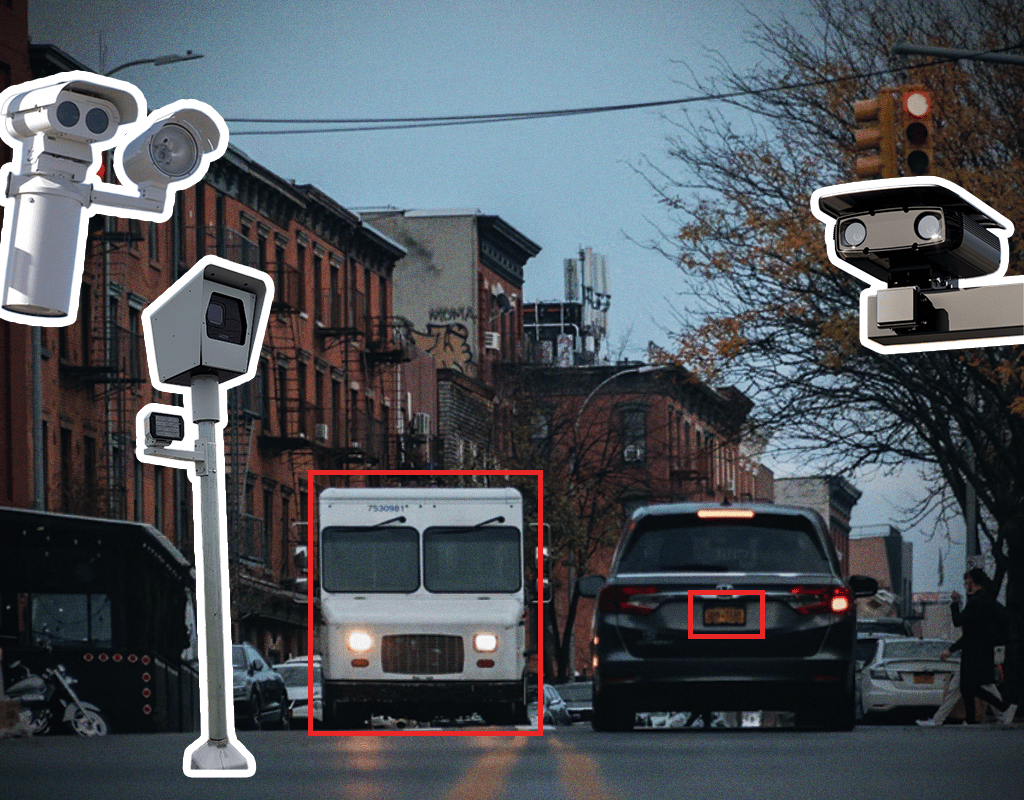
A proposed federal surveillance ban may threaten speed and red light camera programs across the country, which some advocates say would force cities to pick between privacy and street safety.
Following months of rumors, The Flock-Off Act was officially introduced by Rep. Thomas Massie (R-Ky.) in September, with promises to withdraw all federal funds from any municipality that contracts with a surveillance camera operator. And that’s not just limited to the notorious technology company for which the bill is named, which has deployed an estimated 116,000 motion-triggered cameras in neighborhoods across the US.
Massie claims that his bill prohibits the surveillance of “law-abiding citizens”, not drivers running red lights or speeding. But some advocates fear that the bill’s wide-reaching language about automatic cameras intended to facilitate the “recording of a motor vehicle” would effectively ban all automated traffic enforcement nationwide.
Of course, many street safety advocates do want lawmakers to do more to confront Flock — even if they don’t agree with sweeping bans on other, less-intrusive camera technology.
Since its founding in 2017, the company has faced criticism for offering a near-constant stream of motion-activated footage to law enforcement, tracking every car it sees using the vehicle’s license plate, model, and even characteristics like paint scratches or dents. And people outside cars aren’t immune from its gaze, either.
“A pedestrian, bicyclist, or animal who happens to be caught in the frame of a Flock camera can be swept up in the vast and unregulated Flock surveillance network,” wrote the Oregon ACLU.
Speed and red light cameras, by contrast, are only triggered to record when drivers speed, run red lights, or otherwise break roadway laws. In San Francisco, excessive speeding is down 84 percent where cameras are installed.
Even where collisions do still occur, those lower speeds translate into much better outcomes for victims. Pedestrians struck at 40 miles per hour have an 85 percent chance of dying, but at 20 miles per hour, the probability decreases to five percent.
Automated red light enforcement has a similarly positive impact. Cameras are shown to decrease red-light running overall, and reduce injury crashes by 20 percent.
Advocates like McKenzie Ortiz, who creates content about street safety under the Instagram account @pedestrianpride, say it’d be a shame if Massie’s bill makes those types of programs illegal.
“I feel like the red light and speed cameras caught a stray,” she said.
Dr. Kelcie Ralph, a researcher at Rutgers University who studies traffic enforcement, was also disappointed by the bill’s conflation of two vastly different types of camera programs.
“It’s such a same,” she said. “[Automated traffic enforcement] is so … different than what’s happening with [Flock].”
Some advocates suspect that the benefits of automated enforcement can extend even farther for Black Americans — and that Massie’s bill would be doubly harmful for their communities.
Police are more likely to use force against Black drivers during traffic stops. Ortiz, a Black woman herself, supports using speed and red light cameras as a substitute for road patrols.
“We already feel the effects of over-policing,” she said. “If it meant less police officers on our streets … but still the level of enforcement that could encourage people to drive more safely, that would be a sacrifice that I would be willing to make.”
Even Rep. Ro Khanna (D-Ca.), a co-sponsor of the Flock-Off Act, acknowledged how automated traffic enforcement differs from Flock.
“I’m for speed and red light cameras,” he said in an interview with Streetsblog. “You don’t have speed and red light cameras being abused by police officers.”
Khanna did not clarify what, if any, steps he was taking to exempt street safety programs from the bill. He did suggest that he viewed the legislation as a temporary measure to address Flock in the immediate term.
“What we’re saying is to shut off that federal funding until we get some privacy regulation,” he added.
If the Flock-Off Act is indeed a pause, its sponsors are not alone in wanting one.
Kelsey Huse, is a Memphis, Tennessee-based organizer behind the Instagram account @MemphisUrbanism. She generally supports automated traffic enforcement, but feels that a moratorium on camera surveillance is necessary to address the Flock problem.
“It’s just a messy topic right now,” she said.
Huse’s concerns aren’t limited to Flock, either, since speed and red light cameras have room to grow, too. For starters, cities must address the financial incentives driving how programs are managed.
Despite Rep. Khanna’s contention that police don’t “abuse” automated enforcement, reports show that some police departments do site cameras on speed-inducing roads specifically to raise the traffic fine revenues on which their budgets over-rely. A 2024 Fines and Fees Justice Center analysis even argued that “the expansion of automated traffic enforcement simply creates a new and more effective way to fine exponentially more people.”
Huse has the same concern.
“Is our goal to reduce traffic violence events, or is our goal to make money off of tickets?” she added.
Ralph, who led a 2022 study on improving automated enforcement programs, says that the concern is valid — and has implications for safety outcomes, too. Amongst them is a scenario in which a speed camera operator, receiving a share of the revenue of each ticket issued, places cameras where they are likely to catch a maximum number of violations, not where they are most needed.
“When a speed limit shifts from 35 to 25 [miles per hour], you post up there, you get a lot of drivers in the transition — but maybe there are no crashes there,” she said.
Some advocates also cite the potential for racial discrimination as a key drawback of automated systems. A 2022 study found that automated enforcement cameras in Chicago issued a disproportionate number of tickets in the city’s majority-Black neighborhoods.
Though the study could not identify the race of the drivers themselves, the findings raise significant concerns about a technology touted as a fair alternative to traditional enforcement.
The Flock-Off Act, though, doesn’t attempt to address any of those concerns, instead banning them outright.
Ralph says that’s a shame, considering how many levers cities have available to them to ensure cameras are used fairly. For example cities could invest ticket money back into infrastructure to improve street safety — preferably close to the camera’s location, so no one gets hurt there again.
“How you spend the [revenue from tickets] matters a ton,” she said.
Ralph also encouraged cities and towns to reconsider how they use monetary fines as a punishment.
“There’s a real concern that [automated traffic enforcement] is a tool for the … pipeline from poverty to prison,” she said. Rather than creating a flat-rate for fines, she suggests a smaller fee for a first infraction, to mitigate excessive punishment of drivers who are unlikely to be repeat offenders.
On the other hand, some drivers may not be dissuaded by a ticket at all.
After repeat violations, Ralph suggests that governments consider non-monetary punishments like mandatory speed governors. One 2022 study from New Zealand found the devices to be incredibly effective at limiting recurring speeding, providing some hope for the strategy’s viability in the US.
If nothing else, advocates say the architects of automated enforcement programs need to learn from Flock’s mistakes and warn communities that they’re about to installed – while offering education about their potential to save lives.
Shawn Joseph, a transit advocate and software engineer in Irvine, California, says Flock cameras cropped up in his neighborhood with minimal to no public input.
“People want the technology in their communities to be a choice,” Joseph said.
With proper enforcement, catching dangerous drivers in the act can deter the behavior in the future. But Joseph, Huse, Ortiz and Ralph all emphasized that designing streets for lower speeds can deter bad driving before it happens. Narrowing 10 to 13 foot travel lanes to nine feet, for instance, can reduce crashes on higher-speed roads.
“We should really start with how we’re designing our streets,” Ortiz said. “Make it uncomfortable to speed and uncomfortable to run red lights.”
Preventative design can even mitigate concerns of surveillance by taking punishment out of the equation altogether.
If you are worried about privacy, just drive the speed limit,” Ralph stated.

Read More:
Streetsblog has migrated to a new comment system. New commenters can register directly in the comments section of any article. Returning commenters: your previous comments and display name have been preserved, but you'll need to reclaim your account by clicking "Forgot your password?" on the sign-in form, entering your email, and following the verification link to set a new password — this is required because passwords could not be carried over during the migration. For questions, contact tips@streetsblog.org.