You Won’t See These Defunded Projects in Sean Duffy’s US DOT Reality Show

Corporate sponsors, a big cast of kids and the war on “woke” all appear in Secretary Sean Duffy’s “Great American Road Trip” reality show. But one important thing goes unmentioned as he and his family make their way across the country — the transportation projects his U.S. DOT has defunded since President Trump returned to the White House last year.
The six-episode series, which premiered on YouTube last week, follows Duffy, his wife (and Fox News personality) Rachel Campos-Duffy as they drive from city to city and state to state. Their nine children come along, though not all at once; even an eight-seat SUV couldn’t fit the whole family, so kids are rotated in and out of the trip. Each episode is packed with confessionals and unscripted family moments, and very little discussion of transportation.
That may be for the best, since every location Duffy visits has been the victim of his war on bike lanes, sidewalks, mass transit and any project that does not adhere to the current administration’s policies on diversity, gender identity and climate.
The Department of Transportation announced last May that it would review all grants made during former President Joe Biden, and proceeded to cut as many as it could. By September, U.S. DOT had canceled at least $77 million worth of federal investments in location infrastructure.
Here’s a rundown of some of those defunded projects, which Duffy does not mention once.
Philadelphia
Duffy has sparred with Philadelphia officials multiple times since stepping into his role last year, mostly around a series of fires onboard SEPTA, the city’s regional transit agency. On Oct. 1, 2025, U.S. DOT ordered SEPTA to inspect and repair its entire Silverliner IV train fleet before returning the cars to service.
“If changes are not made immediately, it is only a matter of time before SEPTA’s crumbling commuter rail system erupts in flames and kills someone,” Duffy said in a letter last year to Pennsylvania Governor Josh Shapiro.
Shapiro pushed back, calling on Duffy to convince Pennsylvania’s Republican-led legislature to approve $167 million in funds for SEPTA repairs. (Duffy declined.)
The transportation secretary finally announced a $13 million grant for the agency last month — ten months after the initial ask for help. That grant covers less than eight percent of the amount that Shapiro says is needed.
SEPTA’s damaged fleet was the oldest in the nation of its kind. Facing a $10 billion deficit to its maintenance fund, and no substantive federal support in sight, the agency has been forced to defer dozens of infrastructure projects.
Boston
The Duffy family spent their Boston trip far more focused on Harvard University’s liberal politics than the millions of dollars their dad withdrew from Beantown safety projects.
Last September, Duffy’s DOT cancelled $20 million that would have improved three major streets in Roxbury, a neighborhood of Boston. The project included electric car charging stations, which U.S. DOT said went against its “traditional forms of energy and natural resources” in its cancelation notice last year.
“The city won these competitive federal grants to replace sidewalks, improve lighting, upgrade bus stops and plant trees on neighborhood streets,” a city spokesperson told StreetsblogMASS, which covered the funding rescission.
U.S. DOT also cancelled a smaller $2 million grant for Mattapan Square, just five miles south of Roxbury.
The majority-Black neighborhood was part of the agency’s Reconnecting Communities Pilot, a program to increase access in areas historically segregated by road and rail infrastructure. But because the street redesign would reconfigure some car lanes for other uses, Duffy’s cancelation notice accused it of being “hostile to motor vehicles” and lacking national significance.
Montana
The Duffys’ visit to the Mountain West is a heartwarming family ski trip … straight through areas where he’s frozen several key street safety initiatives.
The Transportation Secretary’s attack on “woke” grants targeted a planned upgrade to Highway 200, which runs through East Missoula, Montana.
“All of our years of planning, we’re now gonna see dirt move. We’re gonna see some construction. And now we’re back to where we were almost a decade ago where nothing’s happening,” East Missoula Community Council member Lisa Thomas said in a July 2025 interview with 8 KPAX, a local news station, after Duffy cut the $24 million grant.
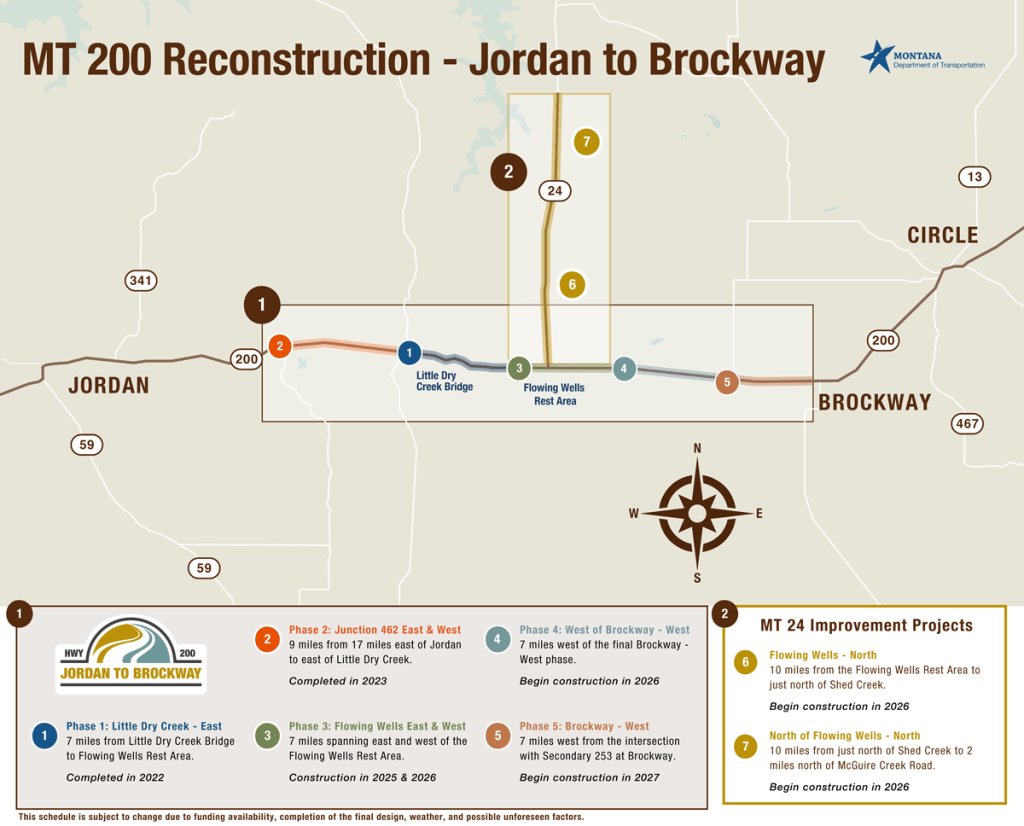
Planned upgrades to the roadway included new bike lanes, bus stops and sidewalks, additional street lighting, a new roundabout and an improved grade-separated railroad crossing. The changes were funded through the same Reconnecting Communities grant as Boston’s disendowed Mattapan Square project.
The canceled grant had unlocked an additional $6 million in state and local funds, which may now be in jeopardy as well.
“We’re almost back to square one,” Thomas told 8 KPAX.
Charleston, South Carolina
In a rare acknowledgement of the kind of transportation infrastructure projects he oversees, the fourth episode of The Great American Road Trip takes Duffy’s family to Charleston, South Carolina for a private tour of Boeing’s local manufacturing facility, showing off the airplane company’s high-tech 787 Dreamliner fleet. (The company’s cameo isn’t particularly surprising; it is a top sponsor of the show.)
Charlotte’s push to build out its mass transit system, though, doesn’t get any airtime at all.
The planned 21-mile “Lowcountry Rapid Transit” bus network would run from Northern Charleston to downtown on a network of dedicated transit lanes. Lined with high-end bus “stations” and priority at stop lights, the system would help a region growing at three times the national average. The federal government hasn’t shown much enthusiasm.
The project is due to receive $374 million from the Department of Transportation through the Capital Investment Grants program, but Duffy hasn’t approved a single new funding agreement for the program since his appointment as Transportation Secretary.
The Department of Transportation’s contribution is expected to cover nearly 60 percent of the project’s total cost — threatening its implementation if Duffy refuses to move the money by January.

“We are concerned by the actions the Department has taken to withhold these funds and delay implementation of critical infrastructure projects across the country,” a group of Democrat Members of Congress wrote in a March 2025 letter to Duffy. U.S. Rep. James Clyburn (D-S.C.), one of the letter’s authors, represents a majority of Lowcountry Rapid Transit’s service area.
Texas
The road trip’s penultimate stop left the Duffys loving Texas … but not enough to fund its trains.
Last spring, Secretary Duffy terminated Amtrak’s nearly $64 million grant to build a high-speed passenger rail line between Dallas and Houston.
The project, which is estimated to cost more than $40 billion total, could carry passengers between the two cities in under 90 minutes, proponents say. An estimated 50,000 Texans travel along the corridor every week, signaling major demand for a high-capacity and convenient option. Without federal support, funding the line is more out-of-reach than ever.
“We were a little surprised … I don’t think we were shocked,” said Peter LeCody, the President of Texas Rail Advocates. The organization supports high speed rail in the state through public and private sector coordination, according to its website.
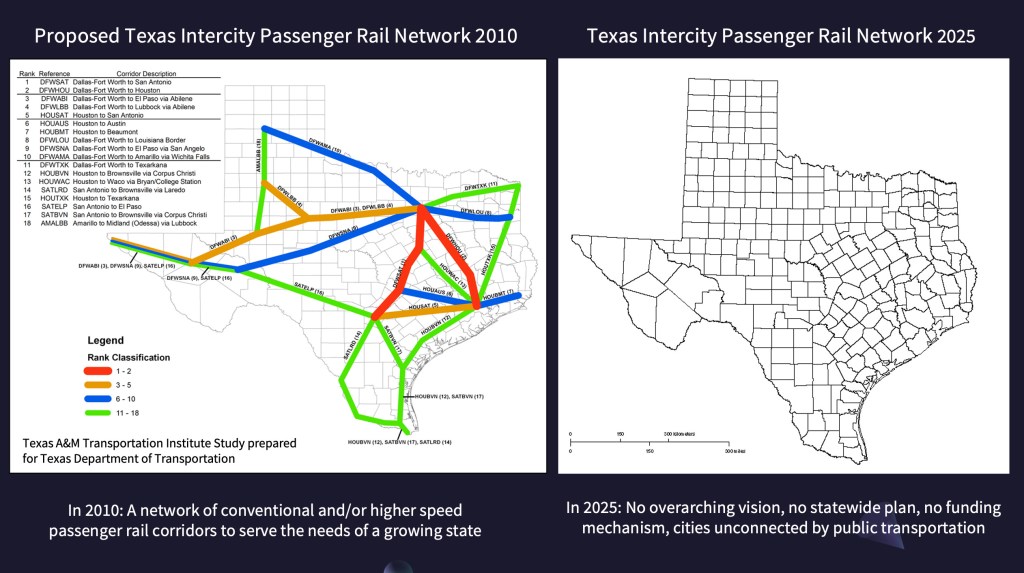
Now, the public-private partnership may rely entirely on private funding to stay afloat, according to LeCody. The switch could lead to a much faster project timeline, but it needs to close its massive deficit first.
Even with federal support, the project was primarily funded through Texas-based private investors. Duffy nonetheless called it yet another form of government “waste” to be axed by the Trump administration.
“Underwriting this project is a waste of taxpayer funds and a distraction from Amtrak’s core mission of improving its existing subpar services,” the transportation secretary said in a statement in April 2025. “If the private sector believes this project is feasible, they should carry the pre-construction work forward, rather than relying on Amtrak and the American taxpayer to bail them out.”
It’s an ironic move for a president who named the Texas High Speed Rail project a top priority in 2017, and whose first administration pitched the initial public-private funding model.
Irony doesn’t lay track or build trains, though, and supporters are searching for a backup.
Arizona
The corporate-backed tour wouldn’t be complete without a trip to Arizona, where driverless cars dominate the public road. In the final episode of The Great American Road Trip, several members of the Duffy family take a Waymo for an autonomous test drive. Waymo shares a parent company with Google, which sponsored the show. Still, the reviews were mixed.
“It’s weird … I did not like that,” said Evita Duffy, the secretary’s 26-year-old daughter.

The family also met with Suzanne Philion, a representative for Waymo, who touted the company’s better-than-humans safety record. For the first time in the series, Secretary Duffy acknowledged the nearly 40,000 lives lost to traffic violence every year in the US.
“This will be the first time we actually have a huge impact on saving lives on American roads,” he said. It’s a bold statement from the man who has taken nearly $2 billion from lifesaving street improvement projects across the nation.
Even Duffy, who quietly removed bike lanes, road diets and speed cameras from the Department of Transportation’s list of street safety measures this year, won’t deny the epidemic of car-induced problems in the US. Yet the only solutions he’s accepted don’t cost his department a penny — and do enrich a private auto interest.
“To love America is to see America,” Duffy says in the kickoff for his reality show. To love America, as it turns out, is also to block any attempt at making it better.
Read More:
Streetsblog has migrated to a new comment system. New commenters can register directly in the comments section of any article. Returning commenters: your previous comments and display name have been preserved, but you'll need to reclaim your account by clicking "Forgot your password?" on the sign-in form, entering your email, and following the verification link to set a new password — this is required because passwords could not be carried over during the migration. For questions, contact tips@streetsblog.org.