‘Big Brother’ At U.S. DOT: Bike Lanes Aren’t Just ‘DEI,’ They’re Also Unsafe
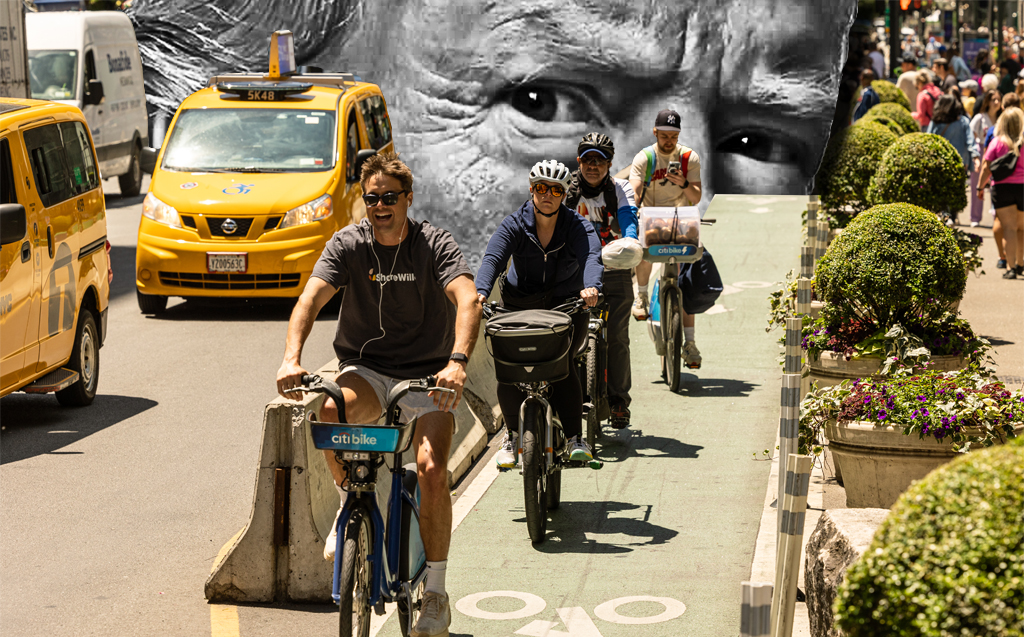

Bike lanes are unsafe. Speed cameras cause crashes. Safety redesigns cause congestion and injuries.
Or, as Big Brother said, freedom is slavery, war is peace, ignorance is strength.
President Trump and federal Transportation Secretary Sean Duffy have made it clear for more than a year that they object to bike lanes, automated enforcement cameras and other proven safety measures — with Duffy going so far as to say that bike lanes are just government “DEI” activism — but neither man went out of their way say that such safety measures were, in fact, unsafe. Until now.
Sometime between June 30 and July 10, the Trump-run Federal Highway Administration changed its web page of “Proven Safety Countermeasures” to eliminate safety strategies that, before President Trump’s second term began, the agency had long supported, including protected bike lanes, speed cameras and road diets:
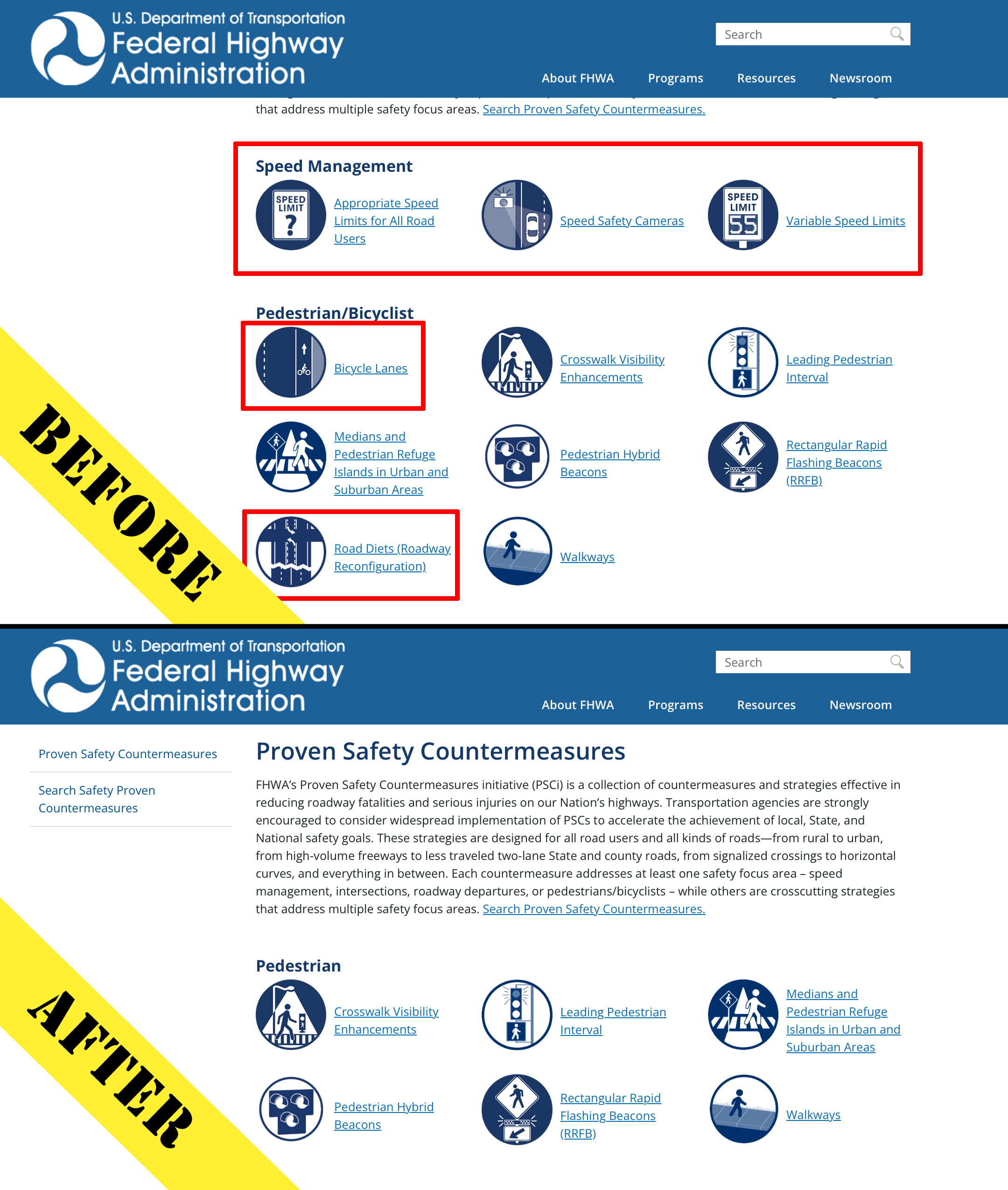
The administration had previously criticized road diets — the removal of a lane of traffic to make room for bike lanes or pedestrian safety measures, or also to improve flow with turning bays — by claiming without evidence that they cause traffic congestion. The agency has also canceled grants for projects that it deemed hostile to cars.
But the changes to the web page reflect the administration’s new contention that safety measures are not merely annoying to drivers, but unsafe.
Activists can’t believe it.
“Bike lanes and road diets are still legitimate safety measures,” said Ken McLeod, policy director at the League of American Bicyclists. “Absolutely nothing has changed about their effectiveness or the data that led them to be placed on the Proven Safety Countermeasures list in the first place.”
And until July, the FHWA certainly agreed. On the archived web page, the agency said protected bike lanes “can mitigate or prevent interactions, conflicts, and crashes between bicyclists and motor vehicles, and create a network of safer roadways for bicycling. … State and local agencies should consider installing bicycle lanes.”
Bicycle lanes align with the Safe System Approach principle of recognizing human vulnerability — where separating users in space can enhance safety for all road users,” added the web page (which, ironically, was illustrated with a protected bike lane in Washington, D.C. that the president sought to remove earlier this year).
The agency said that creating separated bicycle lane to protect cyclists from car traffic “reduces crashes up to 53 percent.”
And on road diets, the FHWA (at least until July) said they “can improve safety, calm traffic, provide better mobility and access for all road users, and enhance overall quality of life.” The agency said conversions of roadways from four lanes to two (plus a turning bay) lead to:
- Reduction of rear-end and left-turn crashes due to the dedicated left-turn lane.
- Reduced right-angle crashes as side street motorists cross three versus four travel lanes.
- Fewer lanes for pedestrians to cross.
- Opportunity to install pedestrian refuge islands, bicycle lanes, on-street parking, or transit stops.
- Traffic calming and more consistent speeds.
- A more community-focused, Complete Streets environment that better accommodates the needs of all road users.
It promised a 19- to 47-percent reduction in crashes.
And on speed cameras, the agency’s archived page boasted that can reduce crashes by 54 percent. In New York City, which has the nation’s largest speed- and red-light camera enforcement program, officials reported a 95-percent drop in speeding at locations with cameras, and that locations with cameras experienced 14 percent fewer injuries and
fatalities compared to control corridors without cameras.
But as of July 10, those measures are no longer considered safe by the federal government. In a statement, an FHWA spokesperson did not address Streetsblog’s questions about why the agency now considered its own safety countermeasures to be unsafe.
“The Federal Highway Administration is conducting an ongoing administrative review of its ‘Proven Safety Countermeasures’ to ensure they align with US DOT policies and the Administration’s priorities,” the statement read. “The Department is taking action to reverse the last administration’s policies that decreased lane capacity and increased congestion. Drivers paying taxes and vehicle fees expect their dollars to be reinvested into our roads, not social initiatives that burden their commutes.
“Under Secretary Duffy, the Department is getting back to basics and putting safety first,” the statement concluded.
The agency did not respond to a follow up question: “We understand the administration’s position on road capacity, but are bike lanes and road diets now considered unsafe?”
Clearly, bike lanes, road diets, speed cameras are just as safe now as they were a month ago, when they were promoted on the very same agency’s site, advocates said.
“Nothing has changed; no new evidence has emerged to indicate that separating cyclists from motor traffic or slowing and better ordering motor traffic with fewer lanes are anything but tremendously successful street safety measures,” said Jon Orcutt, a former top official with the New York City Department of Transportation under then-Mayor Mike Bloomberg, a Republican, and Mayor Bill de Blasio, a Democrat. “Their removal from FHWA’s proven safety list is the latest step in Sean Duffy’s intentional infusion of stupidity into US DOT policy.”
Orcutt included in that list Duffy’s war on congestion pricing, which also ended up being a stunning safety and traffic-reduction success.
Orcutt added that FHWA’s action “could be harmful” because there are many places in the country “where the efficacy of bike lanes or road diets is contested, or state or city officials are still foot-dragging over them.”
“In places smart enough to already implement such measures — like the 80 cities that are members of NACTO — [the FHWA change] will be rightly ignored,” he added. “If FHWA tries to use the change to interfere with specific projects, local and state agencies should take their cues from New York’s Metropolitan Transportation Authority and sue the Trump DOT early and often.”
The irony, of course, is that until very recently, federal officials did not dare to testify under oath that bike lanes are unsafe. In ruling earlier this year against the Trump administration’s attempt to remove the 15th Street bike lane in Washington, the court wrote, “The government does not dispute, and it did not submit any data that would contradict, plaintiff’s contention that the dedicated bike lanes reduce collisions. As counsel for defendants acknowledged at the motions hearing, “[t]here is information in the record that says as a general principle, protected bike lanes prevent collision.”
One former FHWA administrator said there’s a reason that even the Trump administration didn’t put on the record that bike lanes are unsafe — because they remain safe.
“We should be making decisions about safety based on evidence,” Stephanie Pollack, the former acting administrator of the FHWA under President Joe Biden, told NPR. “It’s hard for me to understand how you could say you’re putting safety first, and then make arbitrary decisions about what does and doesn’t improve safety.”

Read More:
Streetsblog has migrated to a new comment system. New commenters can register directly in the comments section of any article. Returning commenters: your previous comments and display name have been preserved, but you'll need to reclaim your account by clicking "Forgot your password?" on the sign-in form, entering your email, and following the verification link to set a new password — this is required because passwords could not be carried over during the migration. For questions, contact tips@streetsblog.org.