Report: Building More Homes Reduces Overall Driving

As if we didn’t need another case for building more homes — turns out, it reduces driving.
New planned housing is expected to cut the number of miles driven in California, according to a new study released on Thursday.
Researchers from UC Berkeley and UCLA analyzed the state’s housing plans to understand how changes in supply affect vehicle miles traveled. They found that building more homes can eliminate up to 1 percent of miles driven statewide, inching towards California’s official goal of a 25-percent drop by 2030.
Transportation researchers agree that decreasing vehicle miles traveled minimizes pollution, eases traffic congestion, and mitigates roadway fatalities. In some studies, less driving has brought money-saving and public health benefits, too.
“Many existing neighborhoods do have opportunities for people to be able to drive less,” said Zach Subin, one of the study’s researchers and an Associate Director at UC Berkeley’s Terner Center. “There’s very clearly an opportunity to … solve the housing shortage by directing new housing to these places.”
Now, research confirms that the benefits of reducing driving are achievable through building more housing. By growing the neighborhoods where public transit is reliable, walking is convenient, and shorter drives are possible, more Californians can enjoy car-light and car-free living.
The results are an encouraging sign that the state is making material progress towards ending car dependency. They don’t, however, capture its full potential, nor reduce driving to a livable standard.
More strategic housing placement could reduce vehicle miles traveled by as much as 6 percent per capita, well-above the 0.9-percent currently expected. To reach that more ambitious goal, the study claims that cities would need to locate new housing with the sole intent of reducing driving, which they do not currently do.
They may not be fully equipped to do so, researchers suspect.
California uses a top-down process in planning for new housing, with mandated growth goals for each city and county. First, state officials conduct a Regional Housing Determination, an eight-year projection of needed housing growth in every region. Regions are then on the hook for their allotted number of homes.
Each region then divides its target number amongst its municipalities based on current supply and expected demand. Finally, every municipality must then pass a state-approved Housing Element that demonstrates how they plan to build new housing, and where it will go.
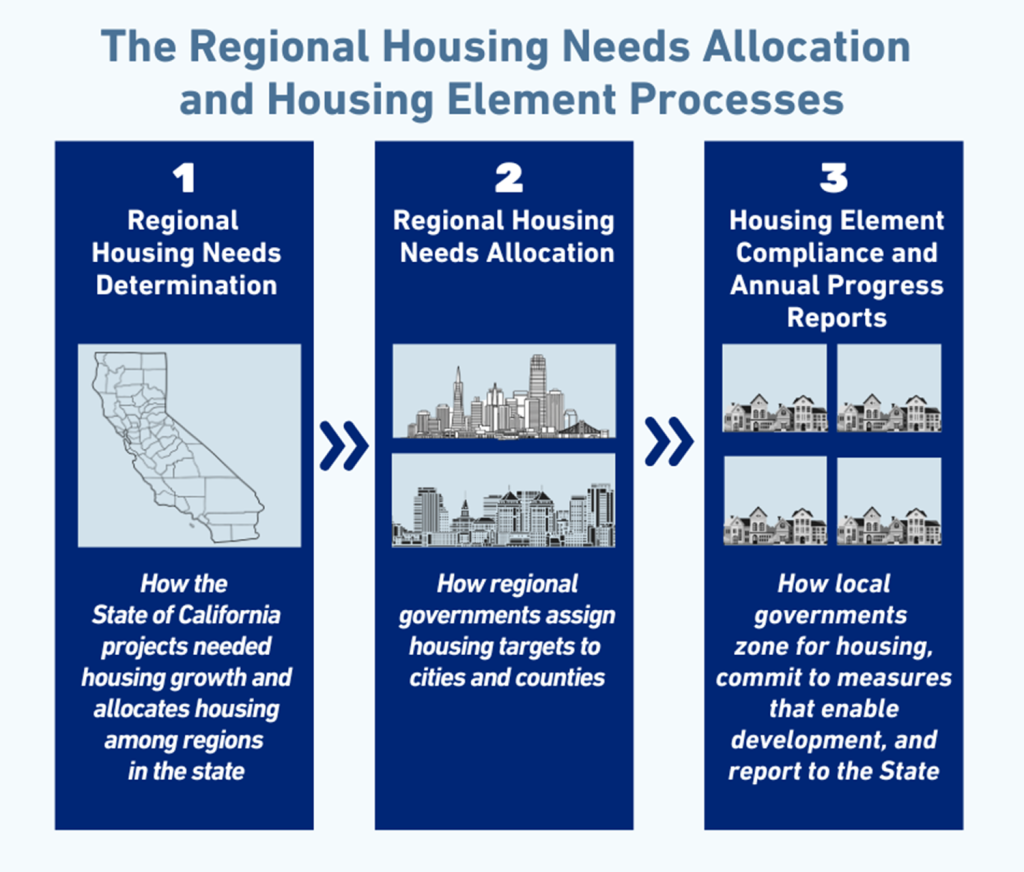
Cities are the focus of the state’s struggle to more dramatically reduce driving. Regional governments, the study finds, are sufficiently investing in housing production in cities and counties where residents drive less on average. But local governments aren’t paying the same attention to their car-light neighborhoods.
Subin theorizes that competing priorities and insufficient state support could both curb cities’ ability to plan more strategically. He notes that the study did not conclude a primary rationale for slowed local-level improvements, and that each municipality had its own unique struggles. However, he still sees clear opportunities for improvement.
“[Cities] can’t just do it on their own,” Subin stressed. “The state really needs to step up in terms of, not just guidance, but high quality data and technical assistance.” The study also recommends a prioritization of state-issued goals to help local governments stay on track.
California has long charted the nation’s path for climate action. To reach its ambitious carbon reduction goals, and to reduce other pollutants, traffic, and roadway fatalities, the state must continue to build. It won’t succeed, however, if cities can’t get with the program.

Read More:
Streetsblog has migrated to a new comment system. New commenters can register directly in the comments section of any article. Returning commenters: your previous comments and display name have been preserved, but you'll need to reclaim your account by clicking "Forgot your password?" on the sign-in form, entering your email, and following the verification link to set a new password — this is required because passwords could not be carried over during the migration. For questions, contact tips@streetsblog.org.