Talking Headways Podcast: What Does It Cost to Build a Bus?
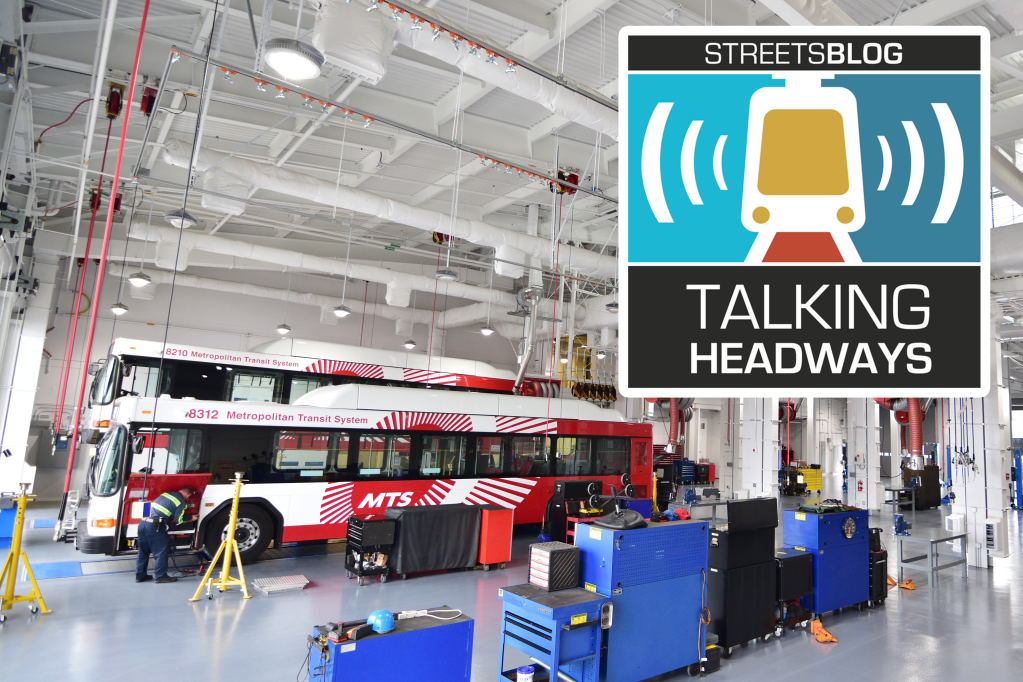
This week on the Talking Headways podcast, Lisa Jerram of APTA and Philip Plotch of the Eno Center for Transportation to talk about their new report, “Customization, Competition, and Costs: Findings and Recommendations for the U.S. Transit Bus Industry.”
Jerram and Plotch discuss what agencies want in a bus and why, the differences in European and U.S. bus markets and why customization standardization is hard to achieve.
Listen to the full episode using the audio player below, or by reading the unedited transcript, which may have some AI typos. Or check out an edited partial excerpt below.
Jeff Wood: So is that the main issue then, the costs of the bus? Is that kind of what brings everybody to the table? We’re spending so much more money than we think we should on these buses, and it’s going up over time because we’re losing manufacturers?
Is that kind of like a unifying principle, or is it just a whole bunch of things that kind of bring it together like that?
Philip Plotch: I would say those were important, but I think there’s also a concern about the existing manufacturers and the supply chain. During COVID, I think the word supply chain got … we all learned a little bit more about what that term means.
When, in the United States, the federal government pays for 80 percent of a transit agency’s bus, which means they have a lot of say in what kind of buses we can buy at the transit agencies. One of the biggest requirements is this Buy America requirement, which means that transit agencies can only buy buses that are made in the United States.
So they’re assembled in the United States, and then most of the components have to be purchased from United States companies that are actually made in the United States. And we were thinking a lot, and APTA’s been thinking a lot about this also, is how do you bring in more manufacturers, and how do you make sure that the existing manufacturers are strong?
And it’s not just the manufacturers we worry about, we also worry about the suppliers.
Philip Plotch: We worry about the manufacturers of seats and engines and air conditioning systems, and we want to make sure they’re strong. And one of the challenges we have in the United States is there’s about 16 million cars and SUVs that are made every year.
There’s only about 4,000 or 5,000 buses that are made every year. So it’s a relatively small market, and we want to make sure there’s good competition, but at the same time, we want to make sure that the manufacturers are strong because if a manufacturer goes out of business, they’re not gonna be there to support you, they’re not gonna be there to provide the parts, they’re not gonna be there to provide the training.
So we were thinking a lot about the manufacturing industry as a whole for buses. And I just want to say that Lisa was such a great resource on the advisory panel, as well as the other advisory panel members. Really helped us at Eno understand this. We went in not really understanding what was going on, why things were going on, and what could potentially work.
Jeff Wood: Can you compare 5,000 buses … I mean, 16 million cars, you can kind of understand that. But I mean, when you look at Europe or you look at China or you look at other countries who are making buses and building them and at a lower cost, like, how many buses are they making in Europe, or how many buses are they making in China as compared to that 5,000 number, as a kind of a comparison for folks to kind of wrap their heads around the idea of how many buses we are making or not making?
Philip Plotch: So in Europe, it’s about 40,000 buses. And it’s a little bit different in Europe because they tend to buy in bulk more. There’s more joint purchasing. There’s also more private operators in Europe. So if you are a private operator and you’re running service in six different European cities, you’re gonna buy buses for six different European cities.
So you’ll consolidate that purchase, and then you’ll have that ability to get not just more standard buses, but also more efficiency in the marketplace and be able to keep the price a little bit lower. Lisa, are you aware of outside of Europe, the bus market at all?
Lisa Jerram: You know, I don’t know the numbers actually on, for what it is.
Obviously China, the numbers are, are gonna be enormous. But I think that comparison with Europe really shows you the difference, though. You know, my impression is people are sometimes surprised ’cause, ’cause usually the US is a big market for anything, right? But in this particular product, if you will, it isn’t really a very big market.
I mean, and the other thing too is, you know, if we’re talking about the cost, I think Phil really answered it really well actually, which is we wanna make sure that the bus manufacturers that we have are, like, healthy businesses and that they can continue to supply our, you know, need for transit buses, and, you know, that we could encourage new companies to come into, uh, the market.
I think that’s always good to have that happen. You know, there are gonna be other things that affect cost differences between the US market and Europe besides the customization. Customization is one of the factors, but you have to think about again, the Buy America. We already talked about that. That obviously is just, it’s regulation that is going to be increasing the supply chain, increasing the prices.
We have a 12-year life requirement for buses, right, that are purchased with FTA funds, and I believe in Europe, I think the typical life of bus is maybe more like around eight years. That’s my understanding certainly, I think, for, like, the, the London buses, the TFL buses. It’s just a more expensive bus, I mean, just inherently.
Obviously something that lasts 12 years is gonna cost more than something that lasts eight years. Uh, there’s some ADA requirements that are a little bit different, so there’s a lot of different factors. I think it’s, you know, you wanna make sure you’re kind of comparing apples to apples when you’re talking about, like, what the differences are in the, the prices.
Philip Plotch: Yeah. Just to think about the size of the market, so not only is it about 4,500 buses a year, but then you, you sort of disaggregate it. So you have the 40-foot buses, and then you have the 60-foot articulated buses, right? So that means there’s even fewer buses of the same thing made. And then we have different propulsion types.
So traditionally it’s been a diesel bus, but there’s a lot of CNG buses out there. There’s hybrid electric buses, and there’s hydrogen fuel cell buses, and there’s also battery electric buses. That’s a lot of different kinds of buses that are coming out there. And in Europe, I think almost all the buses that are being produced now are battery electric, and European manufacturers, when they think about entering the United States, they don’t see that market as necessarily being stable and strong for battery electric buses.

Read More:
Streetsblog has migrated to a new comment system. New commenters can register directly in the comments section of any article. Returning commenters: your previous comments and display name have been preserved, but you'll need to reclaim your account by clicking "Forgot your password?" on the sign-in form, entering your email, and following the verification link to set a new password — this is required because passwords could not be carried over during the migration. For questions, contact tips@streetsblog.org.