Talking Headways Podcast: Carspreading
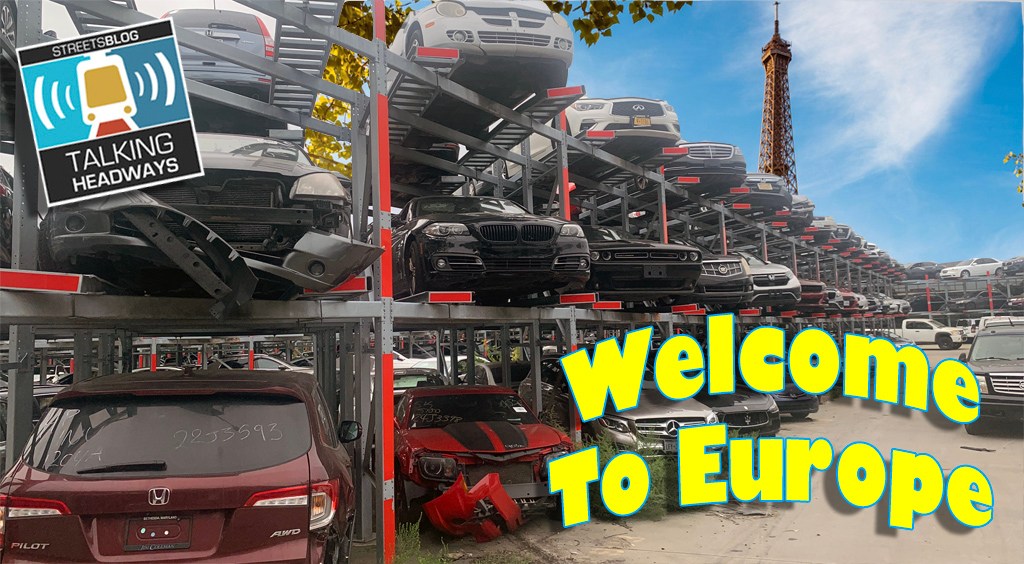
This week, we’re joined by Sofia Navas and James Nix of the NGO Transport & Environment to talk about their recent report, “Ever Bigger? Car Size at a Crossroads.” Why, why why are car sizes continuing to grow? It’s so clear that safety is directly linked to vehicle size — not to mention the toll big cars take on traffic and public space.
They literally bloat our lives, but you can find out more with the normal Talking Headways lineup:
- Read an excerpt of our exhilarating conversation below.
- Read the entire text (with some transcription typos) here.
- Put on some headphones and click “play” in the player below:
Here’s the excerpt:
Jeff Wood: We talk about “geometry” all the time when it comes to the space in cities — like how much space vehicles take up, how much space people as individuals, bikes take up, especially in terms of street design. But the fact that you guys came up with the numbers that show that larger cars mean less parking. Yes, we all want to move that direction where cities have less parking, but we don’t want it to be because the cars get bigger because that means there’s less space for every other use that you would want to have on a street, including bike lanes, public space, whatever else it might be.
Sofia Navas: Yeah, we basically looked at the parking situation in Berlin as one example city. Right now, the width, the bonnet [hood] height and length has been increasing over the past 25 years at a steady rate across Europe.
And so we extrapolated this trend to 2040 and asked what happens with our public space in the scenario where we just continue with this linear trend in all of these dimensions? We found that compared to the parking situation today, European cities are set to lose 8.5 to 14 percent of car parking space.
City planners are constantly fighting if they want to, as Paris, make a city more livable with planting more greenery or making just more space for pedestrians and the people that live in the city. It’s always a huge fight.
But then if we look at the loss of public space that we’re currently seeing, the car fleet is quietly eating our public space away. Decisions about our public space are not being made at City Hall, but in car showrooms around the world. We believe should stop this by going back to dimensions that we call reasonable, and this is our right-sizing scenario which we advocate for.
James Nix: It’s not really discussed, but this is probably one of the greatest privatizations of public space that we’ve ever seen. And just because it’s incremental, that doesn’t mean it’s inconsequential.
Each new year is 1.2 centimeters longer than the previous year. And again, the average width also increasing, and that’s increasing by half a centimeter, so each new year of sales is on average half a centimeter wider than the previous year of sales.
Other times, the next generation model is six or seven centimeters wider than the previous generation.
I just wanted to emphasize the privatization-of-public-space point because we would never allow, you know, millions of football pitches that we never talk about.