Talking Headways Podcast: Architecture’s Role in Population Decline
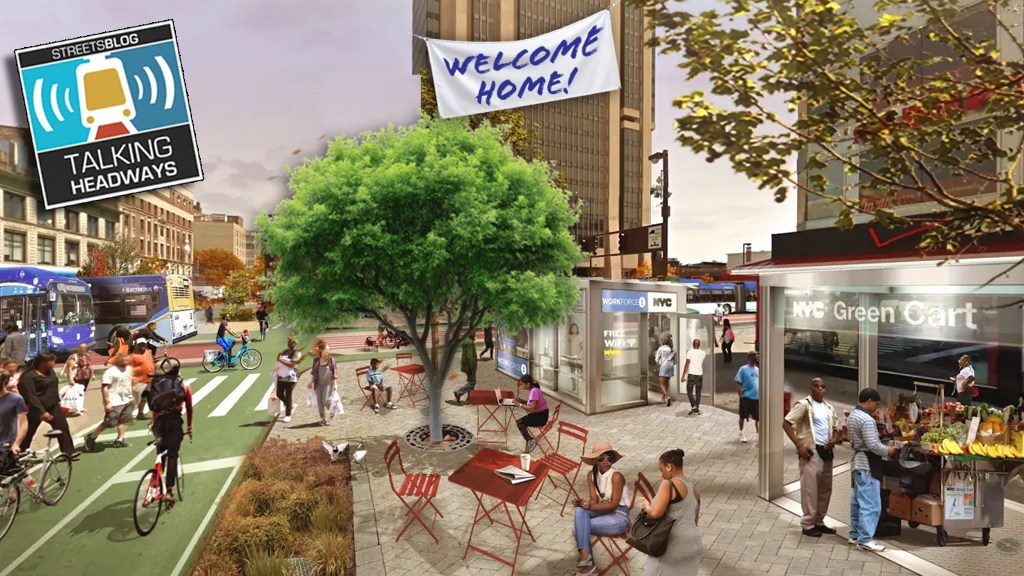
This week, we’re joined by Blaine Brownell, the director of UNC Charlotte’s School of Architecture to talk about the role architecture plays in population decline, the need for permeability in walkable neighborhoods, and a revolution in building materials.
Here’s how we work it at Talking Headways:
- You can read the full transcript, but you’ll have to bear with some of Intern Claude’s typos, by clicking here.
- You could scroll below the audio player for an excerpt of our riving conversation.
- Or you could just hit play on the player below.
Here’s the edited section:
Jeff Wood: I’ve seen a number of your pieces in Architect Magazine that talk about subjects that not a lot of people want to touch. First, I wonder how architects respond to your prodding in those articles, like population collapse. I feel like the pronatalism has gotten kinda weird in some circles. But you have what I think is a really smart take on it, which is that if people want to have families, we need to address that paradox of quality-of-life improvements versus slow population growth, and kind of the, the mix and match between that.
It’s really an interesting topic to cover because it gets kinda weird when people try to push it from certain political angles. But from a built environment angle, there are very clear ways of addressing it or figuring out what needs to happen in order to change the trajectory.
Blaine Brownell: Yeah, that’s well said. I felt compelled to draw attention to the inherent contradiction in creating better designed places, that inherently become more desirable and less-economically accessible. I’ve been thinking about how in different arenas that have to do with design and lived experience, there are these analogies that kind of revolve around, like, tripartite interdependent qualities. That’s a very convoluted way of saying, for example, for building construction, a common phrase would be, “Good, fast, cheap — you can pick two.”
You’re not going to get all three. If you want good quality and fast, then it’s going to be expensive, right? That kind of thing. Similarly, in a very different arena, in a restaurant people talk about how you can have, “Price, quality, and atmosphere or something — pick two.”
You can’t have all three. And of course this is a super generalization, right? But in the built environment in terms of where people live, we could kind of distill it to a model like this and say, “It’s the cost, it’s the amount of space, and it’s the quality.”
So the quality in this case would be quality of design, but it’s also quality of the experience. It’s walkability score. You know, it’s the number and diversity of different types of services that you have access to, and opportunities, right?
So quality gets a lot of things lumped together. But this is inherently what individuals or families are faced with whether or not they’re explicitly thinking about these three as levers, as soon as they move one, the other two adjust, right? When they’re thinking about moving somewhere or buying a house somewhere, it’s implicit thinking.
It seems almost strange to say it out loud because it’s so obvious to us. But we bring a lot of assumptions that are very well-informed, such as, “Well, if we want to be closer to that exciting area, we’re going to have to sacrifice space and affordability, right?”
But the point, I think, related to the neo-natalism and concern about population decline is that those two factors, having adequate space and affordability, weigh so heavily into people’s decisions.
It affects them subconsciously as much as consciously about having children. What intrigues me with cities today is that disconnect of these three levers has become so exaggerated — where even for a low- to moderate quality, you’re going to have to pay a lot and you won’t have much space.
And it’s come to the point where my own kids, they’re in their 20s now, they just… And I think that generation generally seems to have the mindset like, “Oh, we’ll never be able to afford a house.” And I, I hate to be a downer here, but, I mean, this is serious.
So what do designers do?
They think, “Well, okay. We’ll have these micro units, because then we can shift the affordability lever and maintain the quality,” but you sacrifice a ton of space. And so I’m not against micro units at all. But it’s important to factor that into this larger question about people having kids.
And why wouldn’t you want to be in a culturally vibrant place with a high walkability score and great access to all these things and many different forms of transit while also having a lot of space and a big garden and quiet? I’ve even heard people joke about this, like, “I want all of these things.”
Well, you can’t. So this is a big question for design, and I, what I would like to see with design and planning is maybe a more kind of explicit look at, at these factors and their interdependencies, and how can we not just jump to something like micro units as the solution, which it might be for many, and probably should be, but, you know, take into account these other parameters and factors.

Read More:
Streetsblog has migrated to a new comment system. New commenters can register directly in the comments section of any article. Returning commenters: your previous comments and display name have been preserved, but you'll need to reclaim your account by clicking "Forgot your password?" on the sign-in form, entering your email, and following the verification link to set a new password — this is required because passwords could not be carried over during the migration. For questions, contact tips@streetsblog.org.