How to Use the ‘Emergency Streets’ Strategy to Move From ‘Crash Response’ to System Change
When a fatal crash occurs, we tend to focus immediately on the individual: What was the driver doing? What did the cyclist or pedestrian do? Who made the mistake?
Emergency Streets aims to shift that framing. A fatal crash is also a failure of the surface transport system. And often it is a failure that, at some level, was predictable. For aviation or rail sectors, thorough review protocol are enacted upon to reveal systemic failures. Why not for streets?
Those of us who study streets know that certain priorities have become deeply embedded in transport planning in the United States. Speed and vehicle movement are institutionalized through turning radii, lane widths, multiple travel lanes, sight distances, signal timing, slip lanes, pedestrian crossing times, and measures such as automobile Level of Service.
No single one of these practices created our safety problem. Collectively, however, they have shaped the system we have today—and what we expect.
The problem is that when the system fails, our normal response is often to clean up the crash, restore the street, investigate what happened, perhaps conduct a traffic study — and eventually, return the system to normal. But what if the crash itself became a reason not to return immediately to normal?
That question led us to develop Emergency Streets. The idea is straightforward: following a fatal crash, temporarily change the street in ways that meaningfully reduce kinetic energy. Make the intervention visible. Explain to the community why it is happening. Use the event not only to respond to one crash, but to ask what the crash reveals about the larger surface transport system. And, how to prevent such crashes in the future — including how money flows and how future practices are prioritized.
The underlying proposition is that we already know a great deal. We know the relationship between speed and crash severity. We know that accessibility, particularly local accessibility, does not necessarily require maximizing vehicle speed. And we increasingly have new ways to provide access, from e-bikes and smaller mobility devices to changing patterns of connectivity and travel.
So the question becomes: Can a fatal crash become a catalyst for doing something differently?
Spokane: The Real-World Test
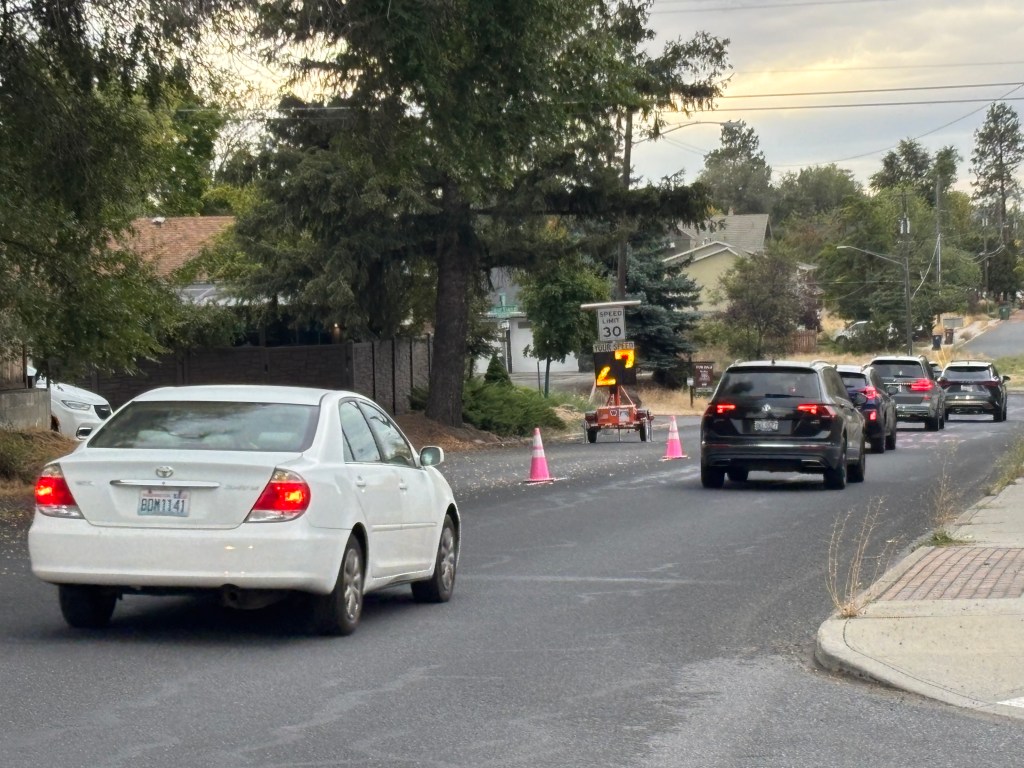
That idea has now moved from a theoretical idea, to an academic proposition, to a municipal practice. Spokane, Washington, has adopted an Emergency Streets pilot protocol and recently deployed its first intervention following a fatal motorcycle crash.
The significance isn’t simply the cones or temporary street treatment. Spokane has created an institutional response: following a qualifying crash, the city must develop and implement a temporary traffic-management plan. That means the crash triggers action, rather than simply analysis.
The intervention is deliberately temporary because part of its purpose is learning. It is temporary to shortcut/circumvent traffic engineers’ long habits to over-engineer and study stuff, to provide decision-makers cover from public pressure for making uncomfortable changes to the street, to use swift timing to tie the error with the correction, to allow drivers to practice more careful driving for a non-trivial but non-disruptive period of time, etc.
At the end of the treatment period, the city must decide what happens next: extend the intervention, return the street to its previous condition, or meaningfully move toward a more longer-lasting change.
That creates an unusual opportunity. Emergency Streets isn’t simply a traffic-calming intervention. It’s intended to become a way of asking whether a disruption to normal practice can change the trajectory of future transportation decision-making.
So what should we measure, and how? There are at least three dimensions.
First, physical and behavioral change, largely tied to kinetic energy. Did speeds decline? Was hard-braking reduced? Did vehicle behavior change around the intervention? Did the kinetic energy around the crash site lessen? These are relatively tangible questions and can be measured using speed observations, GIS and mobility data (including vehicle characteristics), and other behavioral indicators.
Second, institutional change. Did professional understandings change? Did organizational routines change? Did departments begin working together differently? Did the intervention influence subsequent funding, design standards, or decisions about how accessibility should be provided?
An institutional trace is evidence that something generated through Emergency Streets persists beyond the physical removal of the temporary intervention. This trace may not be immediate or tangible. It might be visible in changed professional understandings; altered organizational routines; new relationships between departments or agencies; different expectations about how fatal crashes should be treated; changes to approval, design or decision-making processes; the use of evidence generated during deployments; subsequent temporary interventions; proposed capital works; allocation of funding; or permanent physical changes to the street.
The institutional part of the evaluation therefore distinguishes between temporary effects and institutional consequences, without assuming that institutional change must result in permanent infrastructure at the crash site. Rather than simply asking “does Emergency Streets reduce vehicle speeds?”, this study asks whether temporarily refusing to restore a fatal-crash site immediately to “normal” can interrupt the routines, assumptions and institutional relationships through which unsafe street conditions are reproduced.
More specifically, a thorough evaluation can reveal:
- What, institutionally, is different from when the trial began?
- How did Emergency Streets contribute to those changes?
- What mechanisms appear to have enabled change?
- What institutional structures or countervailing mechanisms constrained or prevented change?
- What disappeared when the cones disappeared, and what remained?
A null or uneven outcome can reveal organizational, legal, procedural or resource barriers that prevent rapid-response approaches from influencing longer-term infrastructure decisions. The broader theoretical contribution is to understand whether deliberately disrupting the normal institutional response to road death can create conditions for institutional change.
Third, public expectations. Did people begin thinking differently about what a street is for, what constitutes an acceptable level of risk, or what should happen after someone is killed? Did the intervention create public discussion about what could be done differently to provide for accessibility?
And that leads to the larger research question: To what extent can Emergency Streets empower municipalities to adopt meaningfully different transportation-planning practices?
The cones eventually disappear. The more important question is what remains after they are gone.
If professional practices, institutional relationships, public expectations, investment decisions, or street designs begin to change, then Emergency Streets has accomplished something much larger than temporarily slowing traffic at one location. It has used a specific failure as an opportunity for the system to learn from itself — and change.

Read More:
Streetsblog has migrated to a new comment system. New commenters can register directly in the comments section of any article. Returning commenters: your previous comments and display name have been preserved, but you'll need to reclaim your account by clicking "Forgot your password?" on the sign-in form, entering your email, and following the verification link to set a new password — this is required because passwords could not be carried over during the migration. For questions, contact tips@streetsblog.org.