Advocates Get D.C. Mayor To Release Buried Report On The Potential Benefits Of Congestion Pricing
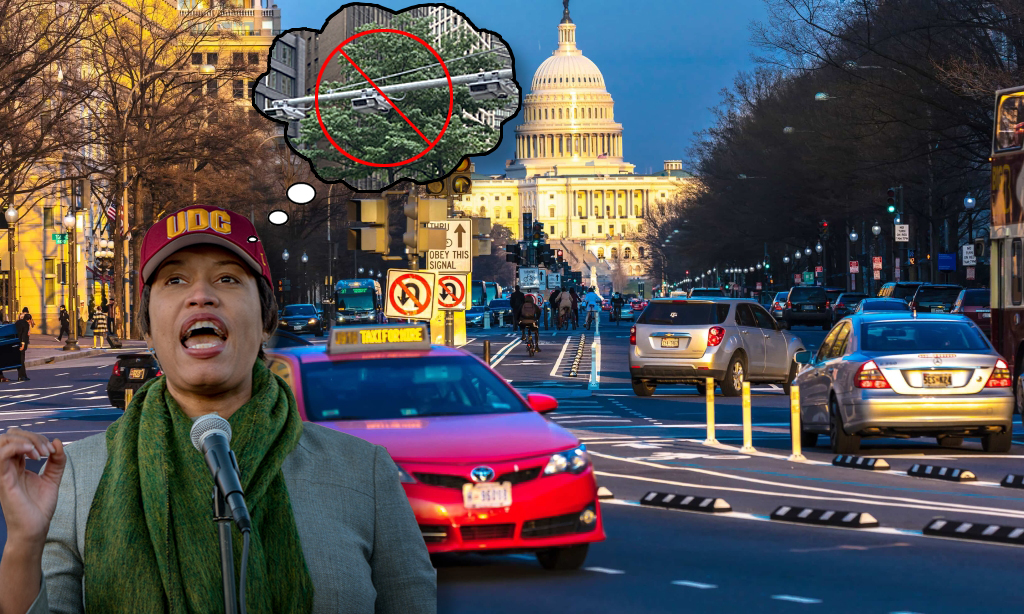
The release of a long-buried report on how congestion pricing could benefit the nation’s capital raises disturbing questions about the local government’s refusal to even start a conversation about implementing the game-changing policy — and what it will take for other cities across America to move even closer to that finish line.
Earlier this month, Mayor Muriel Bowser finally made public a Council-mandated analysis of the potential impacts of charging drivers to enter the most-congested roadways in the transit-rich city, almost five years after that report was first submitted to her office in July 2021 and long after she was required by law to release it.
The report was based on pre-pandemic data, but advocates were still stunned by the results of the proposed pricing models:
- an 11-percent reduction in vehicle traffic
- a 30-percent increase in transit trips
- up to $667 million in gross revenue that could be allocated towards transit, biking, and walking improvements, particularly in the region’s most transportation-burdened areas. Businesses were also projected to experience a boost.
And there’s a benefit to drivers, too. The toll would reduce so much traffic that motorists who were willing to pay the toll would gain back as much 24 hours every year in the form of faster travel times — without sacrificing the mobility of those who weren’t, since D.C. has one of the most robust transit networks in the country.
In a letter, Bowser said she had released the report of her own accord — which is debatable, considering that a lawsuit from nonprofit Greater Greater Washington would have forced her to do it in just a few weeks — and that she did not accept its results, urging the District Council to “move on to more serious conversations about how we can strengthen, not weaken, the District’s downtown core.”
Bowser explicitly noted that D.C. is “not Midtown Manhattan,” citing the nation’s first congestion pricing program which by many accounts has been wildly successful at cutting congestion and funding transit (with side benefits of economic development and street safety) since it kicked off in January 2025. She also dismissed the study’s “deeply flawed methodological assumptions” about the volume of daily commuters, shoppers, and teleworkers in her community, all of which she says have changed since the dawn of Covid-19.
“It’s the wrong policy at the wrong time,” she added.
Proponents of congestion pricing, though, say that the pandemic alone is not reason to discount the immense potential of a policy that’s worked in cities worldwide — never mind refuse to release a report that doesn’t even make any concrete recommendations for how D.C. could implement it. And they say Bowser’s unwillingness to even start the conversation is deeply troubling.
“There is no such thing as a silver bullet when it comes to public policy, but this is about as close as you can get,” said Chelsea Allinger, executive director of Greater Greater Washington. “Pick an issue — travel times, transit service and ridership, economic impact, public health, air quality, safety for pedestrians, environmental benefits — it’s one policy change that can have profound impacts across [all of them]. This analysis confirms what’s so compelling about congestion pricing in other cities around the world: it just makes cities more livable and improves quality of life along a whole bunch of different dimensions.”
Allinger says that the primary reason why D.C.’s congestion pricing report is so badly out of date is because Bowser herself buried it, undermining what could have been a powerful catalyst for dialogue about how D.C. could use the forward-thinking policy to heal from the impacts of the pandemic and generations of harmful auto-centric policies — not to mention the Trump administration increasingly testing the limits of its ability to interfere in District governance.
And it could still be that catalyst, if the mayor or her successor has the courage to recognize that there is never an ideal moment to fight for change — and that change is already long overdue.
“We are a long ways away from having a specific recommendation on the table, let alone implementing it, and we don’t know what the political context is going to look like when that day does come,” she added. “So in the meantime, I don’t think we should let the uncertainty of this current moment scare us away from even talking about important policies — or even DC’s particular vulnerability when it comes to the federal government’s ability to meddle in our affairs.”
Even if Bowser saw the light about congestion pricing, it would still take years for the policy to wind its way through a maze of legal approvals, follow-up studies, and procurement processes — and that’s assuming that future local and federal administrations don’t try to stamp it out.
“Regardless of who’s in power at any given moment, the United States in general has been built around private automobile ownership,” Allinger added. “So it’s always a challenge anytime we are talking about a policy change that might be interpreted as threatening that way of life — even when, as in the case of congestion pricing, we know that the policy makes it easier for drivers to get around, too.”
Still, if shining daylight on reports like this can help get the word out to residents that this policy could potentially make their lives better, Allinger hopes that D.C. and every city like it can move the needle forward. Chicago, San Francisco, and Boston are just a few of the major cities that have at least discussed charging drivers to enter badly congested, high-transit areas — and if they need more proof of what that looks like on the ground, they can just look to New York.
“Now it no longer feels abstract,” she added. “We only have to look a few hours north of us to see how this can function in practice. There are a lot of challenging political headwinds right now, but I also think there are reasons to be hopeful, [and] to have robust public dialogue about what this could look like.”

Read More:
Streetsblog has migrated to a new comment system. New commenters can register directly in the comments section of any article. Returning commenters: your previous comments and display name have been preserved, but you'll need to reclaim your account by clicking "Forgot your password?" on the sign-in form, entering your email, and following the verification link to set a new password — this is required because passwords could not be carried over during the migration. For questions, contact tips@streetsblog.org.