Three Theories About Why U.S. Car Crash Deaths Are Plummeting

America may have recorded its largest one-year drop in traffic deaths in decades, according to a top safety organization — but what drove the trend, and how can the country protect even more of its residents?
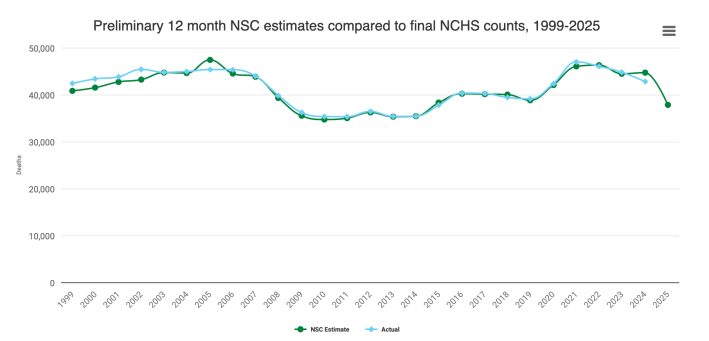
The National Safety Council recently estimated that U.S. traffic deaths plummeted by nearly 5,000 between 2024 and 2025 — a 12-percent drop, and the largest single-year decline since at least 1999.
That estimate still means that 37,810 people lost their lives in car crashes last year — a horrifying number, but the lowest one published by NSC since 2019. Their data did not distinguish between deaths of drivers and deaths of pedestrian and cyclists, but if non-driver deaths follow the same trend of the last two years, they will likely fall as well — albeit nowhere near zero, which is the only acceptable number.
Now: these stats come with some serious asterisks.
NSC isn’t an official government agency, even though some advocates regard its fatality estimates as more reflective of the true horror of America’s roadway crisis when compared to the estimates published by the National Highway Traffic Safety Administration.
That’s because NHTSA currently excludes both crash fatalities that occur on places like parking lots, driveways, and private roads, as well as crash-related fatalities that occur more than single month after the collision itself. NSC, by contrast, counts a death as a car-crash fatality if the victim succumbs to their injuries at any point in the following year.
Moreover, NSC bases its estimate on official death certificates compiled by the National Center of Health Statistics. However, that data takes a while to clean up, and last year its initial estimate deviated 4.4 percent from the final tally — the largest discrepancy since 2002.
Still, if NSC is right that deaths are trending sharply downward, that raises the question of why — and what it will take to keep bending the curve. Here are a few theories.
1. Biden-era safety bets are paying off?
Passed under President Biden, the Infrastructure Investment and Jobs Act of 2021 provided a historic amount of funding for street safety projects — and highway projects that could counteract those achievements. Still, NSC says it’s possible that all that new federal money for people-centered infrastructure is starting to pay safety dividends.
Under the Safe Streets and Roads For All program, for instance, the Biden administration successfully awarded approximately $1 billion every year after the bill passed. That was enough, in the first year alone, to fund the development of new street safety plans in 473 communities that are collectively home to more than half of the U.S. population.
Of course, the Trump administration then clawed back, froze, or deliberately slow-walked the obligation of those funds until the Congressional clock to spend the money ran out, particularly when it came to grants that would actually implement life-saving projects. However, some money did make it out the door — particularly those early planning grants that didn’t require years of time-consuming paperwork to execute.
If those plans identified locally-funded projects that could save lives, communities almost certainly built some of them on their own — and a few years down the road, America is probably just starting to reap the benefits. With the federal government erasing Complete Streets research and resources from the national books, though, communities will need to prove and proudly showcase the positive impact of their human-centered safety infrastructure — and advocates must make the case for more of it, whether it’s federally funded or not.
2. U.S. traffic has finally rebounded from Covid — and then some?
Traffic deaths skyrocketed when America went into quarantine in the early days of the pandemic — and so did speculation that empty roads provided drivers more room to hit deadly speeds.
Some later studies validated that hypothesis, while others only partially affirmed or even complicated it, pointing the finger at a rise in “aberrant driving behaviors” like driving under the influence of alcohol, not using a seatbelt, and speeding at late-night hours when few people were on the road even before the virus trapped millions of commuters in their homes. But it was unclear whether deaths would continue to decline after congestion levels rebounded even further — and those levels did rebound in 2025, in a big way.
The most recent edition of Texas A&M’s annual Urban Mobility Report found that traffic jams reached record levels in 2024, with the average American spending a whopping 63 hours per year stuck in a line of other motorists — even after decades of fruitless attempts to eliminate congestion by widening highways. That traffic is “spread out over more of the day, and thus it’s not just a commuter issue,” researcher David Schrank told National Public Radio in December. And that trend likely continued into 2025.
If more U.S. motorists are sitting in traffic jams at all hours of the day and night, that could potentially explain why fewer of them are hitting the kind of dangerous speeds that are most likely to kill people, especially if fewer Americans dare to walk or bike. But until we get more research like the results of the 2025 National Household Travel Survey — and an update to its disturbingly flawed methodology — that will be hard to prove.
3. More (or less) police enforcement?
Fun fact: Because there is no comprehensive national database that tracks the number of traffic stops U.S. police make in a given year, it is impossible to study the relationship between traffic stops and traffic violence, at least in any comprehensive and national way.
What is tracked, though, is the number of people who are killed by police in routine traffic stops — a number that reached 124 in 2024. That statistic led the American Civil Liberties Union to declare police traffic stops in general “dangerous and ineffective,” and to call for the total abolition of pretextual stops for low-level offenses altogether.
Still, more than a few local journalists have wondered whether their local community’s particular traffic strategy is bringing crashes down. Communities across the country have experimented with more frequent traffic stops, ubiquitous cameras, and scaling down the role of police in transportation spaces altogether.
For example: Austin doubled the number of speeding tickets its officers issued between 2024 and 2025, which coincided with a significant 23-percent drop in pedestrian fatalities — but a slight increase in crash fatalities overall.
Chicago, by contrast, counted its lowest number of road deaths in a decade in 2025 after recording fewer traffic stops the year prior. But more of those 2024 stops ended in violence or in a disproportionate numbers of tickets for Black and brown motorists — and a lot of them weren’t recorded at all. The Windy City’s 2025 traffic stop totals, meanwhile, haven’t even been counted yet, and there’s a decent chance that your city’s haven’t been, either.
All of which is to say: it’s complicated! That’s why it’s important not to jump to conclusions about what drove deaths down in 2025 until researchers have a chance to prove solid, causal relationships. It’s equally important to think holistically about all the harms that might be caused by safety solutions — particularly if they involve armed law enforcement.

Read More:
Streetsblog has migrated to a new comment system. New commenters can register directly in the comments section of any article. Returning commenters: your previous comments and display name have been preserved, but you'll need to reclaim your account by clicking "Forgot your password?" on the sign-in form, entering your email, and following the verification link to set a new password — this is required because passwords could not be carried over during the migration. For questions, contact tips@streetsblog.org.