This Bill Would Give Your Community More Money To Build Its Own Transportation Future
A new bill would finally restore basic fairness to federal transportation law by giving metro regions the money they deserve to build the transportation networks they need — rather than letting state DOTs monopolize those funds to build endless highways.
The bipartisan Bridges And Safety Infrastructure for Community Success Act Introduced today by Reps. Rob Bresnahan (R–Penn.) and Kristen McDonald-Rivet (D–Mich.) would make a slew of bold changes to federal transportation formula funding, ensuring that metro areas get back more of the money they disproportionately pour into our national coffers — and that human-centered infrastructure projects stop sitting on the shelf and start getting into the ground where they can actually save lives.
That bill is nicknamed the BASICS act, in what might be seem like a contrast to House Transportation Chairman and Missouri Republican Sam Graves’s infamous suggestion that the next transportation bill needs to “get back to basics” like building highways rather than bike lanes, sidewalks, and transit. And experts say the legislation would almost certainly translate to more money for those kinds of active and shared transportation initiatives, which local residents continuously demand but from which states often divert funding to add more lanes for drivers with little public accountability.
Proponents of the bill say, though, argue that those types of locally-owned infrastructure are the foundation of a functioning community – and it’s time to make them a priority.
“We named it the BASICS Act because there is nothing more basic, nothing more fundamental to our communities, than local roads and bridges,” said Matthew Chase, Executive Director of the National Association of Counties. “These are the foundations that connect our neighborhoods, support our local economies and serve our residents every single day. We wanted to get back to the basics of what transportation infrastructure should prioritize — the local infrastructure that people depend on most.”
In many ways, the BASICS Act is about fairness, too.
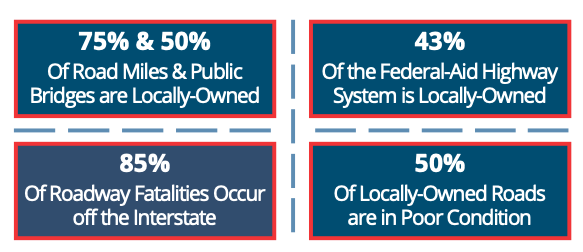
Proponents say the legislation would help fix gaping loopholes that allocate 16 percent of federal transportation funds to regional and local governments, despite the fact that they own a whopping 75 percent of the nation’s roads and generate a disproportionate share of total gas taxes and other transportation funds.
As a result of that gulf, the Local Officials in Transportation Coalition say that locally owned roads and bridges are twice as likely to be rated in poor condition — and they’re also home to a disproportionate share of roadway fatalities, which are difficult to reduce without money for lifesaving infrastructure. And in the meantime, metropolitan planning organization are sitting on long lists of transportation safety projects that they can’t actually build.
“Local and regional governments are on the front lines of America’s transportation challenges, but too often lack direct access to the federal funding needed to deliver solutions,” said Bill Keyrouze, executive director of the Association of Metropolitan Planning Organizations. “We thank the sponsors for introducing the BASICS Act, which realigns federal programs with on-the-ground reality and gives regions the tools to fix the roads, bridges, and safety challenges people experience every day.”
How it works
In some ways, the BASICS Act takes a backdoor route to create the kind of “regional transportation block grant” program that transportation advocates say could hold the key to unleashing more shared and active transportation projects across America — without raising flags with politicians who have made those projects the target of culture wars, or state DOTs who are hesitant to give up control over the vast majority of federal transportation dollars.
That tightrope act would be accomplished, first, by simply moving existing funding from the National Highway Performance Program — an inflexible formula grant program that guaranteed states between $24 and $30 billion to build highways every year since 2021 — and into the far more flexible Surface Transportation Block Grant Program and the Highway Safety Improvement Program.
That might sound like a big shift, but advocates behind the bill point out that states tend to transfer more than 10 percent of their NHPP funds to more-flexible programs anyway.
Critically, though, the BASICS Act would make it harder for states to transfer money out of good programs that could build safe, human-centered infrastructure to use that money to build highways instead — something that a disturbing number of them routinely do. And it would also rework those good programs themselves to make sure that once the money is in those accounts, local and regional transportation networks get a real say in how it’s spent.
The Strengthening Bridges Formula Program, for instance, would be retooled under the bill to require states to set aside 25 percent to distribute to local and regional communities based on their population. That would essentially create a formula program within a formula program, that would guarantee cities more of the money they need to fix their crumbling bridges — and add things like bike and bus lanes to them when they do, without state interference.
The Highway Safety Improvement Program, meanwhile, would also have one-quarter of its money set aside for the little guys — but because the entire program would get an infusion from highway funds under the same bill, state DOTs would still have plenty left over to save lives on interstates, too.
The BASICS Act would also require the federal government to waive local matching requirements on federal funds to plan new projects from start to finish, an expensive process that communities legally have to undergo before they can tap federal construction dollars. It even “directs the Secretary to establish a voluntary pathway for MPOs to become direct recipients of planning funds, promoting administrative efficiency, reducing pass-through delays, and supporting more streamlined project development,” the Coalition wrote.
Rural communities would get a better deal out of the bill, too, even though many of them aren’t currently represented by the kind of metropolitan planning organizations that would receive those formula-within-a-formula funds. That’s because the BASICS act would create the first-ever “dedicated rural and non-metropolitan planning program,” and guarantee that each receive a minimum of $300,000 a year with no local matching requirements.
Of course, the BASICS act wouldn’t require local and regional governments to build human-centered infrastructure at all — nor would it prevent communities from ever building another highway lane, even if experts agree that autocentric infrastructure is already wildly overbuilt. Still, if America can restore the fundamental principle that cities, towns and regions deserve to decide what their transportation networks look like, chances are they won’t choose to bulldoze highways through their own neighborhoods.
The Local Officials in Transportation Coalition is offering a toolkit of ways to support the BASICS Act here.
This story has been updated with additional context and comment from the National Association of Counties.

Read More:
Streetsblog has migrated to a new comment system. New commenters can register directly in the comments section of any article. Returning commenters: your previous comments and display name have been preserved, but you'll need to reclaim your account by clicking "Forgot your password?" on the sign-in form, entering your email, and following the verification link to set a new password — this is required because passwords could not be carried over during the migration. For questions, contact tips@streetsblog.org.