City Officials Seek To Mold the Future of Driverless Cars
Urban transportation experts are trying to get ahead of the introduction of driverless cars — knowing that, if don’t do so, they run the risk of ceding policymaking to automobile engineers and executives.
Toward that end, they’re turning the coming of autonomous vehicles into an occasion to correct many 20th-century planning mistakes: “putting people at the center of urban life and street design, while taking advantage of new technologies in order to reduce carbon emissions, decrease traffic fatalities, and increase economic opportunities,” according to a new manual from the National Association of City Transportation Officials.
“We realized autonomous vehicles are a really good opportunity for cities to reset some of the negative planning decisions we’ve made in the past,” NACTO spokesman Alex Engel told Streetsblog from the group’s annual conference in Toronto. “If you make the street design changes now, you’re ensuring that AV technology adapts to streets that we have and want to have — as opposed to adapting our streets to the technology.”
The 81-city coalition this week released a Blueprint for Autonomous Urbanism, which builds on a prior report by offering policies on transit, congestion pricing, transportation data, shipping, and safety that prioritize people over vehicles.
“In the face of uncertainty, cities must leverage all their tools to reshape their streets now in ways that prioritize people and high-efficiency transit,” the 132-page blueprint said. “Physically changing streets today to reduce speeds, encourage bus ridership, walking, and cycling, and create a more welcoming urban realm will increase the likelihood that AVs will be developed as a force for good.”
Those key policy recommendations include:
- Improving transit service and redesign bus and rail networks, especially along high-traffic corridors, in order to accommodate growth without congestion.
- Incorporating autonomous-vehicle technology to pilot trains and buses and handle fare collection for more efficient transit.
- Developing congestion-pricing plans — either to enter specific city zones, park or idle at a curb, use a ride-hail service, or drive through a tolled highway — directing the revenue for transit, walking and biking.
- Cataloguing AV data for use in updating street infrastructure and communicating changes to road use and traffic, while protecting user privacy.
- Regulating the freight industry to downsize its vehicles for city streets, encourage off-peak delivery and coordinating package and mail delivery based on destination, not the carrier.
Perhaps most important, the blueprint emphasizes redesigning streets with pedestrians and cyclists in mind, by lowering speeds, putting roads on “diets,” widening intersections, and adding plazas — all of which would force vehicles with or without drivers to respect other modes of travel.
That stands in contrast to some wacky ideas floated by automobile executives and driver-friendly designers, such as sidewalk gates that pen in pedestrians at crossings and barcode jackets that cyclists can wear that autonomous cars would detect and avoid.
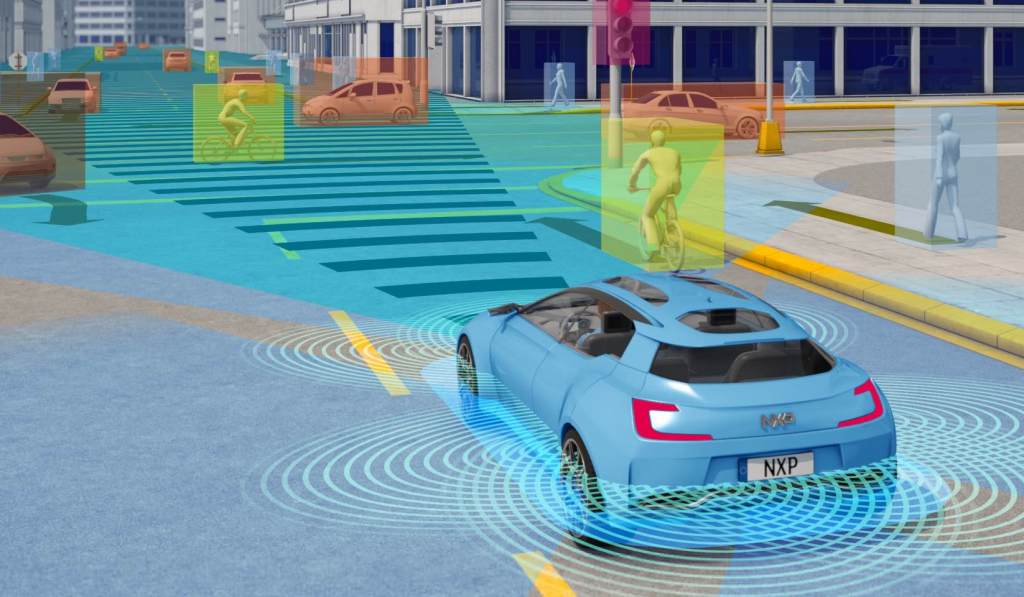
But if autonomous vehicle technologies can’t be made to see people and objects of all shapes and sizes in any kind of weather, then they cannot safely operate on the road, the report asserted.
“Those cars have to be able to identify a kid running down a street to collect a ball hit onto the street,” Engel said. “The technology is not ready if they have to rely on someone else wearing a device. They have to detect pedestrians and not require that they be connected to them.”
It may be more than a decade before autonomous vehicles find their way to city streets. Yet that hasn’t stopped the automobile and tech industries from lobbying states to launch pilot programs for testing on public roads and hiring federal safety officials to lobby Congress to expand exemptions from federal safety standards.
Transportation experts think that their proposals for better street design and land use will ensure a safer, more people-focused future for urban areas — regardless of when driverless cars enter city corridors.
“Simple, physical changes to street geometry can have huge impacts on safety and how people choose to travel,” the blueprint said. “By redesigning their streets, cities and people will shape technology policy for decades to come.”

Read More:
Streetsblog has migrated to a new comment system. New commenters can register directly in the comments section of any article. Returning commenters: your previous comments and display name have been preserved, but you'll need to reclaim your account by clicking "Forgot your password?" on the sign-in form, entering your email, and following the verification link to set a new password — this is required because passwords could not be carried over during the migration. For questions, contact tips@streetsblog.org.