Talking Headways Podcast: Architecture Won’t Save a Bad Street
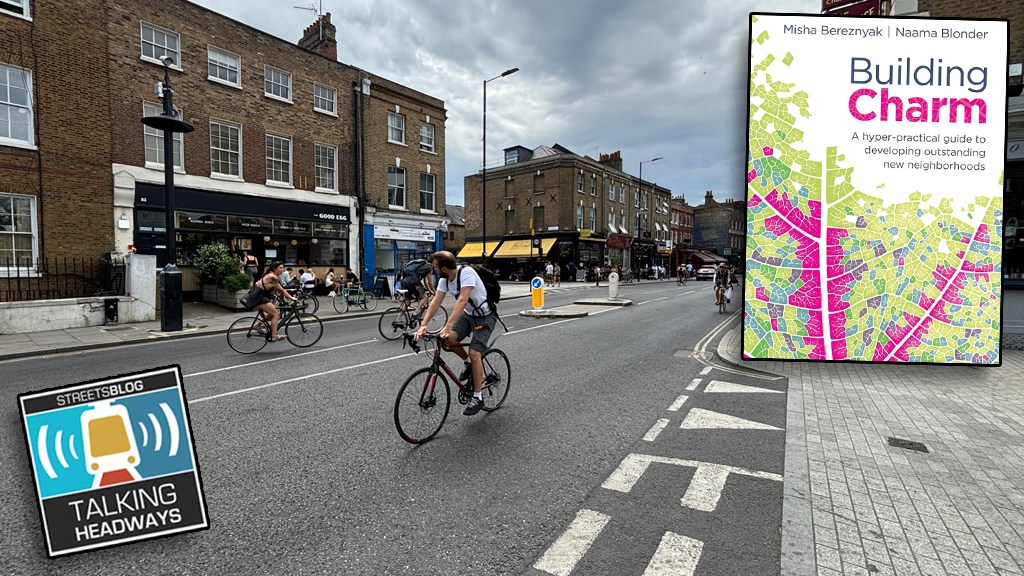
This week on the Talking Headways podcast, we’re joined by Naama Blonder to talk about the book she wrote (with Misha Bereznyak), “Building Charm: A Hyper Practical Guide to Developing Outstanding New Neighborhoods.” We chat about the book’s focus on human scale and how it radically rethinks street design.
This is not for the faint of heart.
Now, you know the Talking Headways drill:
- Listen to the podcast by clicking on the player below.
- Read the full transcript by clicking here.
- Or read an edited excerpt below the player to get the gist.
Edited segment:
Jeff Wood: This is a transportation book, and this is a radical book, and you guys buried the lede with the book cover and the title being about “charm.”
But really it’s about rethinking the functional classification system of roads and basically the street hierarchies to form a place that is more people-oriented. And this blew my mind because I’ve been in this space for 20 years. I’ve been thinking about it. I’ve been thinking about transit-oriented development over many, many years. And I’ve just never quite put my finger on, like you have, why the neighborhoods that we are building now can’t quite match up to the places that everybody loves. And your thinking about buildings and stuff is great.
But it comes down to the basic foundations of the street, and I found that fascinating. I was kinda yelling at the book, “This is amazing. This is something different. This is something we don’t hear about a lot.”
Naama Blonder: OK, here’s the truth. First of all, it’s our first book. Not a day goes by with me not thinking, “Was it the right title?” …. We wanted to make this book bigger and greater and we wanted the title of the book to be the prize.
What is the prize of the book? We first named the book, “Dense and Charming.” I did English as my second language, and I didn’t know that “dense” means an idiot or stupid. And then someone told us, “Uh, I don’t think that’s a good title.” And I was like, “What are you talking about? That’s a great title, ‘Dense and Charming.'” And he’s like, “No, ‘dense’ means ‘stupid.'” And I was like, “Oh, OK. So maybe I do need to change the title.” We wanted the title to be the prize with it, with this, like the outcome, a, a positive result.
And when you say it’s about streets, I agree with you, because at the end of the day, I also need to translate this to clients. What does it actually mean? And it means that I need to go to your municipal team and tell them that their engineering standards need to be revised. And today’s standards are that the most intimate residential street is 20 meters wide. That’s very wide. We don’t need that width for our most-intimate residential streets.
So a lot of it comes down to that. It’s not just about streets, but it is how we overly accommodated car convenience over people. And I think we have five decades that we need to correct now because we inherited that, and we have not questioned the status quo.
Jeff Wood: I didn’t mean to like rag on the book because I do think there is something to be said about the wording that you can get into more people’s heads. But if you’re thinking at it from my perspective — deep in the weeds — there’s something to be said about how this is a radical transportation book. Ultimately what you’re doing is breaking down what “human scale” means in a building format, and putting that into a plan.
But it is going to be hard because of all the things that you mentioned: Service access, car access, the size of streets, etc. One of the interesting things that you talked about in here is, like, trying to get pedestrian-oriented streets, and then saying, “Well, maybe you don’t have to have them on all streets. You could just say that they’re the open space, and then make them the walkable street that you want them to be because then you don’t have to deal with all the standards.”
So you’re pushing back against something that’s very deeply ingrained, but it needs to be pushed back against because we can’t just focus on these two-ton vehicles that take up 250 square feet of space for one person. A people-orientation is what makes these neighborhoods charming. It’s what makes you love going to old parts of a city. I live in San Francisco in the center part of the city. My house was built in 1892. It was before cars even existed. And I love it. It’s amazing, and it creates those social ties that you talk about in the book.
I know my shopkeepers. I know the people around me. I know all of my neighbors. I know goes on on my street, and I think that’s kind of the thing that we, as a profession, are missing out of our designs is, like, creating that people-oriented center, and it starts with the street grid or the street network as you all have imagined it.
Naama Blonder: Thank you. Was there a question?
Jeff Wood: This is a conversation
Naama Blonder: I’m kidding, but, you know, I did receive one email that says, “Your book is wonderful, each and every part of it, but the transportation part of it where you are not radical enough.” Listen, we call this hyper-practical — not practical, but the hyper-practical. We wanted this to be something implementable. We’re not talking about the day when we live car-free or self-driving cars will be around. No, we want you to have a tool to design with it.
In the book, we are proposing a system of streets, the service streets and the people streets, and we’re saying right now we’re treating a new development. There’s this term complete streets, which is another term for let’s have everything under one street, the car, and the parking, and the bike lane, and the transit, and the sidewalk.
And here, you end up with just something between 38 and 45 meter right of way, which is again 135 feet, right? Let’s just put or load everything that we need on every street. And let’s have a hierarchy of streets. In our plans, we use the through street, the mews or the car-light street, and the pedestrian street.
And even the car-light street we design it much narrower than most standards require. And yes, I have only positive experience with municipalities when I approach them. Did I work with every municipality in North America? No, but the ones that I have worked with were very positively accepting what we are trying to do, and agree to work with us, because the standards are a recommendation.
They’re a starting point. They’re not the zoning necessarily that you need to change. With that, we are trying to offer a menu of streets. Yes, we accommodating the car. Yes, there are services. Yes, you need an Amazon delivery. Yes, you need fire safety, and you need emergency, and you need, here, not in San Francisco, you need snowplowing machines and we, we accommodate all of that.
But right now, we are overly accommodating that with, a lot of asphalt. And, uh, going back to why focusing on charm, when we are spending so much land on asphalt, we’re not using the land for the things that we need, which is more housing right now.

Read More:
Streetsblog has migrated to a new comment system. New commenters can register directly in the comments section of any article. Returning commenters: your previous comments and display name have been preserved, but you'll need to reclaim your account by clicking "Forgot your password?" on the sign-in form, entering your email, and following the verification link to set a new password — this is required because passwords could not be carried over during the migration. For questions, contact tips@streetsblog.org.