Traffic Noise Kills 6,330 Americans a Year; We Stopped Counting in 1982

Ask a street safety advocate why we should slow cars down, and you will get a solid answer about reducing crashes. Ask why we should cut traffic volumes on a residential street, and you will get another one about congestion.
Both answers are right — but both leave out a health effect that has been rampant on those same streets the entire time, and that no federal agency in this country has measured since 1982.
I spent the past year putting a number on it, and the study came out in June.
Why traffic noise kills — and how big the death toll is
Road, rail and aircraft noise is linked to about 6,330 premature cardiovascular deaths across the contiguous United States every year. That’s because around 94.5 million Americans, or close to one in three, live in places where transportation noise runs at or above 45 decibels.
Those deaths tend to come from the louder end of that range — above roughly 50 decibels. But the impact is still staggering. On average, a person who dies of a cardiovascular disease linked to transportation noise will lose 14.5 years from their projected lifespan. Another 13,600 cases of type 2 diabetes a year are attributable to the sounds of cars, trains, and planes, along with 3.3 million people whose sleep is regularly broken.
To understand why these numbers are so high, it’s important to understand that transportation noise does not have to wake you to hurt you. It sets off a stress response, and over years, that shows up as vascular inflammation and cardiac events. Your sleep fragments whether or not you remember it in the morning.
The World Health Organization built guidelines on noise in 2018, and the method I used to estimate the impact of noise exposure on deaths and disease is the same one WHO already uses for air pollution in more than a hundred countries. Moreover, the studies underlying that methodology adjusted for air pollution, and the noise effect remained.
Put another way: the danger of noise pollution is not just the danger of traffic exhaust wearing a different label. Transportation noise is harmful all on its own.
Quieter save lives
Here’s the good news: we already know how to reduce traffic noise, and doing it would save siginficant lives.
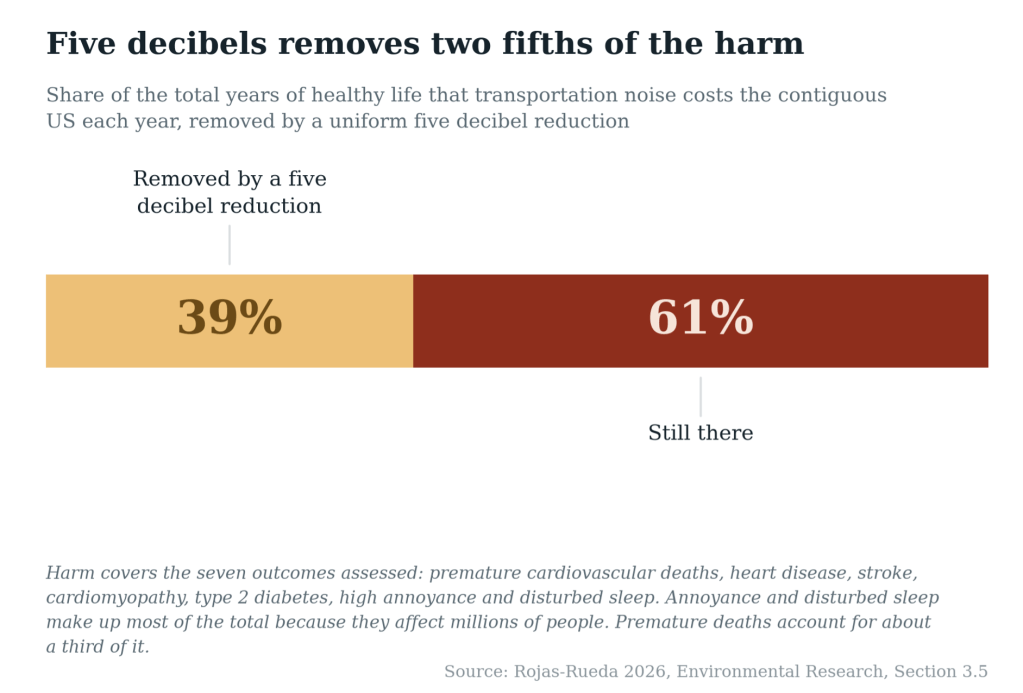
If we made every neighborhood in the country five decibels quieter, that one change would spare Americans about 106,500 years of healthy life every year, using a measure researchers call “disability-adjusted life years.” Think of it as a running tally across the whole population: every year someone spends with noise-broken sleep, chronic stress, or a heart condition that noise helped cause counts as part of a healthy year lost, and every year cut from the life of someone who dies early from it counts as a full year lost. Add that up across the millions of people affected and you get the total.
About a third of those 106,500 years comes from those roughly 6,330 early deaths; the rest comes from people living with the harmful health effects of noise pollution. Moreover, just those five decibels would be enough to erase 39 percent of the damage to our collective health caused by our current traffic noise levels.
Decreasing traffic noise by five decibels is not out of the question. The levers to accomplish it are the ones already on the agenda of transportation reform advocates: addressing what the road surface is made of, how fast cars travel over it, how many cars there are, and how many trips happen by foot, bike or transit instead.
Rolling noise rises with speed, and automobile volume matters because noise is energy and energy adds up. A repaving contract, a speed limit, a road diet, a bus lane: each of these is also a noise decision, whether or not anyone at the meeting says the word “noise.”
I should be straight about what my study does not do. It does not tell you which combination of those measures gets a specific corridor to five decibels, or what that would cost. Nobody has done that at city scale in the US, partly because we do not have source-specific noise maps to work from. That work is still waiting.
But we do know that harmful transportation noise is not distributed equally. In the most socially vulnerable fifth of American communities, 1,940 deaths related to it happen each year. In the least vulnerable fifth, 849.
Exposure drives the gap: 45 percent of residents in the most vulnerable communities live with traffic noise above 45 decibels, compared to 20 percent in the least. The communities enduring the most noise endure more of the disease that noise aggravates.
Who’s listening
None of this appears in your agency’s dashboard because nobody reports it.
Congress defunded the EPA’s noise office in 1982. The Noise Control Act of 1972 is still law, but it has gone unenforced for four decades. HUD’s noise standards for federally supported housing were written in 1979 and have not been revised since.
The European Union, by contrast, has required its member states to map noise since 2002 and now ranks it among the top three environmental health risks on the continent.
Still, it’s important to note that the U.S. is not short on data about transportation noise. Two researchers at the University of Washington built a national transportation noise exposure map from federal data, which is what made my study possible in the first place. What is missing is anyone with a mandate to publish that data on a schedule, and say what it means for health.
That fix needs no new legislation. The Bureau of Transportation Statistics already holds the inputs. That is the federal ask, and right now, the federal government is slow to answer.
The nearer-term move is smaller and it belongs to the people who are likely reading this: everyday advocates and policymakers. When you write the memo for a road diet, a pavement specification, a speed limit change or a transit priority project, the crash numbers are already in it. Put the noise numbers in the same paragraph. Every state in the contiguous US has its own figure now.
We have spent forty years treating traffic noise as a complaint to be filed. But it is a health exposure that is killing us — and we can make better decisions now.

Read More:
Streetsblog has migrated to a new comment system. New commenters can register directly in the comments section of any article. Returning commenters: your previous comments and display name have been preserved, but you'll need to reclaim your account by clicking "Forgot your password?" on the sign-in form, entering your email, and following the verification link to set a new password — this is required because passwords could not be carried over during the migration. For questions, contact tips@streetsblog.org.