How Phoenix’s ‘Invisible’ Parking Lots Are Making Its Heat Problems Worse
Editor’s note: A version of this article originally appeared on Signal Doctrine and is republished with permission.
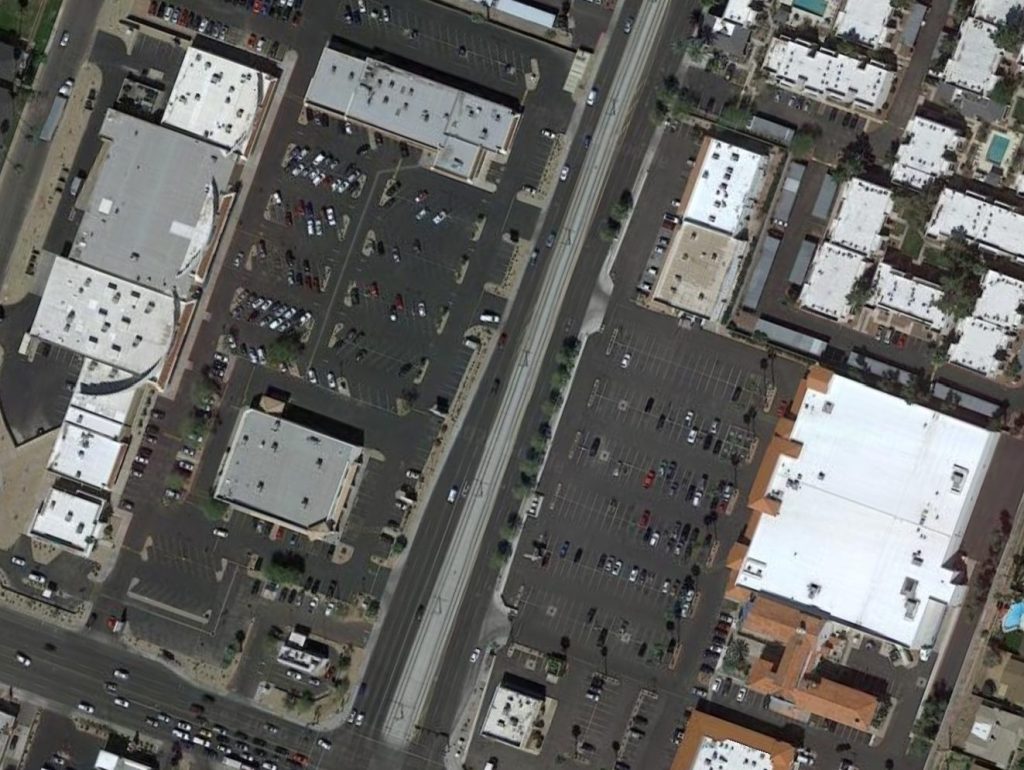
Stand in a surface parking lot in Phoenix on a July afternoon and you are standing on one of the hottest surfaces a human body can approach without being burned.
Phoenix has 12.2 million of these spaces.
That figure comes from a peer-reviewed inventory published in 2019 by researchers at Arizona State University, among them Mikhail Chester, who led the study, and David King, an associate professor of urban planning and a student of the late Donald Shoup, whose work on parking economics reshaped the field. They counted off-street residential spaces, off-street commercial spaces, on-street spaces — all of it.
The result: 4.3 parking spaces per registered vehicle. Roughly 3 spaces per person. Ten percent of all urbanized land in the metro devoted to storing cars. Since 1960, Phoenix has added roughly 200,000 new spaces per year.
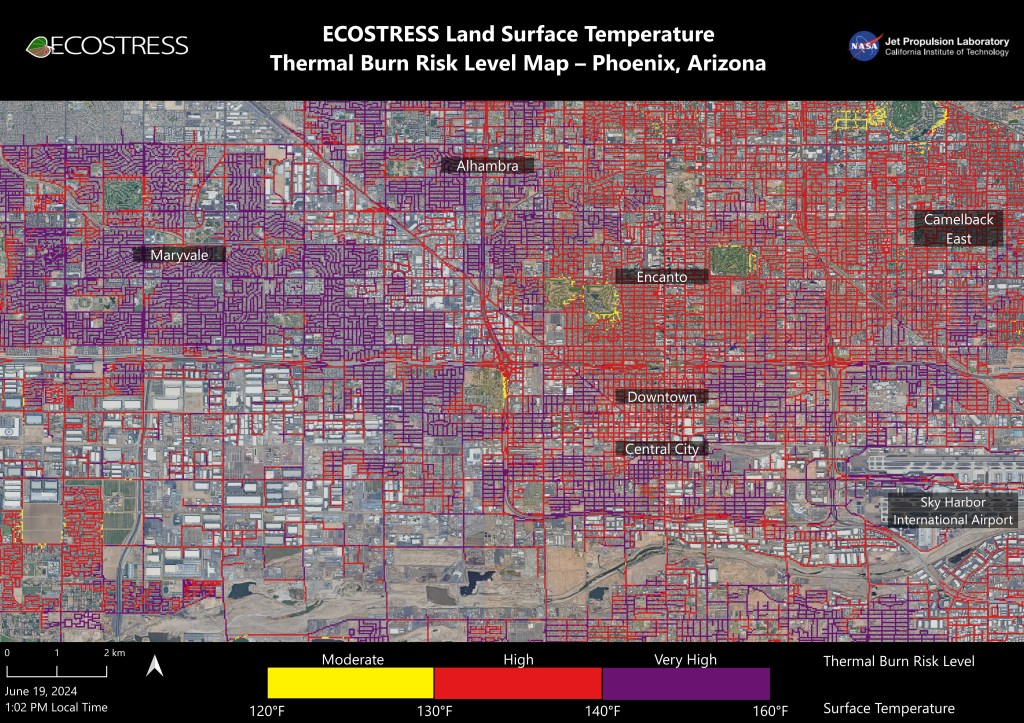
The asphalt beneath your feet absorbs approximately 95 percent of the solar radiation hitting it. Its surface temperature is somewhere between 150 and 170 degrees Fahrenheit — the upper range hot enough to cause a second-degree burn in under 30 seconds. NASA’s thermal imaging of Phoenix on a June day in 2024, when the air temperature was 106, showed roads and parking lots glowing between 120 and 160 degrees across the metro. The cars sitting in those lots are ovens. The air rising off the pavement is a wall.
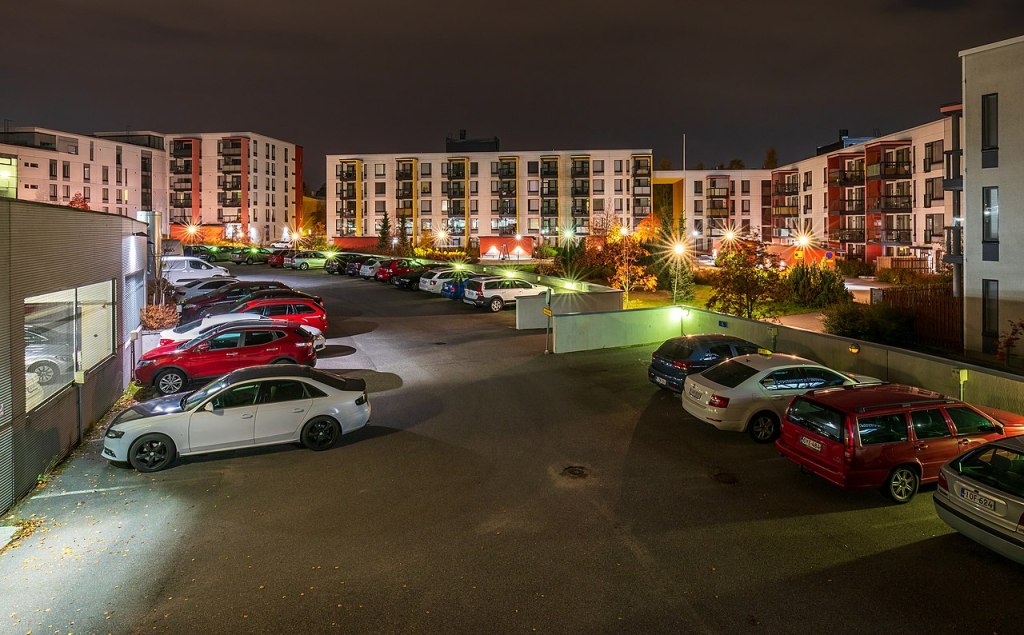
The number is hard to feel from inside a car, which is where most people in Phoenix experience the city. The parking lot is invisible infrastructure — noticed only when it is full, which it rarely is, because the system was designed around the assumption of peak demand and routinely runs at a fraction of capacity. Most spaces sit empty most of the time. Their vacancy is not experienced as waste. It is experienced as availability, which is to say, as comfort, which is to say, as the whole point.
But the lot does not stop existing while the car is away.
Surface parking accounts for roughly 29 percent of all heat emitted from pavement and vehicles across the metro on a typical summer day. Chester, who led the original study, confirmed the estimate remains current. Asphalt radiates 46 percent more heat than natural landscape during the afternoon. It emits 37 percent more sensible heat than bare ground. And it does not cool quickly. Unlike vegetation or even bare soil, pavement stores the day’s heat and releases it slowly through the night — keeping nighttime temperatures elevated long after sunset.
This is not a new finding. It has been documented here for decades. What it means, measured over time, is a 9-degree rise in average nighttime temperatures in Phoenix over the past twenty years — a number that appears in city reports so often it has started to lose the quality of alarm.
Nine degrees. Every night. Added to a city that was already one of the hottest on earth.
Before 2000, Phoenix averaged roughly five summer nights that did not cool below 90 degrees. In 2024, that number was 37. On July 19th of that year, Sky Harbor Airport recorded an overnight low of 97 degrees. The models now suggest the city could experience a night, within this decade, that does not fall below 100.
The parking lot did not cause this alone. Phoenix’s heat island is the product of everything the city has built: roads, rooftops, walls, the relentless substitution of absorptive surface for desert ground. But parking is one of the largest single components of that surface area, and it is the one whose thermal cost is most clearly optional. A city needs roads. It needs buildings. It does not need 4.3 spaces per vehicle.
The city has been aware of this for a while and has begun, slowly, to respond. The Cool Pavement Program applied reflective coatings to more than 140 miles of city streets — out of more than 5,000 total. ASU studies found the treatment reduces surface temperatures by roughly 10 to 12 degrees at noon. The effect on nighttime air temperature barely registers. The thermal mass problem runs deep.
The more structurally significant change came in January 2024, when the Phoenix City Council voted 8–1 to reduce parking minimums citywide. In walkable urban zones along light rail corridors, the minimum dropped to 0.75 spaces per unit. For affordable housing near transit, it fell to zero. A 100-unit affordable apartment complex near light rail that once had to provide 113 spaces now has to provide none.
The reform passed over the objections of eight village planning committees. King, who has studied parking policy for over a decade, describes the opposition as “making a good faith, incorrect argument.” The deeper problem, he says, is that cities have required so much parking for so long that reducing the mandate feels like a concession rather than a correction.
“They haven’t yet taken that step to say, we’ve been wrong for the last century,” King told me. “Which I think is a critical thing that the cities have to do.”
Phoenix has not eliminated parking minimums, and the citywide default remains well above zero. But the vote was meaningful. Just because a city stops requiring parking, King points out, does not mean no one will supply it. The market still responds to demand. What changes is that the supply is no longer mandated at levels the market never justified.
What is changing in the urban core is visible enough. Block 23, the mixed-use tower that opened in 2019 on the site of what had most recently been a surface parking lot, brought 332 apartments, 200,000 square feet of office space, and the first grocery store in the downtown area. Other lots are becoming hotels, housing, parks. The ground is slowly being reclaimed.
But the urban core is not most of Phoenix. Most of Phoenix is the arterial corridor: the strip mall anchored by a pharmacy and a nail salon and a mattress store, each surrounded by more asphalt than any reasonable traffic model requires.
The BedMart at 19th and Northern had thirty-two parking spaces and, in my experience, zero customers. The store closed. A coffee shop moved in and installed a drive-thru. The thirty-two spaces remain.
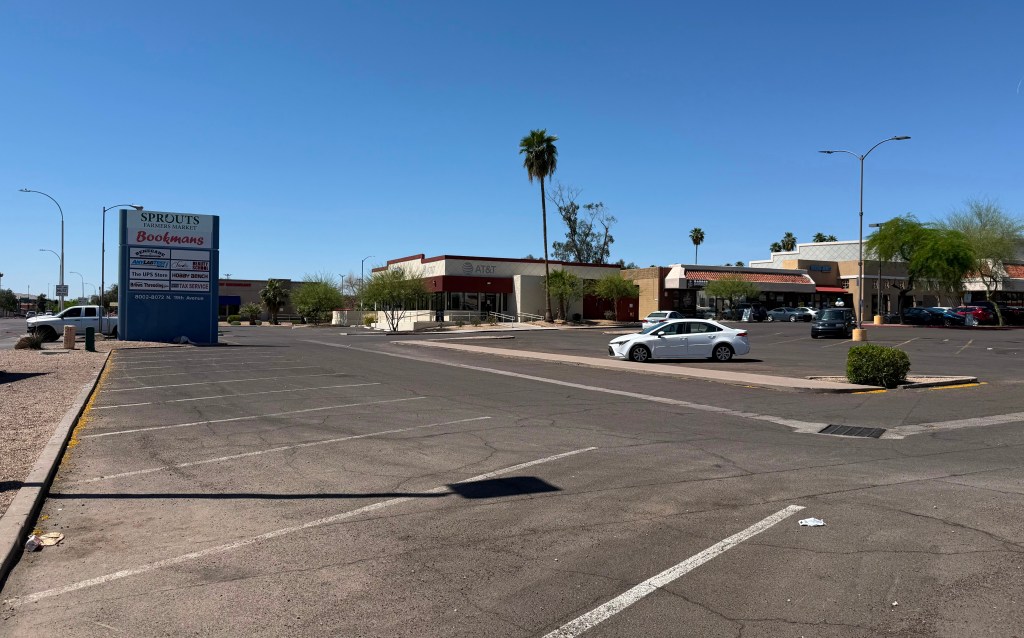
Drive 19th Avenue at two in the afternoon in June and the whole corridor shimmers. The lots are empty. The heat is not. You can feel the pavement through your shoes in the twenty seconds between your car door and the entrance, and those twenty seconds are the entirety of your relationship with the public realm.
When I asked King what he sees driving Phoenix’s arterials that most people don’t, his answer was immediate: “Arterial walls rather than permeable spaces.” The buildings all turn away from the street. The front door faces the parking lot. The corner — which should be the highest-visibility, highest-accessibility point — is treated as an afterthought. Every curb cut for every parking lot is, in his words, “an insult to the pedestrian environment.”
King argues that exposure should be a key metric of planning in a city like Phoenix. Three or four minutes in the summer sun is tolerable. Ten or fifteen is not. The difference between those two experiences is often the distance a parking lot adds between the street and the door. The twenty seconds I described are not an accident of design. They are the design.
I grew up in that corridor. The parking lots never looked like a problem. They looked like the ordinary space between things.
Each of those lots was mandated into existence by a zoning code that assumed the car was the only unit of movement worth designing around. Removing that mandate does not immediately remove the pavement. Changing what gets built next takes longer than changing what the code requires.
King calls the science behind parking requirements “100 percent pseudoscience.” No study determined that a pharmacy needs a certain number of spaces, or that a nail salon needs another. The numbers were invented, codified, and enforced for decades. And the mandated parking, once built, generated its own secondary costs: stormwater runoff required bioswales and retention ponds, which further shrank the buildable footprint, which pushed buildings further apart, which guaranteed more driving. The code created the problem and then created the infrastructure to manage the problem it created.
There is a word for what Phoenix has built, and it is not parking. The word is infrastructure — the infrastructure of a particular assumption about how life in a desert city should be organized. That assumption was: you arrive by car, you park, you enter, you leave, you drive. The space between things is transition, not place. The outdoors is not somewhere you are meant to be; it is somewhere you are briefly passing through on the way to somewhere cooled.
The pavement encodes that assumption in both directions. It stores the day’s heat and holds it through the night. It repels the monsoon’s rain — five to eight inches a year, nearly all of it arriving in violent bursts — and channels it fast, hot, picking up motor oil and heavy metals and fertilizer, into a storm drain system that delivers it to rivers and washes without treatment. For every additional percentage point of impervious surface, annual flood magnitude increases by an average of 3.3 percent.
The city has spent tens of millions on drainage infrastructure to manage flooding events generated by its own hardscape. The surface that will not release heat will not absorb water either. The imperviousness is the same.
That assumption made the lot possible, and the lot made the assumption self-fulfilling. More parking meant more driving. More driving meant less walking. Less walking meant less pressure to build the kind of dense, shaded, connected environment where walking made sense.
The city that built 12.2 million parking spaces was also building the case for why it needed them. Chester describes what emerged as a system that nobody designed: “For a century we’ve codified and normalized decision making that builds out this system. Now we have it and are largely unaware of its scale and impacts.”
This is not a design flaw. It is a design choice that Phoenix made for seventy years and is only now beginning to question. The cost was always there. It was just measured in degrees rather than dollars, and Phoenix does not have a habit of reading thermometers critically. “There’s a lot of people who don’t like to accept the truth when it implicates them in the system,” King told me. “If parking is the problem, then I have to drive less. Maybe I’m the bad guy.”
Phoenix is not the only American city that made this choice. It is the one where the cost of the choice is most directly physical and most directly measurable — in degrees, in burn rates, in the temperature of a surface that a fallen person cannot get up from.
ASU’s Urban Climate Research Center has estimated that a half-degree reduction in average air temperature across the metro could save Phoenix $15 million per year in avoided air conditioning costs. The math of the lot, run in the other direction, is considerably less comfortable.
The city is beginning to learn what it built.
The 9 degrees are already here.
The cars go home.
The lots do not.

Read More:
Streetsblog has migrated to a new comment system. New commenters can register directly in the comments section of any article. Returning commenters: your previous comments and display name have been preserved, but you'll need to reclaim your account by clicking "Forgot your password?" on the sign-in form, entering your email, and following the verification link to set a new password — this is required because passwords could not be carried over during the migration. For questions, contact tips@streetsblog.org.