Talking Headways Podcast: Greensboro’s Downtown Greenway
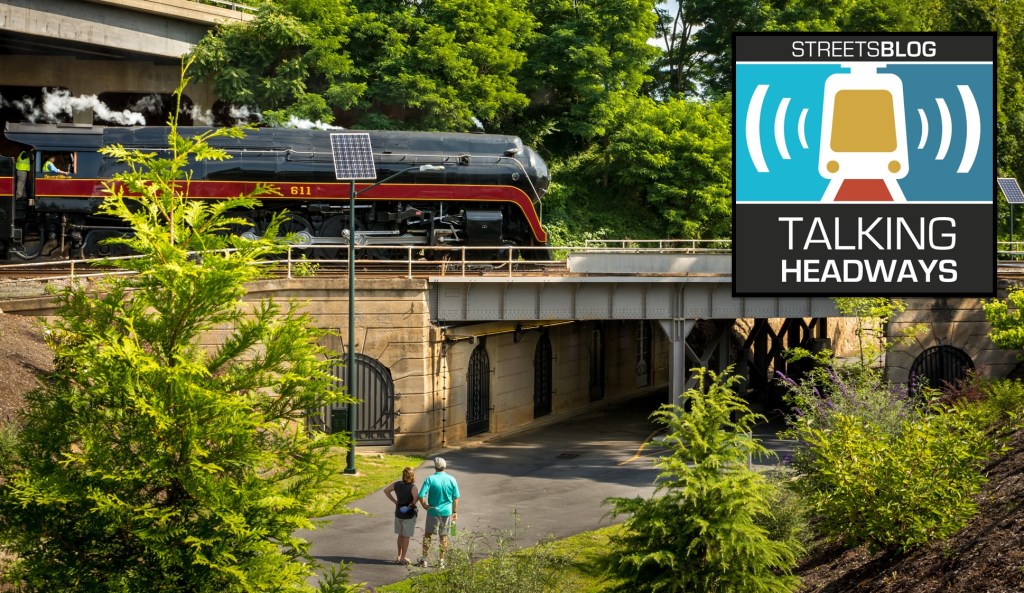
This week on the Talking Headways podcast, we’re joined by Dabney Sanders, the project manager of the Downtown Greenway in Greensboro, North Carolina. We chat about opening the greenway’s final section after 25 years of work, the remarkable art installations along the route, and lessons for other cities that want to build greenways.
There are three ways of following the conversation: The audio player embedded below; a full transcript generated by artificial intelligence; and further down this page, a partial, human-edited transcript.
Jeff Wood: How hard was it to make sure that the whole greenway was connected? Obviously, some of it is in a trail section where it’s off on its own, but then other parts seem to be next to the road, and then others seem to be part of the sidewalk.
Dabney Sanders: We had two opportunities in Greensboro that made us think this was possible to do in a way that maybe some cities wouldn’t be able to do. If you had to purchase all of the right-of-way for this, in your center city, the cost would be prohibitive. But in our case, we had a six-lane divided highway, Morrow Boulevard, which did not carry a lot of traffic on it.
We knew we could take at least a full lane of traffic out of that to convert, so we did not have to do right-of-way purchasing for that because the city owned it. That’s on our east side. On the west side, we had a railroad corridor that had one commercial user, and we had the sense that maybe we could convince that user not to use it any longer, and we could do a rail-to-trail conversion on that line.
We were successful with that. We did have to pay for that. We were naive in the beginning, thinking that the railroad might just abandon it. That’s not how it works.
Wood: They never give it up for free.
Sanders: Exactly. I will say that we did not have to do as much right-of-way acquisition as you might imagine. It was more kind of little bits and pieces that we might need here and there. There were a few properties. One of the properties had been a gas station and a convenience store — and we just knew, being right there in the corner where it was, that we wanted that property, and we were lucky enough to be able to purchase it.
We had a lot of cooperation, even from some private property owners. On the northern section, we had a very tight right-of-way, and we had a property owner who really believed in the project. And when we approached them about needing additional right-of-way from their property, they actually donated the right-of-way instead of asking for that compensation because they knew what this project could do for our community, and they also knew that ultimately this project would increase their own property values.
I feel very fortunate that we were able to acquire most of the right-of-way that we needed in a way that, outside of the railroad negotiations, wasn’t particularly painful.
Wood: Was there anybody that pushed back on it? Was there anybody that was like, “I don’t know about this, having a trail that goes through my property or near my property” or anything along those lines?
Sanders: The final section, the western branch, was the first section in which the greenway is directly adjacent to residential backyards. And we did have a lot of meetings with those residents to talk about the vision and discuss their concerns. Of course, this had been an abandoned railroad corridor, so what we were talking about doing was an incredible improvement to what had been there.
But people did have concerns. Are we gonna have people walking up into our backyards? That sort of thing. And we did work with those residents. We offered to build a fence along all of those backyards, and we offered to put gates in those fences at our expense that the property owners would control so that they would have access, because people were very excited about the greenway happening.
They just wanted to make sure that they had some protections of their property. And of the 16 or so residents, all but one of them requested that gate, and we took that as a real sign of people appreciating the project.

Read More:
Streetsblog has migrated to a new comment system. New commenters can register directly in the comments section of any article. Returning commenters: your previous comments and display name have been preserved, but you'll need to reclaim your account by clicking "Forgot your password?" on the sign-in form, entering your email, and following the verification link to set a new password — this is required because passwords could not be carried over during the migration. For questions, contact tips@streetsblog.org.