Can Neighborhood Block Parties Unite A Broken America?
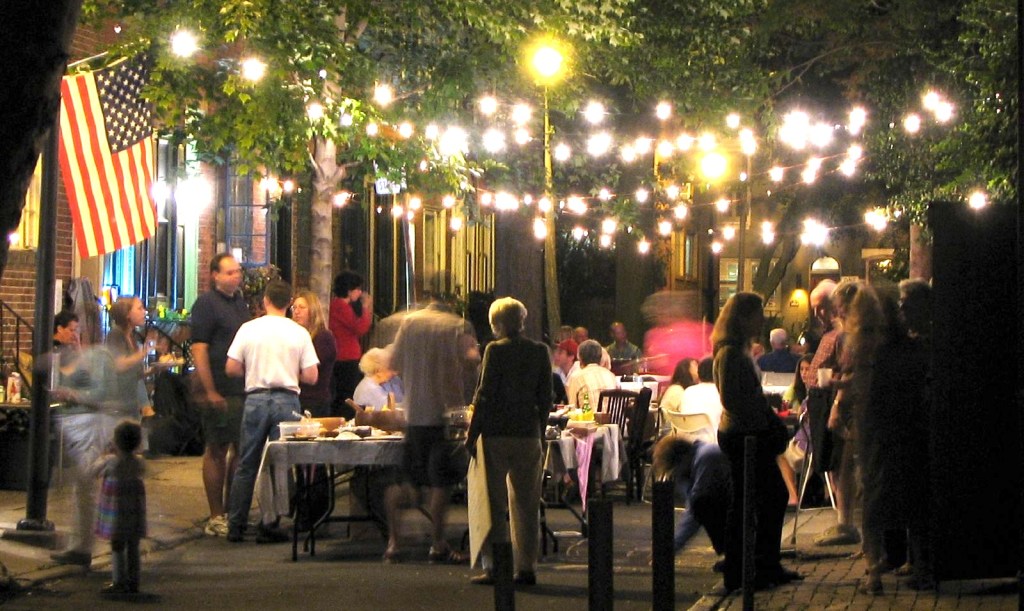
As President Trump’s Department of Transportation encourages American motorists to get in their cars and drive away from their communities to celebrate the nation’s birthday, one advocate is calling on would-be holiday drivers to stay put and deepen their connections to their neighbors — by closing their street to cars and throwing a party.
Nonprofit Block Party USA recently launched its “American Summer” campaign to inspire communities across the country to organize at least 250 block parties between Memorial Day and Labor Day, with an emphasis on the Fourth of July.
Timed to honor the 250th anniversary of America’s founding in 1776, this push could catalyze not only interpersonal connections, but an overdue conversation about our country’s divisions — and the role that neighborhoods can play in bringing us back together.
“With America 250 coming, there’s so much polarization, and people are really suffering,” said Vanessa Elias, the group’s founder. “It is affecting our mental health; we’re feeling divided and disappointed. And when we look at our history, we have become so independent and individualistic that we’ve lost this sense of community.”
A self-described “mental health activist, parent coach, and block party expert,” Elias launched the campaign out of a deep belief that in-person interaction among neighbors is an essential ingredient for a healthy life, healthy kids and even a healthy democracy.
She founded her organization after one of her local legislators spoke out about the experience of being harassed by a constituent online, only to have a far more positive experience with the same constituent in person.
“That was just a light bulb moment for me,” Elias says. “We need block parties; we need face-to-face connection with random people in our immediate proximity.”
In human-centered communities, of course, block parties can be a naturally occurring phenomenon.
When we design our roads to treat motorists as simply members of a broader transportation ecosystem — rather than those roads’ exclusive users — we open up space for spontaneous barbecues and pop-up porch concerts, whether or not anyone has organized a formal gathering. This choice also encourages more casual social interactions between neighbors, which studies show are statistically more likely to happen in walkable neighborhoods, too.
Elias says her block party proposal can adapt to more car-dependent places, with gatherings in rural driveways or meetups in parks. But in an ideal world, she thinks everyone who wants to should be able to step right outside their door and into a true community, rather than getting in a car to go find it.
“Part of the work that I do, is to help people understand how they don’t need a perfect cul-de-sac where they can close the road … That said, I would prefer it be rooted in place, and rooted in the area that people are living,” she added. “Rather than finding a pretty park eight miles from where everybody lives, [the ideal block party would] bring people together as close as possible to where they’re living — and I think some communities make it really easy for that to happen.”
Elias acknowledged that only 6.8 percent of the U.S. population live in walkable neighborhoods, which means ideal block party sites can be hard to find.
And even within those neighborhoods, some will still find it difficult to secure permits to close streets to cars, or to rally neighbors who barely say hello to one another on the way to check the mail. She stressed that, in an era of social media isolation and deep political division, the built environment is far from the only reason why we don’t always connect.
Despite those steep odds, though, Elias argued the humble block party can be a critical first “drop” that ripples out across a whole community, building social connections that grow and deepen over time — particularly for people who are too young to drive. She emphasized that block parties encourage “free play” for children, which “can make children happier, better problem-solvers, and more energized to pursue learning and develop deep interests.”
No matter why communities gather, though, Elias said the best way to celebrate our country this summer may not be traveling to visit our national treasures, but to make treasured memories in our own neighborhoods — and maybe, to forge the coalitions we need to make livable streets and social cohesion the neighborhood norm.
“Whether you’re six or 106, it’s something that is accessible to you — to meet other people, where you belong,” she added.
Visit BlockPartyUSA.org for more tools and resources to throw a block party in your community.

Read More:
Streetsblog has migrated to a new comment system. New commenters can register directly in the comments section of any article. Returning commenters: your previous comments and display name have been preserved, but you'll need to reclaim your account by clicking "Forgot your password?" on the sign-in form, entering your email, and following the verification link to set a new password — this is required because passwords could not be carried over during the migration. For questions, contact tips@streetsblog.org.