Talking Headways Podcast: The Art of the Bus
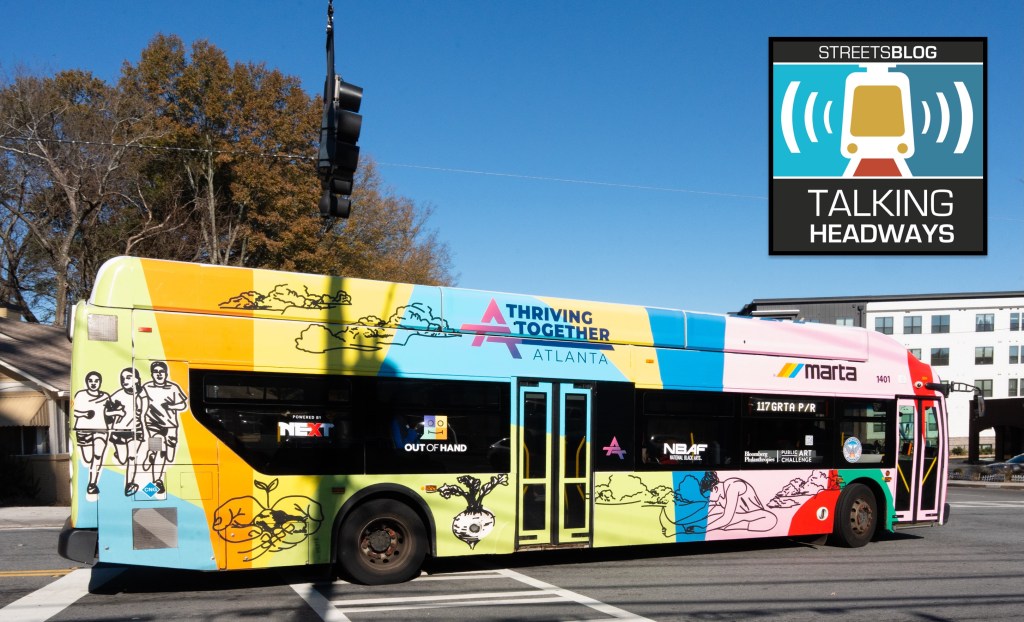
This week on Talking Headways, we’re joined by Stephanie Dockery of Bloomberg Philanthropies to discuss the foundation’s third Public Art Challenge. Dockery considers how bus art gains cult followings, how artists use temporary installations to attract attention in their respective cities, and what happens after those projects disappear.
Listeners have three ways of following the conversation: The audio player embedded below; a full (albeit AI-generated) transcript; and further down the page, a partial, human-edited transcript.
Jeff Wood: Thinking about the Hawaii bus, one thing that was interesting to me is that a lot of agencies are having trouble with their funding, and a lot of times for the buses, they’ll try to do wraps, and the wraps are advertising.
And I find it really great that instead of just putting advertising on your bus, you could actually put an art installation on your bus. There’s some frustrations with covering the windows, which I know a lot of transit advocates have. But the Hawaii bus was actually done very tastefully in terms of not covering up all the windows.
Stephanie Dockery: Yes, we follow all parameters with bus shelters and buses on not covering the windows, not covering the sides of the glass panels in the case of our Houston project. With our project in Philadelphia, which is a poetry project that’s responding to gun violence, Healing Verse Germantown, they are working not only with the Department of Transportation, but with the advertising agency and putting art in the panel of the bus shelters where advertising typically goes.
So now we have murals in a space where there’s typically advertising. So to your point —yes, we should absolutely be using art, and it was so smart of the teams to identify that as an opportunity for them.
Wood: I just find it very refreshing just because everything seems to be commoditized these days. A lot of folks are trying to advertise, and, and for good reason, obviously. The transit agencies need money. But at the same time, maybe that’s why the buses have maybe a little bit more of a following — because it isn’t the typical bus covering that you usually see.
I’m wondering how much of the art we should expect people to understand right away versus how much should be explained. I’m curious about how people come to it or how they experience it when they see it.
Dockery: That’s a great question. People absolutely happen upon the work. People go to the work on purpose. We are doing so much work with all of the teams to help promote [the art], whether it’s on their website, on our guide. We have created maps for all of the cities so they can share those with their constituencies, so they can actually see all of the sites. We have signage at all of the sites that explicitly talks about what the project is, what the installation is.
We have to be really deliberate and not expect or assume that people know what the work is, and that’s kind of the great thing about public art, especially if it’s in a vacant lot in a place where you’re not expecting to see anything, let alone something beautiful. And people get arrested by the installations and question why they’re there and, you know, start questioning why we don’t have more, which is a great question.
Wood: Excellent question.
Dockery: We do a lot of communications both on the press side and the onsite marketing, and then with social media to help let people know that the work is there because it’s for a pretty finite period. Some work is a performance, so that’s quite fleeting. Some work is up for a year.
So we’re just really communicating those timelines, what the work is, who the artists are, and expressing that this is a collaborative team. People should know that this is great work that their cities have done for them. So the cities are behind us and have brought together these nonprofits and artists. We also have an app called Bloomberg Connects, which is a free digital guide available to cultural organizations.
And on our Public Art Challenge guide, we have all of the cities listed and have built out their projects, both images and descriptions. So that’s a place where the projects can live in posterity since they are temporary in nature.

Read More:
Streetsblog has migrated to a new comment system. New commenters can register directly in the comments section of any article. Returning commenters: your previous comments and display name have been preserved, but you'll need to reclaim your account by clicking "Forgot your password?" on the sign-in form, entering your email, and following the verification link to set a new password — this is required because passwords could not be carried over during the migration. For questions, contact tips@streetsblog.org.