‘How Do We Remember to Remember Disabled People?’: When Winter Weather Is an Accessibility Disaster
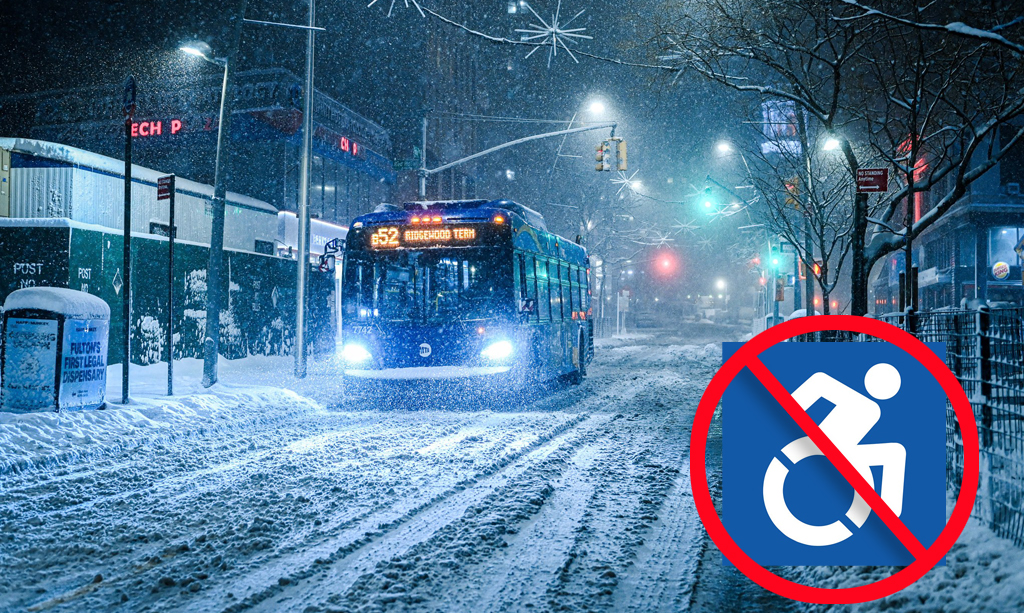
When Cara Leibowitz, a wheelchair user and disability studies professor in New York City, peered outside her window after one of the East Coast’s many winter snowstorms, she realized she was completely stuck inside.
“I’d look out and I’d be like, ‘Oh, the sidewalk isn’t too bad,’” she said. “And then I’d look at the curb cut, and I’d be like, ‘Oh, never mind. Guess I’m not going outside today.’”
This experience is a common one for disabled people during snowstorms and other severe weather events. Disabled people in cities all over the East Coast suffered this winter due to cities’ lack of planning for how to ensure mobility for disabled people in the aftermath of the snowstorms.
This was a tough winter; approximately 123 million people faced above-average snow accumulation, the highest amount in five years. This has also been the winter with the most extreme cold in over two decades for large portions of the Northeast and Mid-Atlantic regions.
Disabled people living in East Coast cities faced similar challenges this winter: the snow blocked sidewalks and curb cuts for weeks, preventing residents from accessing necessary medical care, causing increased physical pain, and the emotional loss of social activities.
These experiences are not just anecdotal. Research has shown that wheelchair users make fewer trips outside per day and travel shorter distances during winter months, with the gap widening sharply on days with snow accumulation. A study conducted after Winter Storm Uri in 2021 found that Texas households with a disabled person had more service disruptions, adverse experiences, and slower recovery after the storm compared to households without any disabled people.
Of course, the snows of winter have long since melted, but advocates say that is never too early for cities to begin preparing for next season to better incorporate accessibility.
Snow problems
Advocates say snow causes real safety concerns for the many disabled people who are trapped inside.
“It makes me feel like our government officials think or care very little of the independence and safety of people with disabilities because they are knowingly putting us at increased risk,” said Germán Parodi, the co-executive director of The Partnership for Inclusive Disaster Strategies, which focuses on equity, access, and inclusion of disabled people before, during, and after disasters and emergencies.
“When a disaster happens, like a massive winter storm, it is the government’s responsibility, the city’s responsibility, the local government’s responsibility to provide safety for the people living in that area,” continued Parodi, a wheelchair user in Philadelphia. “Keeping mountains of snow on curb cuts is not only a risk factor for people with disabilities who use mobility aids, but an argument can be made that it is a failure for the whole community.”
In many cities, property owners are legally required to clear snow and ice from the adjacent sidewalks and curb cuts. But just one forgotten stretch of sidewalk can make an entire path unusable for disabled people. More cities could adopt a system like New York’s, where day laborers are paid to shovel sidewalks, but even that program didn’t quickly create clear paths across a wide area of even that most-walkable city.
Sometimes, the sidewalks were cleared, but the path wasn’t wide enough for wheelchair users to be able to use it. Emma Albert, a wheelchair user and master’s student at Northeastern University in Boston, got stuck in the snow multiple times and had to rely on her friends to free her. Her experiences violate Boston’s snow removal policy, which specifies that property owners must clear at least a 42-inch-wide path within three hours of the snow stopping or otherwise face a fine.
“A lot of the pathways that they paved weren’t wide enough for my wheelchair to get through. I called them ‘Ozempic paths,'” she said. “Obviously a wheelchair can’t fit through this, but also I don’t know how anyone is fitting through this path.”
Physical and social harm
Many disabled people experienced a worsening in their physical condition due to being stuck inside when it snowed.
“Winter is a worse time for me physically in general,” said Kelly Mack, a wheelchair user and writer in Washington. So the aquatic therapy followed by the whirlpool are things that help me maintain my strength, and I definitely lost strength and I was having worse chronic pain.”
Bri Arce, a student in Philadelphia with multiple disabilities, has occasional chronic pain that can interfere with her walking. The snow made her pain worse as well.
“I’m already in pain, I can barely keep my balance. The last thing I needed was to be trudging through thick piles of snow and darn near slipping on ice every two seconds, so it just made the journey a lot harder,” she said.
Snow doesn’t only harm people with mobility disabilities; it also gets in the way of people with visual disabilities.
Kenia Flores, a policy advocate in Washington who is blind and uses a white cane, said the snow made it difficult for her to navigate. At times, Flores had to rely on others to help guide her while she walked, even though she is usually fully independent.
“I feel very confident using my cane, but what’s like kind of scary is even if you feel a clear path, you don’t know what awaits you on the other side if there’s more ice or more snow,” she said.
The winter weather has also caused social isolation, as Albert of Boston explained.
“It’s definitely been really frustrating in terms of having to say no to plans that I wanted to go to or trying to go to plans that I was excited about and then realizing that I wouldn’t be able to get there,” Albert said.
Planning for the future
There are some resources available to disabled people during snowstorms. The Partnership runs a Disability and Disaster Hotline that provides information, referrals, and other resources to disabled people seeking urgent disaster-related needs. Parodi said 13 percent of the calls they received in 2026 have been related to snow, such as inquiries about disruptions to basic needs and services, damage to property not fully covered by insurance, and problems getting food and other supplies.
Much of the work to clear snow after severe storms falls on individual cities, but this is clearly a systemic issue, according to Parodi, due to a lack of national leadership focused on accessibility in emergency management. He said it is unclear who is currently leading the Disability and Integration Division of the Federal Emergency Management Agency. Additionally, because the partial Department of Homeland Security shutdown includes FEMA, the agency was operating at reduced capacity for much of the winter.
Advocates mainly want cities to listen to the voices of disabled residents, perhaps, as Parodi has called for, by creating committees focused on the needs of disabled people during disasters.
“Those spaces need to be accessible, physically, communication, programmatically, and compensation needs to be built in for the time and expertise that members of these community will be contributing and spending to properly identify your localities’ issues, gaps, and opportunities in disasters,” he said. “So there is no one blanket answer, but bring your community.”

Read More:
Streetsblog has migrated to a new comment system. New commenters can register directly in the comments section of any article. Returning commenters: your previous comments and display name have been preserved, but you'll need to reclaim your account by clicking "Forgot your password?" on the sign-in form, entering your email, and following the verification link to set a new password — this is required because passwords could not be carried over during the migration. For questions, contact tips@streetsblog.org.