Urban Truth Collective: The One-Hour City Conspiracy
“I want to be the mayor of hyperproximity,” said newly elected Paris Mayor Emmanuel Grégoire, differentiating himself from the mainstream urban planning mindset of hypermobility. He’s also providing a strong endorsement of the 15-minute city — an idea under attack in tin foil hat circles (or complotiste in French).
But there are fake conspiracies, and there are real conspiracies. SpyCops, Iran-Contra, the Phoebus cartel, Operation Berkshire, and the Tuskegee experiment – these are real conspiracies. In these cases, coordinated and/or aligned interests secretly worked together for years against the public good.
On the other hand, fake conspiracy myths include the illuminati, lizard people, Q-Anon, moon landing conspiracies, and plenty more. These myths are laughable, and yet have an all-too-real impact on public support for government action.
Recently “15-minute cities,” and “low-traffic neighborhoods” have been thrown into the mix of these fake conspiracy myths. Detractors claim that they’re part of a global plot to lock us up in open-air jails, undertake “government-forced isolation,” or are part of a “woke transportation” movement aiming to take away our freedoms, starting with our cars.
Nothing could be further from the truth. The “15-minute city” model is based on the original concept of a city: having the things we want and need closer to where we live. The idea is that we should be able to get to our everyday essentials within, ideally, 15 minutes on foot, bike, or public transit. What’s scary about that?
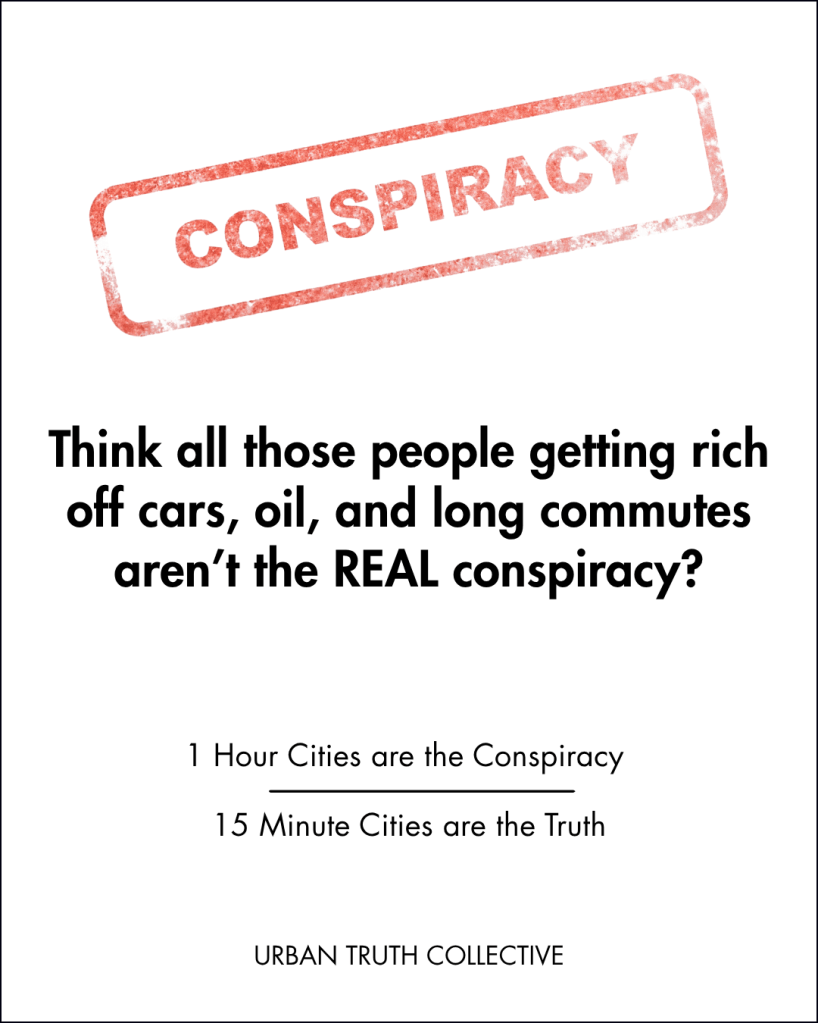
Health-harming industries have long used the conspiracy trope of the “Nanny State” trying to keep us in our figurative “cribs.” The 15-minute city conspiracy myth is just one more iteration of the same – replacing baby cribs with dystopic prisons. This trope serves to distract from what may be an actual conspiracy – what we might call a “One-Hour City” conspiracy.
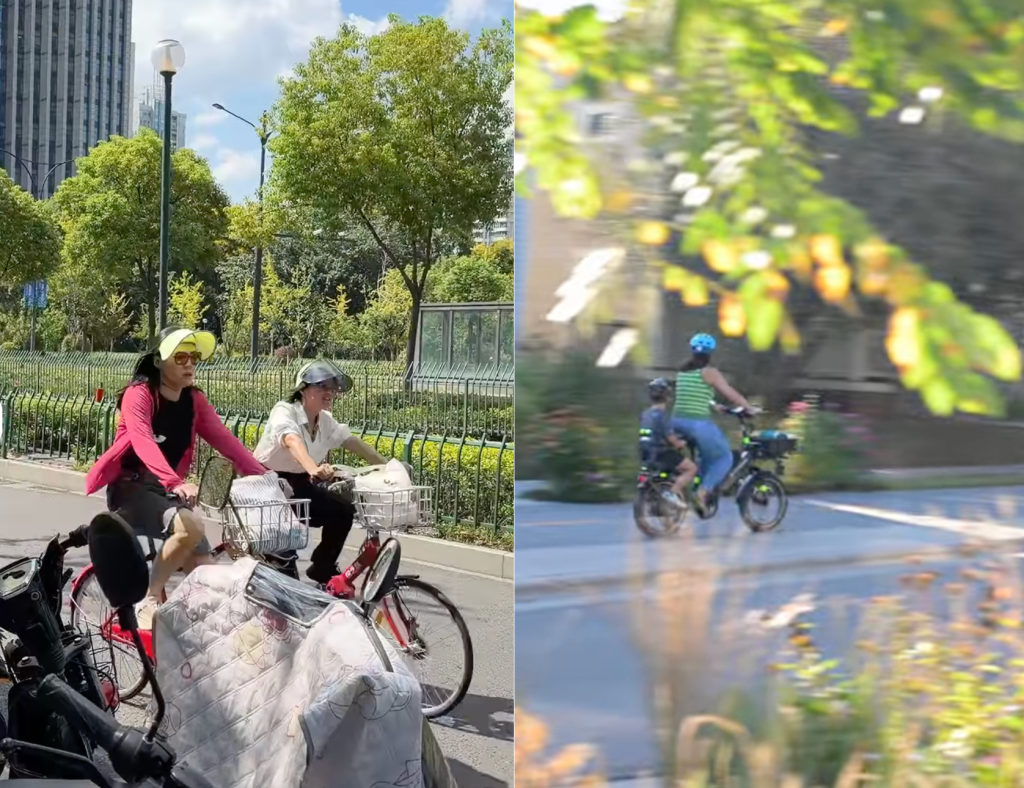
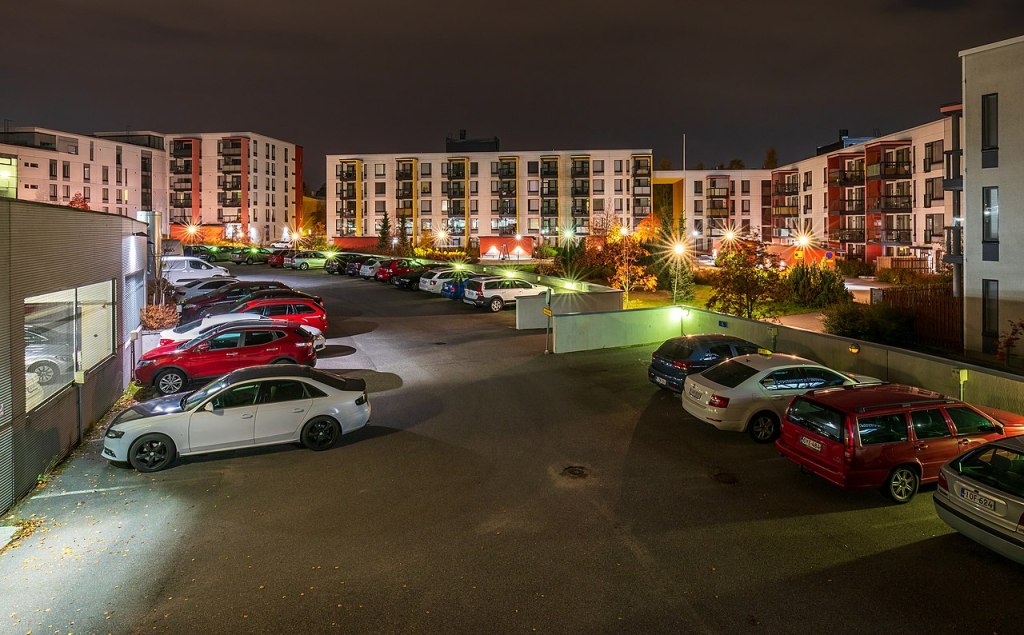
Rather than creating cities where life’s essentials are close-by, government decisions such as setback laws, road width and parking minimums, have spread out our communities and put the essentials at least a one-hour walk, bike, or public transit ride from where many of us live.
That’s far enough away that many people use cars, as there aren’t enough hours in a day to access everything you need without one. At the same time, driving commute times have passed the one-hour mark, meaning that many people are trapped for hours each day in their cars. Too many of us, and more every day, live in these kinds of places.
The one-hour city probably does not involve a bunch of evil men in suits conspiring around a big, sinister table. Short of audio-video footage of said meetings, or extensive documentation, we’ll never know for sure. But we do know from extensive evidence that there is a collection of aligned interests that make a lot of money from people driving more. These actors have lobbied for laws that make it harder to get to shops, businesses, schools, restaurants, and government and medical services near to where people live.
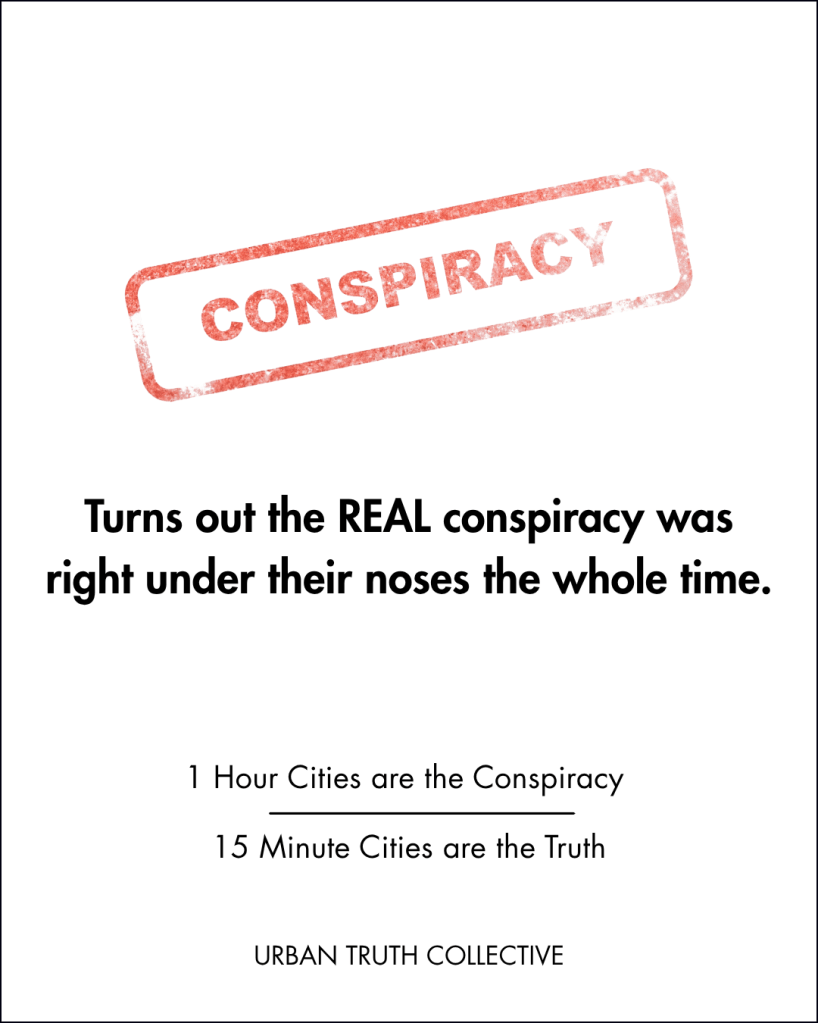
A number of books have documented the machinations and stakeholders behind the one-hour city, including Mick Hamer’s “Wheel’s Within Wheels,” Ian Roberts’s “Energy Glut,” Vidyadhar Date’s “Traffic in the Era of Climate Change,” and others. The constellation of actors profiting from one-hour cities can be referred to as the “road lobby,” and includes road builders, energy industry actors, automobile and motorcycle manufacturers, land developers and construction/home builders, the insurance industry, ride-share companies, the enforcement lobby, and more.
This lobby directly and indirectly pressures government into undertaking policies that spread us out. They have a financial interest in doing so. The diverse array of policies that make them more money are numerous and also include increasing government subsidies for road building, bans on apartment buildings, the underfunding of public transit, bans on local shops and services, excessive parking minimums, road and lane width minimums, subsidies for driving, and much more. These laws force people to drive, which increases profits to these industry players.
This road lobby is powerful and old. In 1964, one British Member of Parliament noted that the road lobby was, “the most hideous lobby of all.” Writing in 1971, the president of the American Public Health Association noted, “The perversion of democracy is well exemplified by the highway lobby.”
“If one had to design the structure for an effective interest group, one could do no better than model it after the highway lobby,” Delbert Taebel noted in 1977.
Little has changed in over 60 years. “The influence of the road lobby is considerable,” according to a 2026 study in Health Promotion International. “The road lobby has fought for the dismantling of rail, against public transit, in favor of unnecessary road building. … Just as the tobacco industry invested heavily in normalizing smoking, so, too, the road lobby has fought to embed a strong social bias towards cars.”
The ramifications of one-hour city conspiracy are real: more crashes, more injuries and deaths, more noise, more air pollution and climate-changing greenhouse gas emissions, more social isolation, more political extremism, and less space for everything good our streets should be giving us.
A lot of us are trapped in one-hour cities right now. The alternative — having a lot more things close by, and a lot more time in our day — isn’t the conspiracy. It’s the cure.
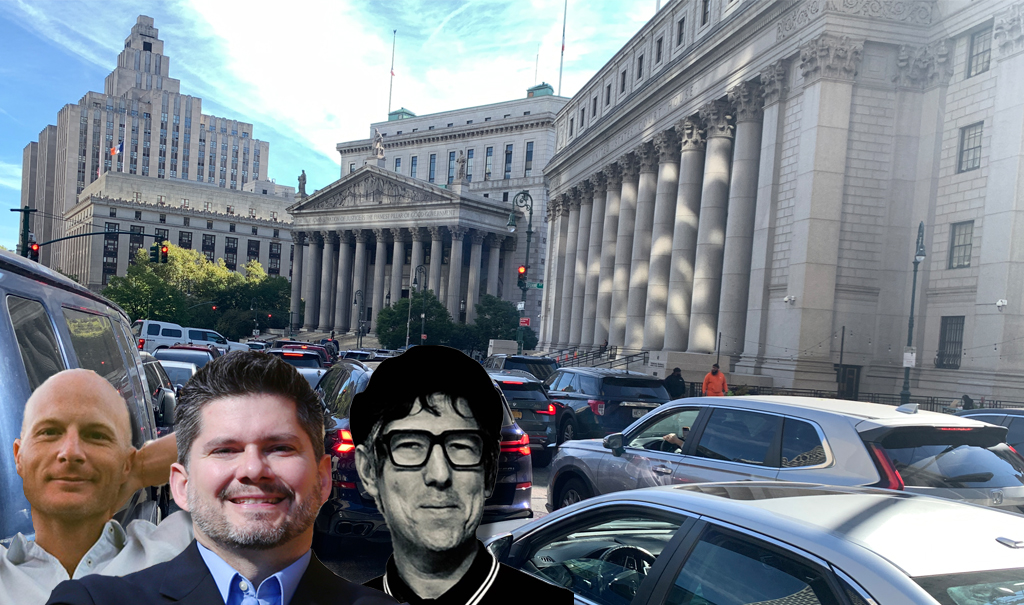
The three authors have recently launched the Urban Truth Collective. It can be found on BlueSky here.


Brent Toderian is an influential city planner and urbanist who advises cities all over the world, the former Chief Planner for Vancouver, Canada, and a popular writer and speaker on cities.

Read More:
Streetsblog has migrated to a new comment system. New commenters can register directly in the comments section of any article. Returning commenters: your previous comments and display name have been preserved, but you'll need to reclaim your account by clicking "Forgot your password?" on the sign-in form, entering your email, and following the verification link to set a new password — this is required because passwords could not be carried over during the migration. For questions, contact tips@streetsblog.org.