Talking Headways Podcast: Evolution, God and Transportation
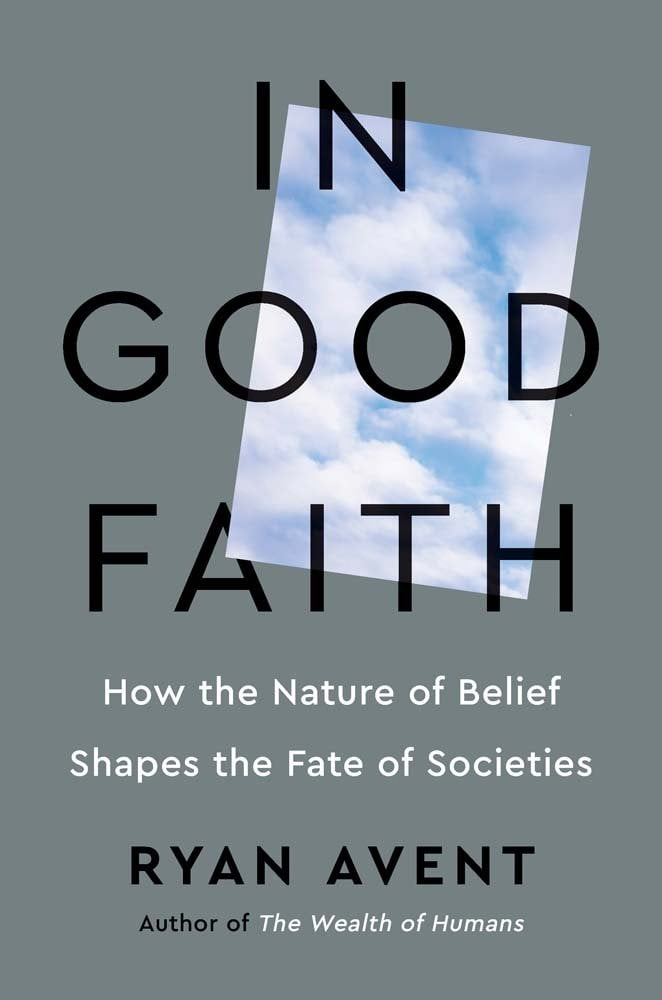
Sometimes, you have to take the long view, so this week, we’re joined by Ryan Avent, author of, “In Good Faith: How the Nature of Belief Shapes the Fate of Societies” to discuss The Big Issues: human evolution, the impact of collective knowledge and culture, and the need to create a new story about the future of society. It gets deeper than that: We also discuss grass-is-greener thinking on infrastructure, the nature of belief without the need for evidence, and the fact that there is no perfect past.
This is a “Talking Headways” for the Ages, so let’s review all the ways you can enjoy this spirited content:
- Click here for a full transcript, albeit with some AI typos.
- Click the player below to listen.
- Or check out the lightly edited excerpt below the player.
Jeff Wood: Usually when I’m thinking about cities and reading a book like “The City History” by Lewis Mumford or whatever it might be, it’s always usually going back 5,000 years. It’s not going back 100,000 years, which I got from reading your book.
That was a really important part of it, because this slow process is building upon itself and all of the cell creation and whatever was happening to apes led to civilization as it is now. And that process was really interesting because usually we think about civilization as like a point that we started building cities, and then we went from there. But actually it goes back even further to this idea of care and caring.
Ryan Avent: As humans, as historians, people love to chop things up into eras and say, “Oh, this sort of revolution unfolded here, and thereafter we were completely different.”
And we do this all the time. We do it with agriculture and the first cities and states and with the Industrial Revolution. And I think it’s important to realize a couple things. One, that these big moments come together slowly out of a lot of accumulating changes in the past, and we can only understand them in that way, right?
As much as it might seem like there are specific individuals or societies or civilizations that figure something out that no one ever figured out before, change is generally evolutionary. But the other side of that is the question of whether there is this process of cultural adaptation that’s going on throughout our whole history, right?
And we have to learn to develop the ideas and the stories that allow us to kind of exploit particular niches, right? So agriculture, when we first became dependent on it, was awful. It was way worse than hunting and gathering. People did back-breaking labor all the time and were, were malnourished and, and it sucked.
And for this to be sustainable, there had to be the emergence of ideas and ways of understanding our place in the world that made sense to people, and that somehow made it OK for them to keep doing this really arduous work. And I think the same thing is true of early settlements. Like, we weren’t born ready to inhabit an urban environment as a species.
We had to come up with the modes of thinking that allowed that to work. And so you have this process of trial and error where early settlements don’t last very long. They kind of flash in and out of existence. And it’s only over time that we come to figure out how to be urban by coming up with the ideas and the sort of cultural touchstones that allow us to adapt to that existence.
And the book sort of follows this line of thought throughout our history. And that’s kind of how we should think about how we got to modern economic growth. And I think if we want to enjoy future prosperity that’s greater than what we enjoy now, we might have to do some similar sort of adapting in terms of our ideas about what we’re doing here.
Jeff Wood: The cultural explosion was interesting as well, and you mentioned the DNA aspect of it, where you’re passing along information through DNA. But then you have this cultural kind of aspect of it, where apes can teach each other how to use a stick to get ants, those types of things. And then you share it, and then you learn it together, and then it gets shared throughout culture, and then you specialize, and then you move forward with that.
I’m wondering if you could kind of explain that a little bit in more detail. It’s really important, especially until we get to the point where Christianity and religion kind of creates this larger cultural experience throughout Europe and the Mediterranean.
Ryan Avent: This is really the heart of the book. I think when we kind of think about humans and what makes them special, we tend to focus on the fact that we’re these big-brained creatures who can reason and use logic to solve difficult problems. We can do calculus!
But I think, actually, if you look back at our history, the thing that’s really allowed us to become such technologically capable animals is this capacity to support culture. We’ve got a genetic inheritance — a lot of information that’s useful to us that gets passed to us through our genes, and that’s driven our long-run biological evolution.
But the thing that really sort of marked us off as different as we split off from our ape ancestors was this emerging capacity to use a collective knowledge and collective information processing in the form of culture. And culture, in a nutshell, is a body of information that is passed down over time socially rather than genetically, and sort of lives in the heads of all the people who are helping this process along.
And it includes instructions for all sorts of things. You know, I think when humans occupy an ecosystem, the thing that allows us to adapt and really exploit that ecosystem effectively is not, as with many animals, these biological tricks. It’s these cultural tricks that allow us to figure out when to hunt and gather and what things to take out of the ecosystem and how to prepare them and how to survive the hardships associated with that ecosystem.
But cultural knowledge also includes other things beyond sort of these kind of, you know, practical moment-to-moment things. And it’s what’s really allowed us to scale up and become the amazing creatures that we are, is the way that our social technologies evolve over time. And we’ve found ways to operate, to cooperate, I guess, in larger numbers to better purposes.
We’ve found ways to generate and preserve knowledge at enormous scale, and I think that’s kind of the fascinating part of our history, and it’s not something that individuals authored sort of using their own brains is something that kind of we stumbled on and that’s led us here, and, and now we’ve sort of forgotten that that was kind of our special trick, even though it’s still holding our societies together today.

Read More:
Streetsblog has migrated to a new comment system. New commenters can register directly in the comments section of any article. Returning commenters: your previous comments and display name have been preserved, but you'll need to reclaim your account by clicking "Forgot your password?" on the sign-in form, entering your email, and following the verification link to set a new password — this is required because passwords could not be carried over during the migration. For questions, contact tips@streetsblog.org.