For Earth Day, the Trump Administration Wants To Expand Highways Across America
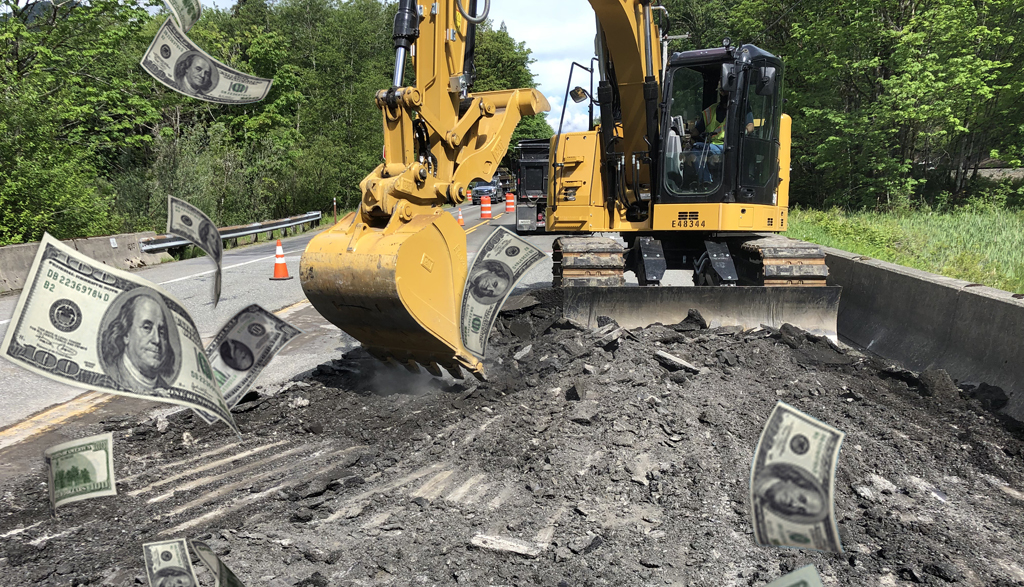

The Trump administration is celebrating Earth Day by encouraging local transportation leaders to expand roadway capacity in an effort to end traffic jams — pushing a long-debunked “solution” that will make roads more congested, polluted and fiscally wasteful than before, experts say.
US DOT Secretary Sean Duffy announced the “Freedom to Drive” Initiative on Monday, which directs governors and mayors across the country to identify strategies to alleviate their “worst congestion nightmares … choking your economy” in 60 days — and the agency will see how it can help.
There are many fiscally prudent ways to reduce congestion, but Duffy explicitly encouraged transportation leaders to “focus solutions on expanding and maximizing roadway capacity for driving” and offered “building new roadway capacity” as the first example of what that approach might look like.
“You may also need to recover roadway capacity from other purposes to support driving,” Duffy warned — possibly a veiled reference to bike lanes, which Duffy has incorrectly maligned in the past as a source of congestion.
Needless to say, that suggestion didn’t sit well with transportation reform advocates — or anyone else with a passing knowledge of how to actually fix traffic jams.
Decades of research has found that while expanding highways offers very short-term congestion relief, traffic levels typically rise to pre-expansion levels within as little as five years as more drivers take to the newly widened roads, thanks to a widely understood phenomenon known as “induced demand.”
Meanwhile, proven traffic-cutting measures — such as congestion pricing and expanding alternative transportation options like transit — were not mentioned in US DOT’s splashy release at all. (The Trump administration is still trying to revoke New York’s successful central business district tolling plan.)
“You can increase lane miles faster than population growth, and you’ll still have an explosion in congestion,” said Jaibin Mathew, policy associate at Transportation for America. “This is not going to solve the problem they want to solve.”
Mathew doesn’t deny that many cities are, indeed, choking on congestion, but he questions the idea that the mere existence of traffic jams on its own constitutes a national crisis, rather than, say, many U.S. residents who struggle to get to far-flung jobs and homes with few transportation options besides driving.
“Is solving congestion the actual thing we need to do?” he asked. “[Measuring] congestion does not measure access to jobs; it does not measure the length of your commute; it does not measure any of these things. It just says, ‘Can a car move at a consistent speed?’”
Transportation for America has, indeed, long pointed out that new highways or expanded roadways not only waste money on construction, but also hit localities with a debt bomb that goes off years later.
Highway construction is “one of the most fiscally irresponsible things we do with transportation policy,” the group pointed out during the debate over the last infrastructure bill. “Every dollar spent on a roadway expansion project is both a dollar that was not spent on repair, and a dollar that created decades of future repair costs.”
Mathew is even more skeptical of the Department’s assertion that the entire American economy is struggling because not enough cars are reaching breakneck speeds at rush hour.
In the release, US DOT estimated that the U.S. experienced “$269 billion in lost productivity” in 2024 alone, plus unquantified delays to commercial and freight activity. But those sorts of numbers generally are based on formulas that experts say wildly over-estimate the dollar value of a few saved seconds on a commute.
They also don’t account for the onerous costs of car ownership, which most U.S. families can’t avoid because they have no other options to travel long distances — and no access to the kind of dense, walkable neighborhoods where regularly traveling long distances might be optional.
“We’re in an environment of increasing fuel prices, of farther commutes, of rising sprawl, of increasing maintenance costs — and all things are all going to increase more,” added Mathew. “The administration’s proposal of reducing CAFE standards and encouraging car-centric, car -ependent travel are going to increase costs. … The ‘freedom to drive’ is really, expensive, and it comes at the expense of freedom [to use] other options, and the freedom of choice.”
Mathew says the “Freedom to Drive” initiative may not make a meaningful difference in how Duffy’s DOT makes its transportation decisions — because the department has been prioritizing broken “congestion mitigation” strategies over virtually everything else from day one.
He says he’s far more concerned about the administration’s many efforts to claw back money for the things that really would get cars off the road, like grants to support transit, walking, and biking — and how those department-level decisions might crystalize into Congressional policies if lawmakers accept the Trump administration’s recommendations to defund transit in the next federal infrastructure bill.
If America is serious about tackling congestion and the access and affordability issues for which it’s become a proxy, though, Mathew hopes that we can chart a better path forward by focusing on the root of the problem: too many cars in too many car-dependent places.
“It does suck to sit in congestion — and the biggest thing you can do is give people options that are not necessarily cars,” he added. “By giving people options like the bus, light rail, walking, and biking infrastructure, you can increase the amount of the capacity of a roadway, get people off of roads, and actually improve commutes. There’s a very simple way of managing congestion: if there are less cars on the road, you’ll have less traffic.”

Read More:
Streetsblog has migrated to a new comment system. New commenters can register directly in the comments section of any article. Returning commenters: your previous comments and display name have been preserved, but you'll need to reclaim your account by clicking "Forgot your password?" on the sign-in form, entering your email, and following the verification link to set a new password — this is required because passwords could not be carried over during the migration. For questions, contact tips@streetsblog.org.