Why This State Is Fighting To Get Its First ‘Active Transportation Plan’

Missourians are fighting to get their state its first-ever plan to support the needs of people outside cars — and shining a light on an overlooked resource that’s missing or badly out of date in other states, too.
Advocates at Missourians for Responsible Transportation are in the final days of a campaign to get the Missouri Department of Transportation — or MoDOT, as it’s locally known — to adopt a “statewide active transportation plan,” which proponents say is among the most critical missing puzzle pieces necessary to solve the state’s traffic violence crisis and reap the broader benefits of a truly multimodal transportation system.
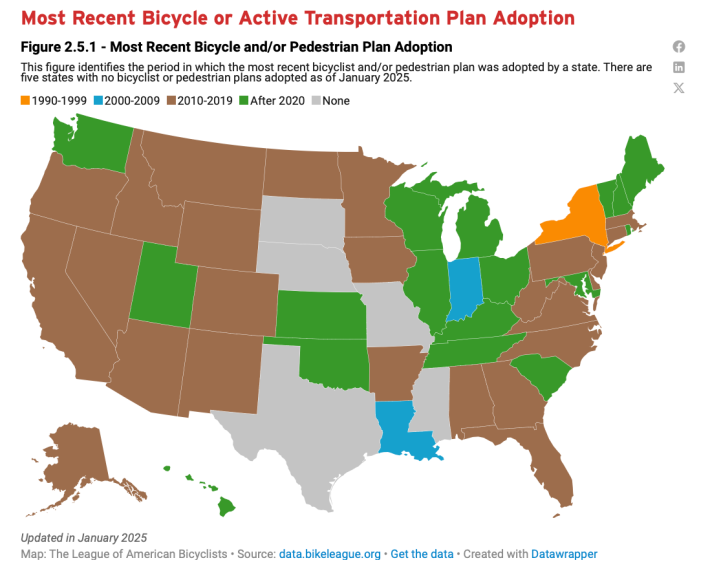
After Texas finally adopted its own plan last year, Missouri became the most populous state of the remaining four that still don’t have that critical document on the books, despite the fact that nearly one-third of its residents don’t have a driver’s license.
That’s also a startling omission in light of the Show Me State’s latest vulnerable road user fatality totals, which set records the last two years in a row and now represent more than 15 percent of total traffic deaths — with 64 percent of those lives lost on state-owned roads. That 15 percent is enough to trigger a new federal requirement that would force MoDOT to spend 15 percent of its Highway Safety Improvement funds on saving vulnerable road users’ lives, even if the state doesn’t have a plan to do it.
Advocates point out, though, that MoDOT has been astonishingly proactive about completing a $2.8-billion expansion of Interstate 70 after state legislators passed a bill to fund it in 2023. But they haven’t received a similar mandate or acted with similar urgency to save walkers’ lives over the last three years — even though advocates say a statewide active transportation plan could cost less than $500,000, and Missouri is in the midst of adopting a new long range transportation plan, anyway.
“Other states are looking to the expediency that MoDOT was able to offer for building out that highway expansion project,” said Jackson Hotaling, MRT’s director of policy and programs. “They are able to deliver some very ambitious projects with limited resources when it’s required. We would want to see [that kind of priority given to] a statewide active transportation plan.”
What a ‘Statewide Active Transportation Plan’ is — and what it’s not
Since Hawaii became the first state to adopt one in 1977, statewide active transportation plans have been a key ingredient in the fight to make communities less car dependent, providing what the League of American Bicyclists call an indispensable “basis for coordination” between states and other stakeholders as they work together to accomplish their multimodal goals.
They can take many forms and be called many things — bicycle plans, pedestrian plans, and Complete Streets plans, to name just a few — but they all typically provide a foundational analysis of the current state of affairs for people who don’t drive, a clear statement of how the state DOT would like to change those affairs in the coming decades, and an outline of what, exactly, agencies will do to accomplish that, including specific plans and policy actions that can be plugged into an existing — and federally required — Long Range Transportation Plan.
For instance, Kansas — a state that Hotaling says could be a good model for Missouri — pledged in its 2023 plan more than seven pages of specific actions, including revising state statues on speed limits and improving crash data collection to help transportation leaders better understand and address why drivers are killing so many people outside cars.
Hotaling says the plan also prompted the development of a guide “that helps communities under 20,000 people identify [opportunities] to build out some of these active transportation networks,” potentially catalyzing new infrastructure throughout the rural parts of the state. And the whole plan cost $481,000 – a microscopic rounding error compared to a multi-billion-dollar highway project like the I-70 expansion.
To be fair, Long Range Transportation Plans have an especially long list of issues with public transparency and accountability — and neither they nor Active Transportation plans actually require states to execute most of their objectives on any meaningful timeline or with any meaningful consequences if they fail. Then there’s the matter of keeping ATPs up to date, which states across America have failed to do; New York, for instance, is only now in the midst of its first plan update since 1997.
Still, Hotaling argues that Active Transportation plans are an especially essential first step for a state like his, which operates as seven distinct, decentralized “districts” that are sub-allocated decision-making and funding, provided that they align with clear state goals.
In a state that ranks seventh for total highway miles but 47th for government revenue per mile of that overbuilt system, many Missouri districts often elect to pour their rock-bottom gas taxes back into one priority that is abundantly clear statewide: building and maintaining freeways. And while Missouri’s major cities aren’t exactly pedestrian paradises, rural areas are even less prepared to choose another path.
“So what that means is that the urban areas are able to build out much more emphasis on increased safety measures with active transportation infrastructure, but in the rural parts of the state, they’re really missing opportunities in some cases,” he added. “And with dollars stretched the way they are, the priority [in those rural places] is generally focused on building out road and bridge needs, rather than what might be considered ‘luxury system improvements,’ like active transportation infrastructure.”
When it comes to massive multi-district projects like the I-70 expansion, advocates have struggled to hold MoDOT accountable for leaving pedestrians and walkers out of its plans, since the agency doesn’t have a document on the books stating that the state has committed to protecting them in specific ways relevant to those projects. In the state capitol of Columbia, for instance, Missourians for Responsible Transportation say that MoDOT won’t build several key pedestrian crossings over the newly expanded highway — and that local residents will have to “foot the bill” for even that basic concession.
“At this point, every one of our neighboring states has adopted a statewide active transportation plan,” Hotaling adds. “And what they’re able to do with those is target those policy gaps. … We don’t have those policy recommendations and guidelines in place to follow. That’s why we’re losing out on opportunities to build active transportation infrastructure into our projects.”
What’s next
Since its campaign launched earlier this year, Missourians for Responsible Transportation has gotten nearly a hundred organizations and counting to submit letters of support for a statewide Active Transportation Plan; individual residents are also being encouraged to submit comments to MoDOT directly in support of the idea while the agency is collecting feedback on the Long Range Transportation Plan update through April 3.
Even before that letter is delivered and the comment period closes, Hotaling says that the state transportation leaders have already shown some signs of being receptive. In a meeting about the campaign, Director Ed Hassinger expressed interest in actions like enhancing “MoDOT’s online presence for priorities, plans, resources, and technical assistance related to active transportation,” and developing “a toolkit for local agencies to assist in developing local active transportation plans,” similar to Kansas’s infrastructure guidebook for small communities.
Still, Hotaling says that his group still wants a full-fledged Active Transportation plan — and members are prepared to fight to see that it’s done well and leveraged to maximum effect. And if they can do it, he hopes it could serve as a better model for other states with a higher proportion of non-urban areas.
“We hear a lot at home here in Missouri that Missouri is a unique place,” he adds. “But we do want to make sure that other states can look to us [as an example of how] we are able to build out a statewide active transportation plan, and see rural ingenuity in action.”
Streetsblog has migrated to a new comment system. New commenters can register directly in the comments section of any article. Returning commenters: your previous comments and display name have been preserved, but you'll need to reclaim your account by clicking "Forgot your password?" on the sign-in form, entering your email, and following the verification link to set a new password — this is required because passwords could not be carried over during the migration. For questions, contact tips@streetsblog.org.