Latest Report Shows That Sprawl Continues To Hamstring Youth, Limit Opportunities
Sprawl kills.
That’s the unmistakable conclusion drawn by researchers at Johns Hopkins University earlier this month in an update of their landmark 2014 report on the nation’s ongoing crisis of land misuse: sprawl chokes life out of our cities, undermines opportunities for our children, and, yes, even raises the risk of disease.
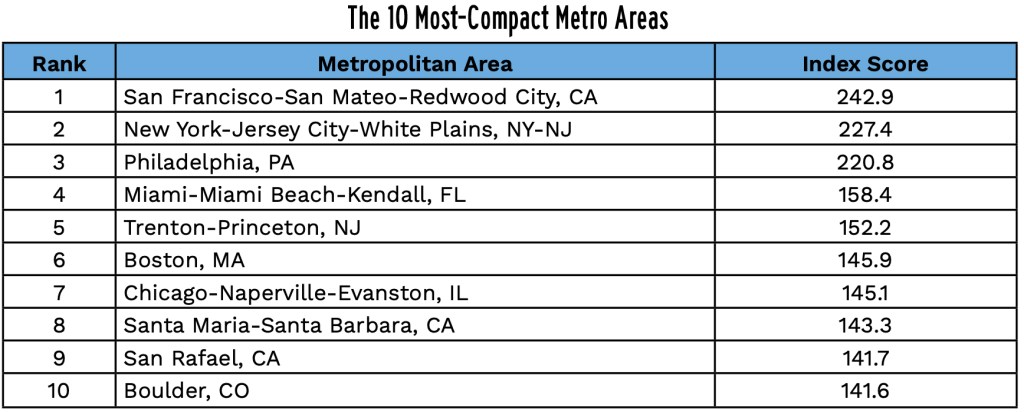
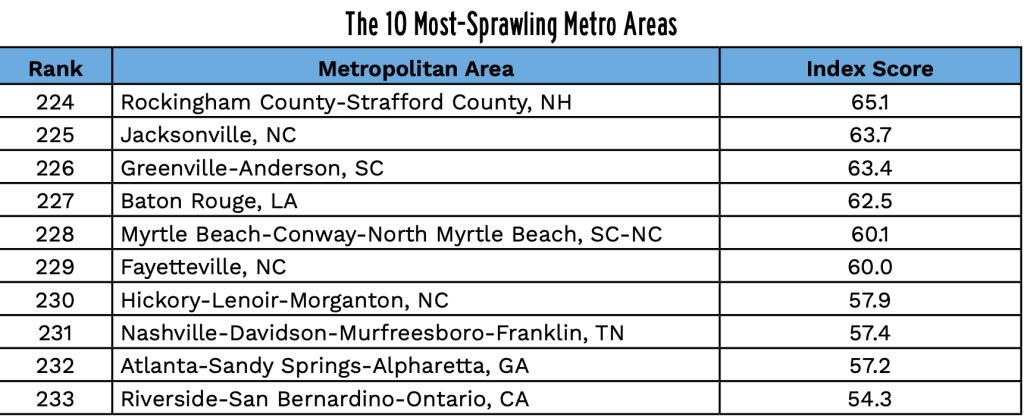
Riverside, the Southern California suburb, and Atlanta were at the bottom of the list for “most sprawling” while San Francisco and New York City topped the list as “most compact,” based on established metrics such as density of development and concentration of jobs.
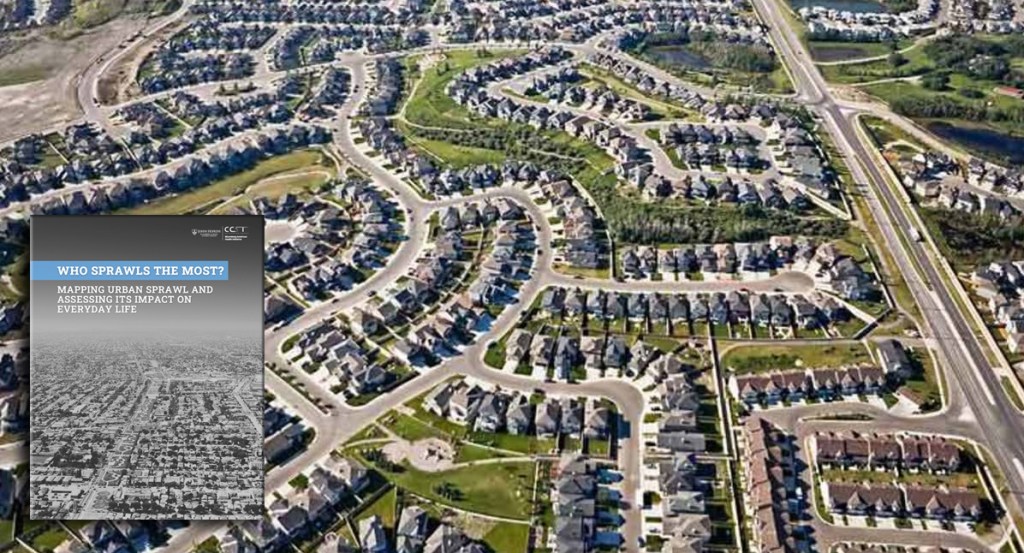
The report, which comprises 233 metropolitan areas in the lower 48 states and covers 85 percent of the U.S. population, is not just about geography, of course, but about the most-basic quality-of-life issues facing the country today. Residents of compact and connected neighborhoods have “lower energy costs, better health outcomes, lower exposure to vector-borne diseases such as Lyme disease, well-connected social lives and greater opportunities for children to thrive,” according to the report, “Who Sprawls the Most? Mapping Sprawl and Assessing Its Impact on Everyday Life” [PDF].
And in a counter-intuitive development, given the debate over “abundance,” housing in compact cities was found to be more affordable than those in sprawling suburbs when the cost of transportation and energy are taken into account. (Transportation and energy costs are much lower for residents of compact and connected areas.)

The overall housing cost surprised the report co-author.
“The amount we pay for energy is becoming more and more a challenge for people,” said Shima Hamidi, director of the Center for Smart Transportation at the Bloomberg School of Public Health at Johns Hopkins University. “We found that in compact and connected neighborhoods, residents pay substantially less of their income on residential energy bills, and if you add that to transportation, the savings on these two budget items in a compact and connected neighborhood saves offsets the higher cost of housing in this area.”
Hamidi told Streetsblog that the report hits at a crucial time because of the ongoing debate about high housing costs in the most-walkable, most-livable parts of our greatest cities.
“Sprawl is getting attention these days because there are so many critics of smart growth and growth management policies these days who are arguing that these policies would restrict housing production and will lead to more expensive housing and less housing affordability for residents,” Hamidi said.
But, she added, there are other factors that cast sprawl in a bad light, including the level of social isolation, which leads to disconnected youth, not to mention “heat-related health outcomes … linked to climate change.”
Quality-of-life is simply worse in areas where people are disconnected from each other, job sites and social venues.
“A typical suburban neighborhood is very low density or exclusively single-family housing,” she said. “You don’t see much more other types of uses, like coffee shops, restaurants, bookstores, grocery stores. They are not within a walking distance of residents of these housing units, so residents have to drive long distances. … These neighborhoods are mostly characterized as having cul-de-sacs or dead ends that accommodate privacy and driving, but not really connection.
“In a neighborhood that’s more compact, you have a mix of uses: different coffee shops, restaurants, grocery stores within walking or biking distance. [These are] livable and vibrant types of neighborhoods.”
Can you put a value on that? The report and Hamidi suggests you can: As a result of sprawl, the U.S. has about double the number of “disconnected youth” as Europe — and it
“costs taxpayers an estimated $94 billion each year in lost productivity … with profound impact on the lives of these individuals and their families,” she said. “The future of these individuals is being shaped, and they just are kind of isolated and disconnected, and not getting the opportunities that they need.”
They’re also at higher risk of disease. And the very edge of sprawl, where low-density residential development meets forests or grasslands, creates conditions for higher risk of human-tick interactions, the report stated.
“A 10-percent increase in the county [sprawl] score reduces the risk of Lyme disease by
about 21 percent,” the report said.
The report is not all bad news. Atlanta had a bottom-of-the list score of 41 in the original report and remains second-to-last in the update, but a decade of effort has led to significant improvements in connectivity resulting in a score of 57.2 — a 40-percent improvement (take that, Lyme disease!).
“Atlanta is becoming more compact over time,” Hamidi said. “It takes a long time for urban sprawl to be mitigated, but the progress can be made. Atlanta [officials have had] a sizable impact.”
Save yourself: Recommendations from the report
Sprawl doesn’t have to be like the weather — that thing that everyone complains about but no one does anything about. The report offered extensive recommendations for urban planners and policy makers. Among them:
- Zoning reform: Allow higher residential and mixed-use densities near transit corridors and employment centers
- Provide incentives for infill with tax breaks, density bonuses, and reduced parking minimum requirements (which reduce development cost).
- Transit-oriented upzoning: Require higher densities within walking distance (e.g., 800 feet of major transit stations).
- Affordable housing integration: Pair density increases with inclusionary zoning and affordable housing mandates to ensure equitable access to transit-rich, high-demand areas.
- Parking reform: Reduce or eliminate minimum parking requirements. (Maryland is clearly listening.)
- Design guidelines for livability: Ensure that higher-density areas include green spaces, community facilities, and active transportation infrastructure so density contributes to livability, not overcrowding.
“Local elected officials, state leaders, and federal lawmakers can all help communities grow in ways that support these improved outcomes,” the report concluded. “This study recommends local governments and elected and public officials to consider land-use planning strategies and policies that create more connections and facilitate healthier
transportation choices in walkable, vibrant, and connected neighborhoods that offer both
local and regional accessibility to residents.”


Read More:
Streetsblog has migrated to a new comment system. New commenters can register directly in the comments section of any article. Returning commenters: your previous comments and display name have been preserved, but you'll need to reclaim your account by clicking "Forgot your password?" on the sign-in form, entering your email, and following the verification link to set a new password — this is required because passwords could not be carried over during the migration. For questions, contact tips@streetsblog.org.