Why Some Members of Congress Want to Go Big on Greenways
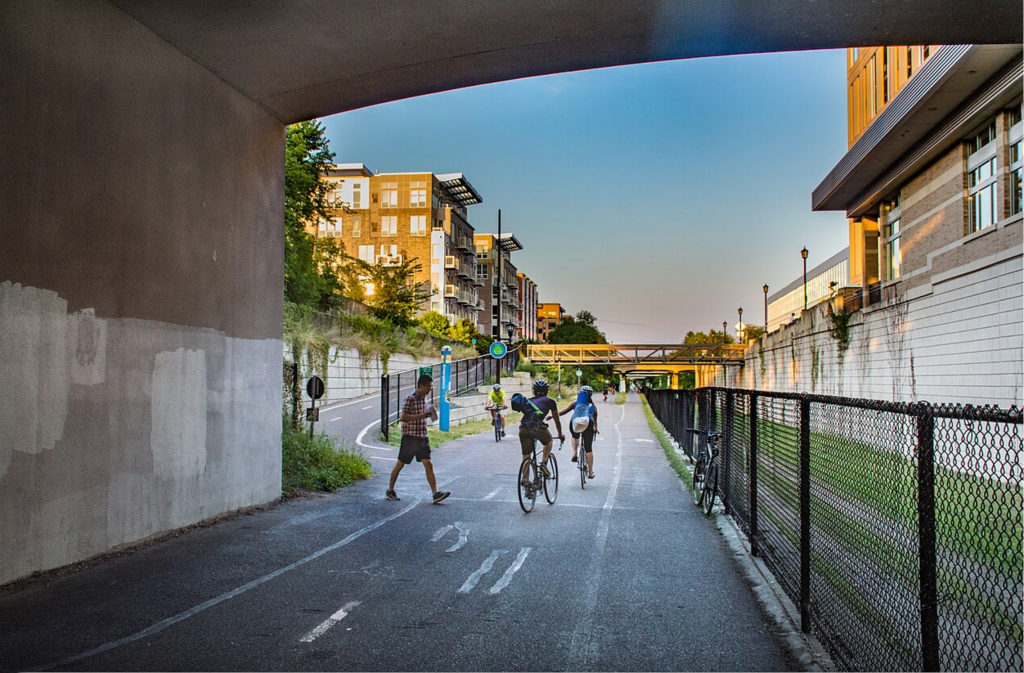
A bold new bill would significantly expand federal funding for walking and biking infrastructure by treating them as essential tools to accomplish America’s transportation goals — even as some in Congress and the White House incorrectly dismiss them as distractions.
Rep. LaMonica McIver (D-N.J.) recently introduced the Parks to People Act, which would fund a $300-million discretionary grant program aimed at building greenways of national and regional significance — and not only in America’s parklands, as the bill’s name might imply.
Co-led by Rep. Lucy McBath (D-Geo.), the initiative would pay for all kinds of greenways, which the bill defines broadly as “a hard-surfaced or wheelchair-accessible facility built for active transportation,” with preference given to projects that “reduce traffic congestion, improve access to jobs, and lower emissions.” It would also prioritize projects that close gaps in existing multimodal transportation networks, or that cross multiple jurisdictions or state lines, where it’s particularly hard to build new greenways without federal support.
“If my colleagues across the aisle were actually listening to their constituents instead of their wealthy donors, they would realize just how important funding is for walking, biking, and other vital infrastructure,” said Rep. McIver in a statement to Streetsblog. “New Jerseyans are asking for less time in their cars and more access to good-paying jobs, quality education, and convenient transportation. That’s why I’m pushing my Parks to People Active Transportation Act forward.”
The legislation may seem like a tall order during President Trump’s second term, as politicians hostile towards infrastructure that doesn’t privilege cars dominate the capital.
Last April, US DOT Secretary Sean Duffy inaccurately claimed that bike lanes universally congest streets by removing lane space from drivers. And in November, House transportation committee chair Sam Graves (R-Mo.) said that he and his Congressional colleagues are “not going to be spending money on … bike paths or walking paths” when Congress reauthorizes the core federal transportation programs this fall, and will urge his elected peers to focus on “traditional infrastructure” like roads for drivers instead.
Advocates have long argued that walking and biking paths are traditional infrastructure, considering that both predate the automobile — and both can actually cure traffic jams if they provide a reliable alternative to driving by connecting people to the destinations they rely on.
“Connectivity is key to maximizing the potential of the country’s active transportation infrastructure in all types of communities — -rural, suburban and urban,” said Kevin Mills, vice president of policy at Rails to Trails Conservancy in a statement to Streetsblog. “As debate on the next federal transportation law moves forward, protecting and enhancing dedicated sources of funding to accelerate progress on active transportation networks is a priority.”
McIver’s bill would not be the first competitive grant program to try to plug the holes in America’s piecemeal greenway infrastructure.
Both that seed money and the program’s sheer scale could be enough to really move the needle, advocates hope. And a well-funded discretionary grant program for active transportation infrastructure might also inspire and catalyze other investments in multimodal travel, such as those funded by formula-based programs.
Unfortunately, the second Trump administration repeatedly demonstrated that discretionary grant programs are uniquely vulnerable to partisan interference. The current US DOT clawed back, slow-walked, or outright froze billions of dollars for sustainable projects in its first year — including some grants authorized under the existing Active Transportation program.
“Congress has the power to reinstate these funds and rein in this rogue administration, and it must do so. … The IIJA was a momentous step in the right direction, and it has been devastating to see what Trump’s administration has done out of petty malice to the programs that law created,” added Rep. McIver. “With that said, we should also see the IIJA as a down payment. There is still so much to do: we need sustained, growing investment in these programs — in the Active Transportation Infrastructure Investment Program, Transportation Alternatives, Recreational Trails, Safe Routes to School, and yes, greenways.”
McIver and other advocates insist there’s still a place for competitive initiatives like Parks to People, in part because they’re designed to center the role of greenways in accomplishing bipartisan goals like ending congestion. And if successful, that strategy could lay the groundwork for a truly complete national network of multimodal paths, and create a playbook for overcoming political opposition.
“The Parks to People Active Transportation Act is exactly the kind of policy our nation needs to get federal funding flowing to these critical projects — from the Maine-to-Florida East Coast Greenway to similar efforts in Detroit, Denver, Los Angeles, and beyond,” said Dennis Markatos-Soriano, the executive director for the East Coast Greenway Alliance Executive Director. “We are grateful for Rep. McIver’s leadership in building a path forward by dedicating federal support for transformational greenway planning, design, and construction toward a healthy, sustainable, and thriving future.”
This story was updated with additional clarity about the funding allocation for Active Transportation Infrastructure Investment Program, as well as to incorporate a comment from Rep. McIver.

Read More:
Streetsblog has migrated to a new comment system. New commenters can register directly in the comments section of any article. Returning commenters: your previous comments and display name have been preserved, but you'll need to reclaim your account by clicking "Forgot your password?" on the sign-in form, entering your email, and following the verification link to set a new password — this is required because passwords could not be carried over during the migration. For questions, contact tips@streetsblog.org.