Talking Headways Podcast: The Future of Transit
This week on Talking Headways, transportation planner Yonah Freemark returns to discuss the state of transit in the United States and around the world. We consider the long-term impacts of the Bipartisan Infrastructure Law, how to improve transit-oriented development, the future of transportation, and updates to one of Freemark’s projects, Transit Explorer.
Note: This is part one of a two-part series.
As our loyal listeners know, there are three ways to listen to Talking Headways. First, you can listen to the audio in the played embedded below or on your favorite podcast app.
Second, you can peruse an AI-generated transcript of the episode here.
Third, you can read an edited excerpt below:
Jeff Wood: You also looked at the infrastructure bill and the results from four years, and it doesn’t look great. If you think back to when the bill was passed, do you think that the results reflect the feeling towards the bill at the time that it was passed?
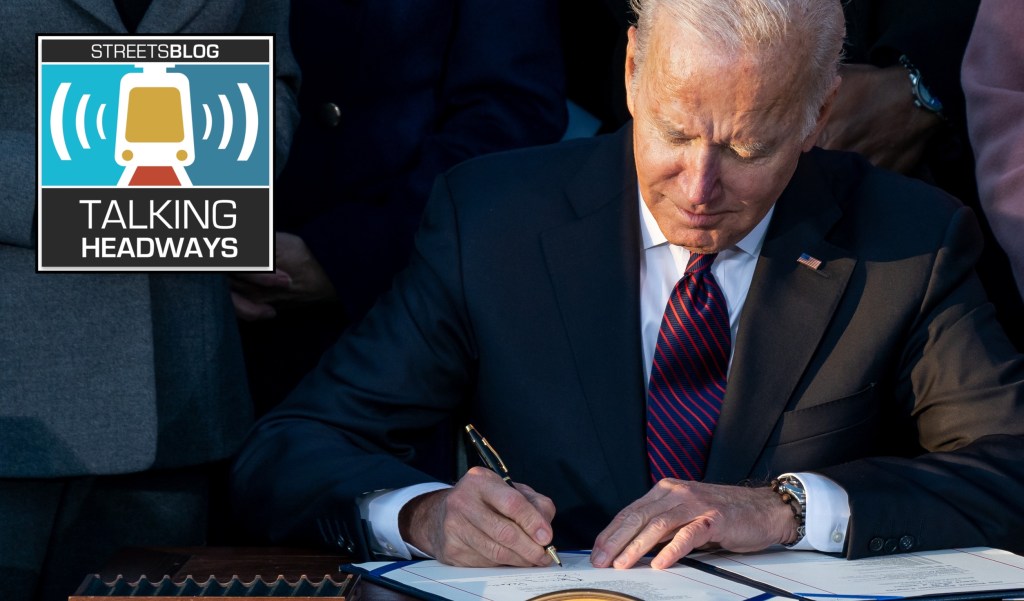
Yonah Freemark: At the Urban Institute, we try to track what’s going on with federal infrastructure spending. This huge law that we’ve passed in 2021 — which Joe Biden said was the biggest law for public transit ever and was this enormous investment in inner city rail — ultimately panned out to have very minimal effects.
There has been some increase in highway construction. But when it comes to transit investment, unfortunately the country is going in the wrong direction. That is really scary because that is not what we wanted out of this legislation. That is not what was described at the time, and it doesn’t even seem to match the numbers that were coming out of the federal government.
I think there are a few different things going on. One is that construction costs have just gone up a ton, so you get a lot less for your dollar. Second, states and localities have essentially [replaced] their own funding for projects with federal dollars — so that the ultimate end amount that’s being spent on projects is the same or lower than what it was before, because the states and localities are not spending as much on these types of things.
And then the third issue is that fundamentally there was perhaps a just sort of a general chilling in the transit investment world on new projects that continues up to this day. I think we used to have a lot more interest, for example, in new light rail lines around the country. And that has, in many ways, ground to the halt.
Jeff Wood: Is it because they’re so expensive?
Yonah Freemark: I think the cost is one explanation. Certainly, we are looking at enormous costs for new light rail lines. In Austin, we’re talking about $7 billion for a purely aboveground project. It’s not even particularly long.
In Seattle, the cost for some of the [light rail] extensions are more than $10 billion. When you have a situation like that, there’s a general chilling effect. A lot of ambitions about what you could buy 10 years ago no longer seem so obvious, and transit is exposed to that.
But it’s not just transit. The crossing between Portland, Oregon and Vancouver, Washington going over the Columbia River — that project’s cost has tripled over the last few years and nobody knows how they’re gonna pay for it. And that’s primarily a highway project. We’re facing this all over the country.

Streetsblog has migrated to a new comment system. New commenters can register directly in the comments section of any article. Returning commenters: your previous comments and display name have been preserved, but you'll need to reclaim your account by clicking "Forgot your password?" on the sign-in form, entering your email, and following the verification link to set a new password — this is required because passwords could not be carried over during the migration. For questions, contact tips@streetsblog.org.