Transportation Investments and America’s Quality-of-Life Gap
For a while it didn’t seem certain, but after a critical vote earlier this month, it looks like California’s on track to build high-speed rail. And, I’ll be the first to admit, California — with two large, global metros just a few hundred miles apart — is a great place for it.
Despite some reservations about the costs and feasibility of the plan, people all over the country who care about sustainable transportation were generally happy to see America moving forward. But in Wisconsin and Ohio and Florida, the news was bittersweet. James Rowen at Milwaukee-based blog the Political Environment again mourned the $810 million in federal passenger rail funding spurned by Governor Scott Walker. (Shortly after Walker’s decision, the LA Times gleefully wrote, “Thanks a billion, cheeseheads.”)
As great a day as it was for sustainable transportation, it also concerned me a little. Ohio and Wisconsin forfeiting billions for high speed rail to California is perhaps the clearest illustration yet of the growing divide between regions willing to invest in a livable future and those that are not.
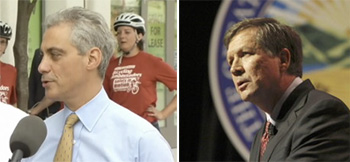
It seems that America is on two divergent paths. Progressive cities are engaged in something of an arms race to design neighborhoods and build infrastructure to enhance the quality of life. In Portland, they have streetcars, light rail, and neighborhood greenways. In New York, expertly-planned public plazas are making the central business district more attractive and reclaiming neighborhood streets for pedestrians. Soon the city will add a world-class bike-sharing system to go with its growing network of protected bike lanes. Seeming to recognize how these projects help to attract talent and investment, Chicago jumped in the game last year, with newly-elected mayor Rahm Emanuel promising to build 100 miles of separated cycle tracks and moving quickly to improve the city’s bus network.
Meanwhile, Ohio and Wisconsin — where talent and investment are no less needed — seem to have chosen a different path. Their Luddite governors are responsible for the painful loss of rail funds. And while there are counterexamples — Cincinnati and its streetcar, or Madison and its bike-share system — these places are moving much more slowly to adopt the kind of infrastructure that’s making places like New York and San Francisco increasingly desirable.
The obstacles in these regions are many. At the top of the list, you have harmful political decisions — typified by the unilateral rejection of passenger rail by Walker and Ohio Governor John Kasich. And political resistance is reinforced when locals who prefer transit and walkability move away, as young, college-educated Midwesterners have been wont to do.
Even where there is political recognition of the desirability of bike and transit infrastructure, these places may not have the money to expand them. For example, Cleveland, where I live, does not own a machine that can alter the striping of city streets to, say, make room for bikeways. Detroit can barely afford to keep its bare-bones transit system operational.
It doesn’t get any easier to invest in things that make your city desirable if people are leaving your city. The danger is that, when it comes to giving people the option of safely getting around without driving, much of the country will simply get left behind.
You can see this pattern at work when you look at the level of support for transit operations in different regions. Yonah Freemark, a master’s student in planning and transportation at MIT who writes The Transport Politic, examined transit spending by region and compared it to median household income. He found the two — wealth and transit funding — are strongly correlated.
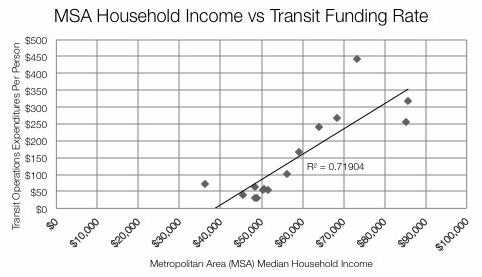
Freemark examined 15 metro areas, finding that wealthier ones were funding the operation of their transit systems at proportionally higher rates than their less affluent counterparts. A 50 percent increase in regional median income is associated with a 220 percent increase in transit spending, he found. The reason, he determined, is pretty simple: Areas that have more money can invest more money in transit.
Freemark’s conclusion was that funding transit operations at the local — rather than the national — level perpetuates inequality. Detroit’s poor transit forces lower income folks who can manage it to own cars, an enormous burden they might avoid in a wealthier metro with better transit. “Regions that are already well-off are making themselves better off, while those that are poorer are reinforcing their economic problems,” Freemark concluded.
Giving states more control over bike and pedestrian funding, as the recently passed federal transportation bill will do, could have a similar effect on street safety. The new bill lets states forgo spending on these modes if they choose. That’s very likely more bad news for places like Ohio and Wisconsin.

Streetsblog has migrated to a new comment system. New commenters can register directly in the comments section of any article. Returning commenters: your previous comments and display name have been preserved, but you'll need to reclaim your account by clicking "Forgot your password?" on the sign-in form, entering your email, and following the verification link to set a new password — this is required because passwords could not be carried over during the migration. For questions, contact tips@streetsblog.org.