“Amtrak Joe” Biden, in Philly, Announces a New Plan for High-Speed Rail

The Obama administration is taking its infrastructure push on the road. First stop: Philadelphia, to announce a $53 billion plan to invest in high-speed rail.
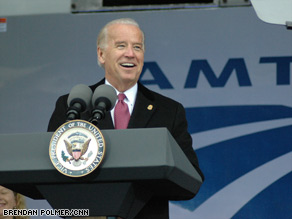
To Vice President Joe Biden, high-speed rail isn’t just another administration initiative. He’s Mr. Amtrak. He gets it. Biden says he’s made 7,900 round trips between Wilmington and Washington on Amtrak. If each of those trips had been reduced by 10 minutes, he says, he would have had 55 more days to spend with his family or working.
So the vice president was a fitting ambassador to travel to Philadelphia’s 30th Street Station with Transportation Secretary Ray LaHood to announce a six-year plan to build a national high-speed rail network that will, the administration says, reach 80 percent of Americans within 25 years. The plan he outlined today would devote $8 billion to rail development next year.
“In the next 40 years, the United States is expected to increase in population by 100 million people,” Biden said. “Seventy percent of all people in America now live within 50 miles of the Atlantic Ocean and the Pacific Ocean. You know how congested we are now. What happens with 100 million more, a significant portion of them along our coasts?”
Each day, he said, six times more people take a train than an airplane to get between Washington and Philadelphia. And more than twice as many people take the train between New York and Washington than fly. “How many more slots can the Philadelphia airport open?” Biden asked. “Airways can only take so much traffic in the lanes.”
“If you shut down Amtrak’s Northeast Corridor,” Biden said, “you’d have to add seven new lanes to I-95 to accommodate the traffic.” He then went on to cite the cost-benefit analysis of building rail instead of road. The construction cost for an average linear mile of one lane through the city of Philadelphia ranges from $40-50 million. And one new runway, like the one Atlanta just built in its Hartsfield-Jackson Airport, costs $1.3 billion.
“When you talk about the investments we’re making in rail, they pale in comparison to investment you’d have to make in runways or highways,” Biden said. “And that’s before you factor in the environmental benefit of taking cars off the road.”
In a press release issued immediately after Biden’s speech, the White House said, “The proposal will place high-speed rail on equal footing with other surface transportation programs and revitalize America’s domestic rail manufacturing industry by dedicating $53 billion over six years to continue construction of a national high-speed and intercity passenger rail network.”
Six years is also the proposed duration of the next transportation authorization, which Congress is planning to start working on once they finish the FAA reauthorization, currently debating. The president’s budget is due to Congress Monday. He’s already said it will include his ideas for transportation funding for the next six years. Consider this the opening volley.
The plan announced today would start with $8 billion in the coming fiscal year. But Republicans are taking a slash-and-burn approach to the budget, and administration priorities like high-speed rail are high on the list of potential casualties. Where will the money come from, now that recovery act money is gone and Republicans are trying (and failing, but still trying) to go back to 2008 levels for discretionary spending. The White House press release doesn’t explain how it intends to come up with the money, or get such a proposal through an axe-happy House.
Nevertheless, the administration proposal is a good start. The plan is to focus on developing or improving core high-speed corridors as well as regional and “emerging” lines with slightly lower speeds, laying the foundation for future high-sped service and connect to existing high-speed corridors. It’s designed to include the private sector, a key goal of Transportation Committee Chair John Mica. And for the first time, it will separate the accounts for new rail capacity and state of good repair, depositing $4 billion in each at the outset.
Don’t expect this plan to sail through Congress. But as the administration continues to articulate and refine its vision for transformational infrastructure investment, it sets a high bar advocates can press lawmakers to reach for.

Read More:
Streetsblog has migrated to a new comment system. New commenters can register directly in the comments section of any article. Returning commenters: your previous comments and display name have been preserved, but you'll need to reclaim your account by clicking "Forgot your password?" on the sign-in form, entering your email, and following the verification link to set a new password — this is required because passwords could not be carried over during the migration. For questions, contact tips@streetsblog.org.