Talking Headways Podcast: Sidewalk Nation
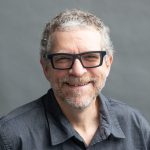
This week on the Talking Headways, former Supreme Court law clerk and Cardozo School of Law Professor Michael Pollack discusses his new book Sidewalk Nation: The Life and Law of America’s Most Overlooked Resource.
Pollack discusses who manages, owns and feels ownership of sidewalks, and advocates for a department dedicated to them.
We also talk about the nexus between sidewalks and roads, the impact of the Americans with Disabilities Act and Denver’s successful funding and maintenance referendum.
Scroll past the audio player below for a partial edited transcript of the episode — or click here for a full, AI-generated (and typo-ridden) readout.
Jeff Wood: Are we free on the sidewalk?
Michael Pollack: Ha. That’s a loaded question.
Jeff Wood: I know. People should go read the book to get the whole answer.
Michael Pollack: Are we free on the sidewalk? We are freer than we might think, but also more subject to being made un-free than we might think. So again, it’s public space, or at least it is private space with a public easement, and so the Constitution applies.
We have rights to speak. We have rights to protest. We have our First Amendment rights. We have our Fourth Amendment rights to be free from unreasonable searches and seizures by the police. I don’t get into this in the book, but sidewalks also raise Second Amendment concerns about the freedom to carry weapons openly or concealed.
So we have our constitutional rights on the sidewalk, and yet the law, the constitutional law, as well as what cities have in fact done, has limited all of those rights, sometimes in the name of public order, as we were discussing before, and sometimes in the name of protecting the adjacent property owners.
So for example, you do get to protest and picket on the streets, but the courts have said it’s okay sometimes if a municipality says you’re not allowed to do that in a residential neighborhood. Sometimes that’s gonna be upheld. Why? Because the owners of those homes or the residents of those homes deserve their peace and quiet, even if, you know, or perhaps especially if they are the target of that protest.
But we are in fact free to picket in front of commercial establishments. That’s well established. We’re free to, as I was saying before, engage in signature gathering for petitions, referendums, things like that on most sidewalks, except sidewalks at post offices, where there’s a whole line of cases where that’s deemed to be obstructive of important federal efforts, right?
When it comes to policing and our right to be free from unreasonable searches and seizures, well that’s true, except that we can be stopped by the police and briefly frisked by the police. If you put your garbage out for collection on the sidewalk, which in New York City, that’s what we do, that garbage can be searched by the police because it’s considered abandoned property.
And then there’s all of the new technology surveillance architecture that is deployed on the sidewalk, so that’s cameras or license plate readers or facial recognition. None of that is really governed by our current Fourth Amendment law at all. So yes, are we free on the sidewalk? Absolutely. It is public space.
It is not private space, therefore we have constitutional rights. But those rights are not quite as capacious as I think we often think they are. Now, when I say that, I don’t mean that we automatically don’t have the right to protest in a residential neighborhood or that we don’t have XYZ rights from unreasonable searches and whatnot.
Rather, what the Constitution tells us is that, or at least how the courts have interpreted the Constitution, what it tells us is that governments have the ability to prohibit us from protesting in a, in a residential neighborhood. They have the ability to instruct their police officers to stop and frisk folks in these ways.
It doesn’t mean that they have to make those choices. It doesn’t mean that we as voters have to make those choices either. And so part of my message in the book is when we think about what we want our public life to look like, that includes what we want our speech, protest, policing, surveillance public life to look like.
And we have more, we as voters have more of a role to play here than I think we often think we do. The Constitution does not answer all of these questions one way or the other. It leaves them to the local political process. And so if you don’t like what’s happening, you can and should vote for something else.

Read More:
Streetsblog has migrated to a new comment system. New commenters can register directly in the comments section of any article. Returning commenters: your previous comments and display name have been preserved, but you'll need to reclaim your account by clicking "Forgot your password?" on the sign-in form, entering your email, and following the verification link to set a new password — this is required because passwords could not be carried over during the migration. For questions, contact tips@streetsblog.org.