Opinion: We Must Price and Manage The Curb Before Robo-Taxis and Other AVs Scale Up
Jordan: I live in Los Angeles, so I see autonomous vehicles every day. I ride in them. I also watch them stop in active travel lanes, idle in red zones, and sit at the curb in metered spaces for which they don’t pay, at which they can’t be ticketed, and that don’t appear in any city system as occupied. The car is physically present, but administratively it is largely invisible, unlike most other vehicles today where cities have at a minimum mechanisms for them to pay for curb use and receive citations for non-compliance.
Gabe: I live in D.C. and AV legislation for commercial service is just being introduced. We currently have robo-taxis testing on the streets, and myriad delivery and ride-hail services are visible throughout the city. The gap between what’s on the street and what cities can actually see, price, or enforce is the defining curb management problem of the next decade. And almost no one is treating it with the urgency it deserves.
Cities are underestimating VMTs
Enforcement is about to get much harder. By BloombergNEF’s count, highly automated vehicles are already operating in 103 cities globally, intermingling with around 310 million people daily. A peer-reviewed study published this year in Travel Behaviour and Society found that automated vehicles in US cities are associated with a roughly 6-percent increase in vehicle miles traveled — driven in part by AVs traveling empty between trips, searching for parking, or returning home after dropping off passengers. That’s not a forecast. That’s a measured effect at today’s deployment levels.
The economics push the curve up sharply from here. Fire the driver — historically the highest single cost in a for-hire trip — and per-mile prices fall. Demand at lower prices rises. Fleets scale to meet it. This is Econ 101, and it’s why we think most municipal planners are working off an expected volume of robotaxis on the street that will look far too low by 2030.
The usual playbook won’t work
Cities learned a hard lesson with shared scooters and bikes: get permitting, data sharing, and curb rules in place before the inventory shows up, or spend years chasing it. With AVs, the equivalent move is largely off the table. State pre-emption in California and elsewhere puts AV regulation with the state not with cities. Most local governments cannot cap AV fleet sizes the way they cap scooter permits. They cannot mandate the granular operational data for AV’s that they extract from micromobility operators today.
And even when they can request it, they’ll be negotiating with Waymo, Zoox, Tesla, Nuro, Uber, Motional, and many others — each with different software, routing logic, parking behaviors, and APIs.
You’re not going to manage a multi-vendor robotic fleet by writing a memo to each company. The data asymmetry is too wide and the political leverage too narrow. Not to mention that every time a new “driver” is downloaded, the entire tech stack can be altered, and the vehicles may behave differently than minutes before.
What’s worse, the enforcement model itself is currently unworkable for AVs in many jurisdictions. Under California law, robotaxis are immune from moving violations because tickets must be issued to a human driver, though that changes in July 2026 when law enforcement will be able to issue “notices of autonomous vehicle non-compliance” to the companies themselves. D.C. plans the same. Even then, parking citations remain the primary enforcement lever, and they’re issued by humans walking up to vehicles with paper. That doesn’t scale to the fleet sizes coming.
The opportunity hiding inside the problem
Here’s where we want to push back on the doom framing, because there is a real opportunity in this — and it’s the opportunity Donald Shoup made the case for in The High Cost of Free Parking and Henry Grabar extended in Paved Paradise: cities have been largely giving away the right-of-way for almost a century, mostly to private passenger vehicles, mostly for political reasons, and mostly at enormous discount to the actual value. Curb space is some of the most valuable real estate a city owns, and it’s been priced as if it were nearly worthless.
AVs are forcing the conversation that should have happened decades ago. A robo-taxi sitting in a metered space all morning is functionally no different from a private car doing the same thing — it’s just more visible, more obviously commercial, and harder to politically defend. That visibility is leverage. It’s the wedge that lets cities finally price and manage curb access at something closer to its real economic value, and use the revenue to fund transit, road redesigns for safety, and the maintenance backlog that’s been deferred for decades.
The best news? The robo-taxi companies want to pay for the time and space they use, but lack a mechanism. And if they pay, then everyone should, driver or no driver. You can only capture that opportunity if you have the infrastructure to actually do the pricing and enforcement. But time is of the essence. We learned that once America had “freeways,” it was nearly impossible to charge for their usage.
Cities must automate the curb (AI for AI)
If cities can’t realistically regulate AVs vehicle-by-vehicle or company-by-company, the strategic move is to manage the right-of-way itself, unilaterally, with a standard set of business rules that apply equally to every actor at the curb — human, commercial fleet, or autonomous. Essentially, a car is a car is a car. AI is not just for the private sector; the government needs to scale up its use quickly to handle the influx of new technologies and services that will automate a litany of tasks and mobility options and need a way to pay for usage.
The Open Mobility Foundation’s Curb Data Specification was developed by cities and the industry with these goals in mind. Curb Data Specification enables cities to express their curb rules and regs in a common and machine-readable digital language unlocking dynamic management, automated payment and curb enforcement. As more cities adopt Curb Data Specification, AV companies only have to learn one new digital language to understand the curb rules anywhere they operate.
That means three things:
Common rules, not per-operator negotiations. The city defines the business rules — at what price, where and when can companies operate, and for how long. Every vehicle in the right-of-way operates with the same rules. AV companies don’t get a special carve-out, and they don’t get to negotiate the data exchange on a fleet-by-fleet basis.
Automated curb payment. Every vehicle that occupies a curb space — whether it’s a Waymo dropping off a passenger, an Amazon van loading a package, or a private car parking for lunch — should be billed for the time it occupies that publicly owned space, automatically. No app required. No meter required. No officer is required to confirm the transaction. The infrastructure recognizes the vehicle and the duration, and posts the charge.
Automated curb enforcement. The same infrastructure that prices legal use should detect and cite illegal use — double parking, blocking a bike lane, overstaying a loading zone, parking in a no-stopping zone. Enforcement at the speed of the violation, not the speed of a parking officer’s walking route. We should be at nearly 100 percent compliance for proper use of the curb, and AV’s can be programmed to meet this standard if the right costs and feedback loop are baked into the system.
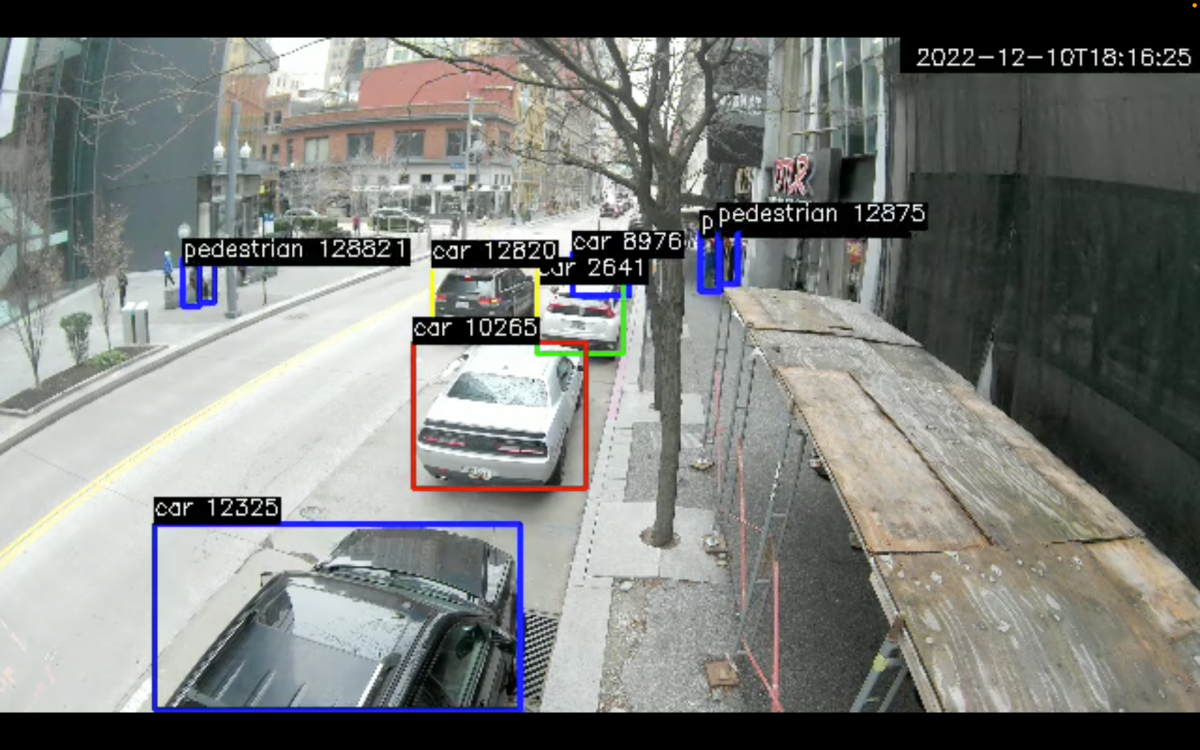
Pole-based cameras with computer vision is, in our view, the only technology that scales to do this across an entire city. It’s vehicle-agnostic, it works on existing infrastructure, it produces an evidentiary record sufficient for citation, and it doesn’t depend on each fleet voluntarily handing over telematics. It’s also the same approach a growing list of cities — Miami, Pittsburgh, Philadelphia, Portland, Los Angeles, Sacramento International Airport — are already using to manage commercial activity from Amazon, DoorDash, and Uber and Lyft via Smart Loading Zones. The use case is identical. AVs just make the need impossible to ignore.
Airports are a testing ground
If cities are the long-term battleground, airports are where the conflict is most acute right now. By some industry estimates, airport trips can generate up to 60 percent of taxi profit from approximately 15 percent of trip volume — meaning the curb in front of a terminal is one of the most economically intense roadways in the country, and AV fleets are entering it with the same playbook they’re running in cities. Cities that may be subject to state regulation for robo-taxis and Ubers, in many cases, do control the airport from the mayor’s office, like Los Angeles, and therefore have a real opportunity to think holistically about curbside management.
At the same time, the airport business model is being squeezed from the other side. Parking revenue — which has historically funded a large share of airport operations — has been in decline as travelers shift from self-parking to drop-off and ride-hail. Add AV trips on top of that, and the revenue line keeps falling while curb volume keeps climbing. That’s not a sustainable equation without a new way to monetize and manage the curb.
This is exactly the gap automated curb management is built to close. At Sacramento International Airport, Terminal A handles more than 175,000 vehicles a month at the curb. After deploying computer-vision-based monitoring automated enforcement, the airport went from 40 percent of vehicles dwelling at the curb longer than policy allows to only 11 percent — a substantial behavior change without adding enforcement headcount.
The same dynamic that makes airports the highest-value testing ground today makes them the most exposed to AV growth tomorrow.
The window is closing quickly
The vehicles are scaling now. The miles are being driven now. The behaviors that San Francisco transit operators are documenting — stalled robo-taxis blocking public streets, problems that can take as long as an hour to resolve, requiring transit dispatchers to call Waymo’s call center or even police to clear the vehicle — are early symptoms of a much larger operational reality coming to every major city in the country.
Cities that build automated curb management infrastructure in the next two to three years will have priced, rule-based control over their right of way before the AV inventory peaks. Cities that wait will be doing it reactively, under pressure, with less leverage and less revenue. Additionally, if costs are lower for robotaxis than traditional Ubers and Lyfts, then the delta is important to be able to price, to assure that the best tool is used for the best trip (walk, transit, bike), and right-of-way pricing will be the mechanism most cities will have left to influence this. Think of it as congestion pricing-lite.
The right-of-way is the city’s. The decision about whether to actively manage it is, too — for now.


Read More:
Streetsblog has migrated to a new comment system. New commenters can register directly in the comments section of any article. Returning commenters: your previous comments and display name have been preserved, but you'll need to reclaim your account by clicking "Forgot your password?" on the sign-in form, entering your email, and following the verification link to set a new password — this is required because passwords could not be carried over during the migration. For questions, contact tips@streetsblog.org.