When Traffic Violence Hits The Same Family Twice — Years Apart, On Exactly the Same Street
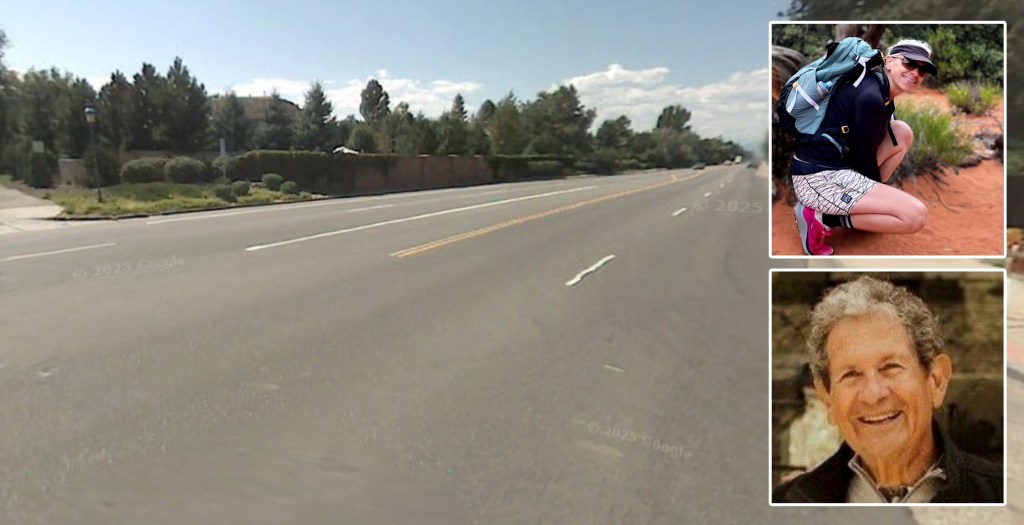
The death of a husband and wife in separate crashes at the same intersection is renewing a battle for traffic calming in the Denver area — and sparking conversation about why multiple people have to die before communities take action to calm dangerous roads.
Gerry Goldberg, 82, made headlines across America last month when he was killed in a two-car crash at the corner of East Belleview and South Franklin in metro Denver, just a block and a half from his home — the exact same place where a different driver had killed his wife Andie, 59, while she was on a morning run in 2024.
Many journalists and even the victims’ own families mourned the Goldergs’ eerily similar deaths as a tragic coincidence straight out of a “science fiction” novel. But local advocates say that it shouldn’t be surprising that multiple people lost their lives at the intersection of a five lane, 35-mile per hour arterial like Belleview and a sleepy residential road like Franklin — even if it is terrifying that the specific people who died were husband and wife.
“You don’t have to be a traffic engineer or a skilled advocate to conclude that the intersection is not safe — and something needs to be done before somebody else is hit,” said Pete Piccolo, executive director of Bicycle Colorado.
Disturbingly, the Goldbergs aren’t the first married couple to lose their lives in separate car crashes years apart — and they’re not even the first to die on the very same road.
In 2021, Claire Grossman, 63, was also killed by a driver just two blocks from where her husband, Robert Grossman, 64, had died six years earlier; both were attempting to cross a six-lane road near their bus stop in Montgomery County, Maryland. Thanks in part to the sheer preponderance of dangerous roads in the U.S., countless other families across America have lost multiple loved ones in successive car crashes, too, even if those collisions usually happen at different sites.
Like Claire Grossman, Gerry Goldberg was even interviewed about his spouse’s death on the local news years before his own death — though in Goldberg’s case, he used his air time for advocacy. He helped mount a petition to get local leaders to explore installing a traffic light at the intersection, which he believed could have saved her life; 432 people eventually signed on.
By the time Gerry was killed in March 2026, though, not even a traffic signal warrant study had been completed for the corridor. And for community members who were working to calm it long before either of the Goldbergs were killed, that delay is growing more unacceptable by the day.
“The debate is not really about safety,” said Jerry Presley, a family friend who helped the grieving husband launch his petition drive. “The debate is about something else. … It’s about the willingness to see the other side. And I don’t think that’s happening now.”
Presley understands better than most just how long it can take communities to come together around a plan to make a dangerous road safer.
A former city councilmember, he’s fought since 2008 to get a traffic light installed at Belleview and Franklin, which lies at the border between Greenwood Village, which he represented, and neighboring Cherry Hills.
Presley and Gerry Goldberg didn’t initially bond over that shared mission; both men were avid classic car collectors, and met when Goldberg helped Presley sell one from his collection. After the death of Goldberg’s wife, though, the two became closer, spending hours strategizing over how to sway the many stakeholders around the intersection that something needed to be done.
Presley helped Goldberg understand that like many of America’s most dangerous neighborhood roads, Belleview is technically a state “legacy” highway, which means the Colorado Department of Transportation gets final say over its design. Practically speaking, though, three separate jurisdictions have a direct stake in the future of the corridor — and they don’t all agree on what should be done.
Before his death, Goldberg’s petition spawned an opposition effort which claimed that installing a traffic light on Belleview would simply displace high-speed vehicle traffic into the adjacent villages, exposing neighbors on both sides of the stroad to the threat of pollution and traffic violence — especially on the Cherry Hills side of the divide, which doesn’t have sidewalks.
Rather than advocating for installing those walkways, though, the authors of the petition wrote, “The lack of sidewalks and street lighting adds to the unique charm and tranquility of our community.” (The authors of the petition did not respond to a request for comment.)
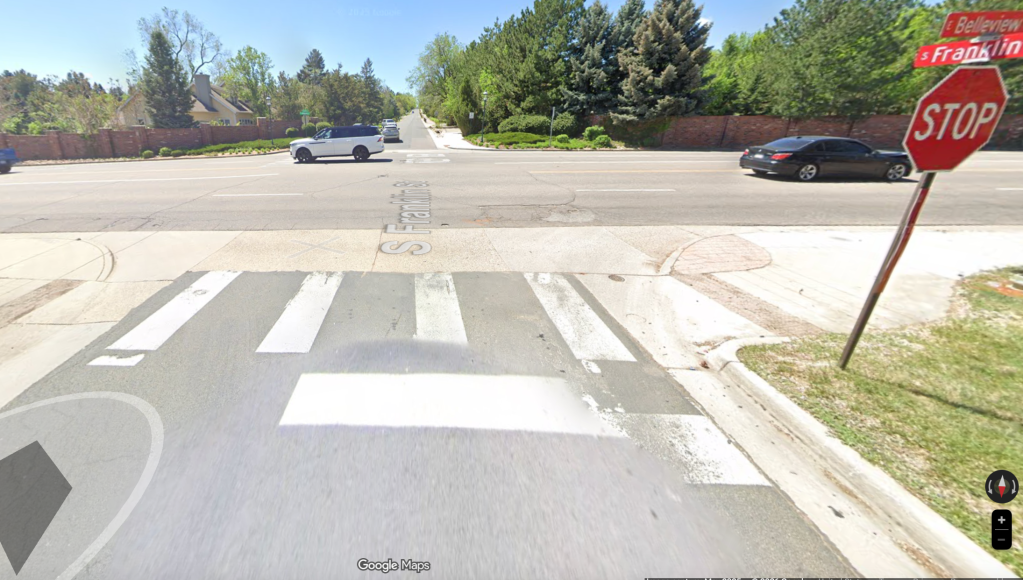
Local officials, meanwhile, say they aren’t opposed to making Belleview and Franklin safer — even if they disagree with some of their neighbors on what options should be on the table. The Cherry Hill council has requested a new traffic signal warrant study on the corridor since Gerry Goldberg was killed, but declined to pursue one jointly with Greenwood Village as his and Presley’s petition requested.
In an email to Presley a week after Gerry’s death, Cherry Hill Mayor Katy Brown heavily implied her residents would oppose installing a traffic light if it also meant installing sidewalks on adjacent roads, arguing that building walkways “would involve significant destruction of property” and would require “a considerable cost that must be considered, particularly when it is not addressing a demonstrated need.
“The fact is that this process has been driven primarily by [Greenwood Village] residents,” the mayor continued, possibly referring to Presley and Goldberg themselves. “While we appreciate their concerns, as friends and neighbors, the CHV City Council is accountable to our residents — they elected us to represent their interests and that is exactly what we are going to do.”
For local Vision Zero advocates, though, it’s baffling that any city should be able to block safety interventions to preserve their preference for the “charm” of dark, sidewalk-free streets — especially when multiple people are dead.
“Anyone who says that this is a complex situation because of multi-jurisdictional dynamics, to me, is making an excuse,” added Piccolo of Bicycle Colorado. “This is not that hard.”
Piccolo says Gerry Goldberg reached out to his organization in the wake of his wife’s death for help with his petition campaign; he’d advised the widower not to accept the idea that simply nothing could be done to make Belleview and Franklin safer right now, even if there were designs to fine-tune and skeptical neighbors to placate.
“I think the delay is, ‘We need to study this; we need to get it get it right,'” he added. “I get all of that. But you can still install a traffic signal, and if it turns out that it’s doing more harm than good and the people who expressed concerns were right, well, then you change it. … There are multiple options [to save lives] that could have been implemented right after Andie was hit – or before she was hit.”
Of course, the Colorado community where the Goldbergs died is far from the only one that’s failed to be proactive about ending traffic violence – or even to react with urgency when tragedy strikes multiple times. Some advocates have even argued that transportation officials should be obligated to automatically treat the site of traffic deaths as emergency zones, throwing up temporary road closures and quick-build traffic calming interventions within as little as 48 hours of any crash.
Until neighbors understand that the Goldbergs’ eerily similar deaths weren’t just an eerie coincidence, though, Piccolo and Presley fear that they won’t take action to prevent future fatalities — and soon, tragedy could strike again.
“Until you’re directly impacted by it, you don’t understand the breadth and depth of the problem of traffic violence,” said Piccolo. “When an advocate says something like, ‘It’s only a matter of time before somebody else is hit and killed here,’ [a councilperson often says], ‘Really? Come on; you’re being hyperbolic.’ … [They treated] Andie’s fatality as an outlier; ‘certainly, it’s not going to happen again in this intersection.’
“But if you look at the data — and if you look at what happened — it’s not an outlandish statement at all,” he added.
Cherry Hills City Manager Chris Cramer issued the following statement in response to a request from Streetsblog:
“Since the accident [sic] on March 2, Cherry Hills Village has multiple efforts underway surrounding [this intersection]. Cherry Hills Village staff has been meeting with the City of Greenwood Village staff and are reviewing conditions at the intersection. Further, the Cherry Hills Village Police Department is continuing to coordinate with Greenwood Village Police Department for increased traffic enforcement in the area. … Cherry Hills Village remains committed to the safety and well-being of the community and will continue working with Greenwood Village in support of that shared priority.
The Greenwood Village City Manager’s office issued this statement:
“The Cities of Greenwood Village and Cherry Hills Village have met and are actively working together to identify potential next steps for the shared Belleview-Franklin state highway intersection, in partnership with the Colorado Department of Transportation. … Both cities share a deep concern for the safety and well-being of everyone in our communities, and these collaborative efforts reflect our ongoing dedication to finding meaningful improvements.

Read More:
Streetsblog has migrated to a new comment system. New commenters can register directly in the comments section of any article. Returning commenters: your previous comments and display name have been preserved, but you'll need to reclaim your account by clicking "Forgot your password?" on the sign-in form, entering your email, and following the verification link to set a new password — this is required because passwords could not be carried over during the migration. For questions, contact tips@streetsblog.org.