Michigan Bill Would Require Seniors to Regularly Re-Take Their Drivers’ Tests

A controversial new Michigan bill would require seniors to prove they’re road-ready as often as once a year — even as advocates argue that policymakers should look beyond age to determine who’s really safe behind the wheel.
Under the legislation, introduced by Michigan State Senator Rosemary Beyer (D-West Bloomfield), people who turn 75 years old in the Wolverine State would need to pass written and on-road driving skills tests every four years, in addition to vision tests that are common in other states. At 85 years old, they would need to clear those hurdles every year.
The bill would create the toughest senior licensing laws in the nation. Illinois is currently the only state that requires any kind of repeat road test for elderly motorists — and it recently increased its testing threshold from 79 to 87 years old, with options for drivers with clean records to opt for a written test instead.
The Michigan bill took inspiration from the death of Sarah Thexton, whom a 94-year-old motorist struck and killed in 2024. The driver hit Thexton’s vehicle, and then inadvertently accelerated into the 59-year-old victim after she exited her car to assess the damage.
Some street safety advocates have focused on changing license laws to put more scrutiny on older drivers. But others caution against assuming seniors are more dangerous behind the wheel — and want to make sure elders can get around without driving instead.
“That is such a tragedy, and I really feel for that individual and their family,” said Cassie Thierfelder, manager of Advocacy for AARP Michigan. “Unfortunately, this bill is not the right reaction. We can still address the concerns that they have about driver safety without it being solely based on age.”
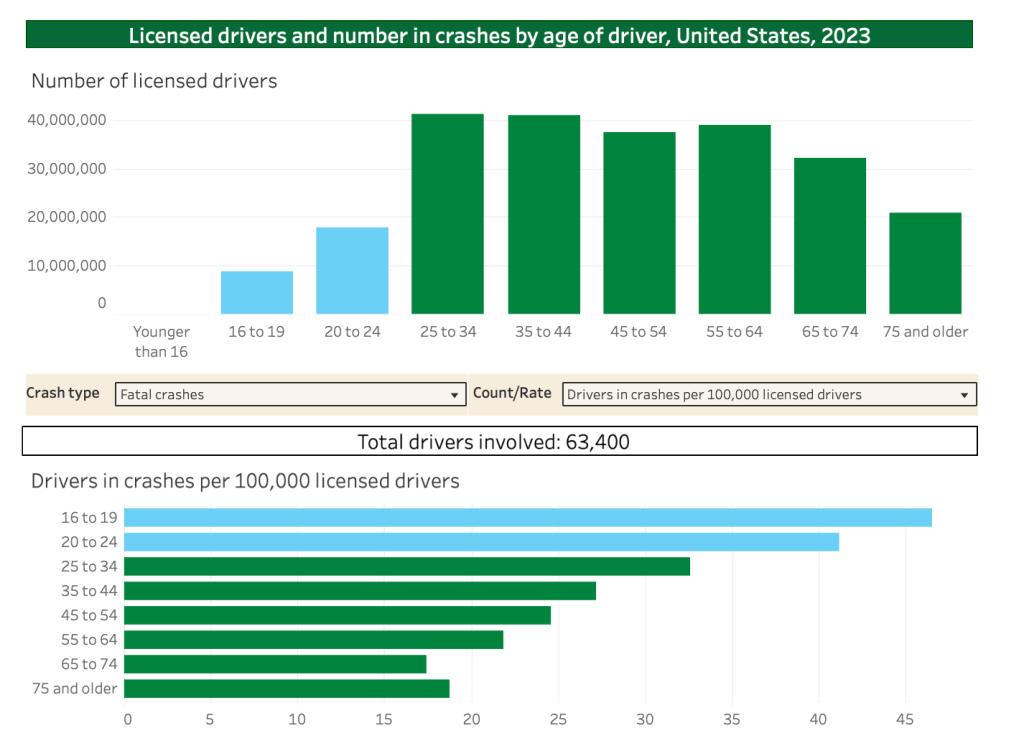
Thierfelder acknowledged that drivers over 70 record higher per-mile fatal crash rates than other age groups. She pointed out, though, that’s in large part because seniors drive significantly fewer miles overall, and have more health conditions that make seniors themselves more likely to die in a crash than younger motorists, who are more likely to kill other people.
The National Safety Council, meanwhile, noted that “the overall crash rate per 100,000 licensed drivers steadily decreases as driver age increases.” Fatal crashes per licensed driver start to tick up when drivers turn 75, but they’re still less than any other age group — except seniors between the ages of 65 and 74.
“Age alone is a poor predictor of driving ability and safety,” she added. “So we’re really concerned about this bill because of its discriminatory nature.”
Even if seniors were less safe behind the wheel, Thierfelder argued that the Michigan bill would still impose unfair burdens by requiring the oldest drivers to “pay private driving companies” to administer road tests and shoulder the inconvenience and expense of annual DMV visits.
In the most car-dependent communities, the bill would also cut off access to the only form of transportation available — which could mean that seniors who fail their tests will just drive anyway, heaping potential criminal charges on top of safety risks.
“This is about people’s independence,” Thierfelder added. “Driving is often what allows [seniors] to get to their jobs, to get to healthcare appointments. This is especially true in Michigan; if you do not have access to other reliable transportation or public transportation, you need to have access to your vehicle to be able to be a full participant in your community.”
Notably, the 94 year-old driver who killed Sarah Thexton did have ready access to public transit; she actually asked a judge to let her use it to attend her job as a court clerk before she had completed her 270-day house arrest sentence. A judge denied that request.
Instead of “costly, time-sensitive and stigmatizing blanket requirements,” Thierfelder argued that policymakers should make it easier for physicians to notify DMVs that specific patients are no longer medically safe to drive, and allow DMVs to impose re-testing requirements on people who have repeated violations or crashes — regardless of how old they are.
More importantly, though, transportation leaders must create alternatives to driving that people of all ages feel comfortable using. That could look like frequent and reliable transit with discounts for older populations and people with lower incomes, land use changes that place the destinations on which elderly residents rely within walking distance, accessible sidewalks, policies to make e-bike and e-trike technology more suitable for seniors, and much more.
“All of [those strategies] would protect public safety — without unfairly singling out older drivers, or undermining their mobility and their independence,” she said.

Read More:
Streetsblog has migrated to a new comment system. New commenters can register directly in the comments section of any article. Returning commenters: your previous comments and display name have been preserved, but you'll need to reclaim your account by clicking "Forgot your password?" on the sign-in form, entering your email, and following the verification link to set a new password — this is required because passwords could not be carried over during the migration. For questions, contact tips@streetsblog.org.