How DC’s Mayor and Council Chair Thwarted Every Effort to Better Its Streetcar
Editor’s note: a version of this article originally appeared on GGWash and is republished with permission.
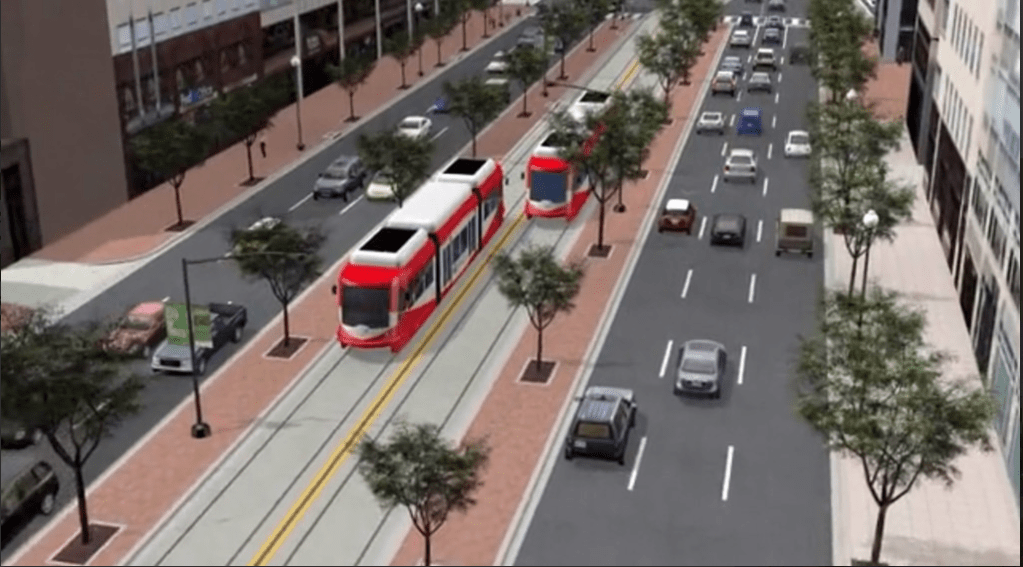
The two biggest technical problems with DC Streetcar have been friction with cars and the fact that it’s too short to be useful for many trips.
That’s technical. Politically, the two biggest problems were named Bowser and Mendelson. Although the District Department of Transportation drew up multiple plans to relieve the operational problems, either Mayor Muriel Bowser or DC Council Chair Phil Mendelson stepped in to thwart every single attempt.
It didn’t have to be that way. The streetcar’s failures are not inherent, they’re supervisory. As the streetcar winds down for its March 31 closure, let’s recount those derailments of stewardship.
A two-mile stub was never the plan
Transit has to carry people to destinations. The more destinations it reaches, the more people can use it.
The original idea behind the DC Streetcar was to cover all of DC. Early network plans from the mayoral administrations of Marion Barry and Anthony Williams evolved under Mayor Adrian Fenty into a maximal 37-mile proposed streetcar network, anchored by an eight-mile-long east-west line from Georgetown to Benning Road, including what became the H Street segment.
Nobody ever seriously considered building that entire network in one single swoop. But Mayor Vincent Gray wanted to build 22 miles of it at once, and got so far as to budget $900 million for it and to formally solicit contractors.
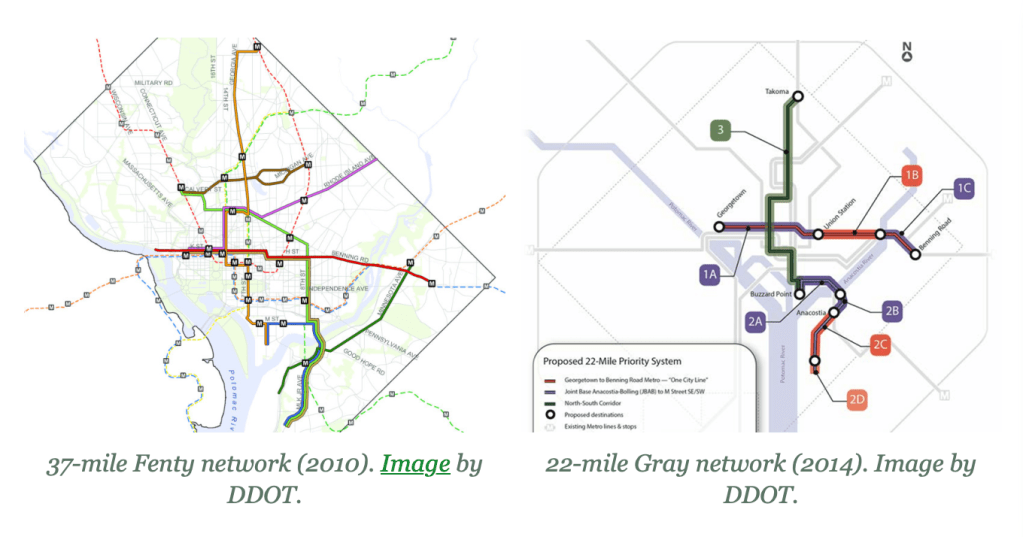
Gray’s plan very nearly happened. Until Council Chair Phil Mendelson slashed that budget by $500 million to fund tax cuts, trimming the system down to just the eight-mile east-west line.
Meanwhile, while running for mayor against Gray, then-Councilmember Muriel Bowser said she’d “reassess” the streetcar program, citing high costs, but avoided details beyond that. After winning election, Bowser promptly canceled the solicitation to build anything beyond the two-mile H Street segment, and floated the idea of killing even that just weeks before it would open.
What had been a funded city-wide system became a two-mile stub, too short to be useful or build a consituency.
Strategic delays in 2017, 2019, 2020, 2021, and 2023
Officially at least, studies to extend the stub into a useable eight-mile line lived on as the K Street Transitway and the Benning Road Extension.
In practice, Mendelson steadfastly refused to actually let them proceed. But rather than kill them and face blowback, Mendelson’s strategy was to repeatedly delay them, chipping away funding with every delay until nothing remained.

By 2017, Bowser’s budget included $160 million to build the Benning extension and engineer K Street. Mendelson eliminated $60 million of that, and pushed the remaining $100 million out to later years, giving him flexibility to cut it more later.
Which is exactly what he did. In 2019, Mendelson cut funding for K Street that had been in the budget for 2020 and 2021, once again pushing it back to later years.
By 2020, Bowser’s DDOT pulled the streetcar out of K Street plans, leaving only a much shorter busway.
In 2021, Bowser’s budget delayed funding for Benning, and in 2023 the council delayed Benning once again, this time at Ward 6 Councilmember Charles Allen’s recommendation, who with Mendelson defunded what remained of K Street that same year.
The public expected a usable line, but five times in a six year span, either the mayor or council chair prevented that from becoming reality.
Scuttled plans to free the streetcar from cars
For one mile along H Street — about half the total length — DC Streetcar runs “curbside,” meaning in the street lane closest to the curb, next to a lane of parallel parking. This is generally the worst place to put a train. Cars block it constantly, queuing to turn, parking, and picking people up. Putting a streetcar here is a recipe for delay.

DDOT built this section of tracks before really planning the streetcar corridor in detail. Circa 2006, they were rebuilding and repaving H Street, and agreed to lay down tracks while the street was already ripped up. The upside: DDOT wouldn’t have to rip up the street twice. The downside: There was never any consideration or public debate about putting the tracks anywhere else, or managing them differently.
After DDOT laid the tracks but before the streetcar opened, criticism started piling up that the line needed dedicated lanes. After service began, that problem was immediately apparent, and has dominated streetcar discourse for its entire decade of service.
Interestingly, throughput congestion was not the biggest driver of delay for the streetcar. Rather, it was cars parked too close, pickup-dropoff, and other problems with being too close to the parking lane. The median lanes on Benning didn’t face those problems and worked much better.

These lessons weren’t lost on streetcar planners. None of the expansion proposals that actually received detailed planning prior to track construction would have relied nearly so much on curbside mixed traffic lanes. There would have been segments of that, yes, but planners focused on avoiding it.

| Georgia Ave: Either dedicated or median, depending on segment. Image by DDOT. | Benning Rd: Mixed traffic but sans parking. Image by DDOT. Anacostia: Curbside sans parking. Image by DDOT originally, depixelated via AI. |
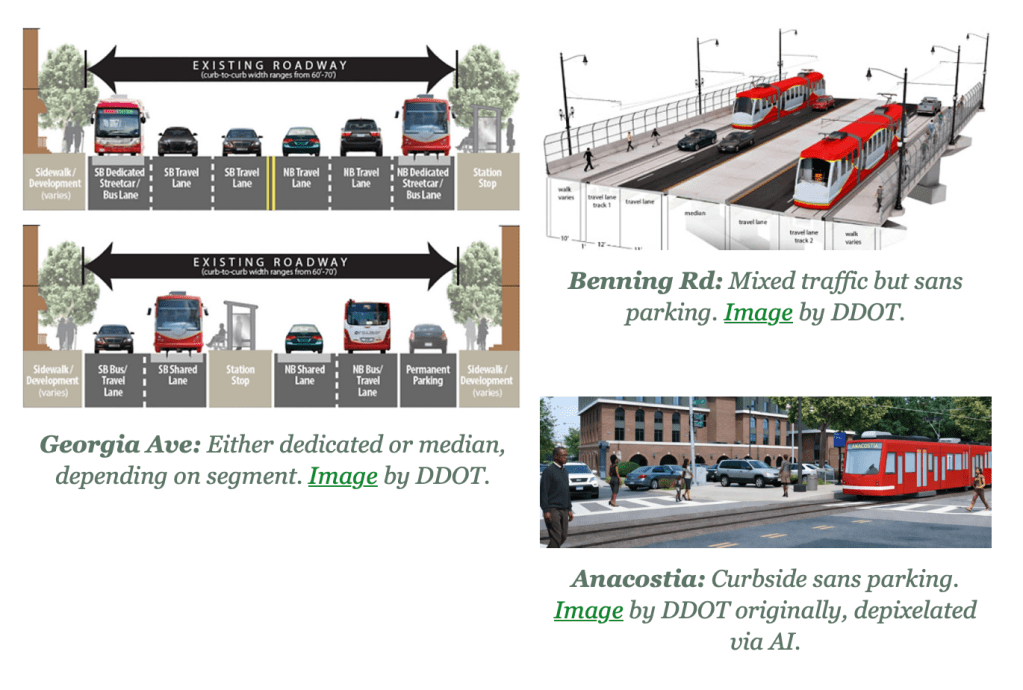
The mayor or council blocked all of these from actually happening.
H Street transit lanes
Even on H Street itself, the business and advocate communities pushed hard over the past few years to give streetcars dedicated lanes. DDOT drew up plans to convert the streetcar’s shared lane into a dedicated one for transit, including buses.
The H Street plan would’ve also added bus bulb-outs, and converted some of H Street’s parking to pick-up spaces.

This plan would’ve had a big impact on that one mile of especially “car-frictiony” H Street. It was fully designed, fully funded, and slated to begin construction in 2025.
Until Mayor Bowser canceled it at the 11th hour, shortly before construction would’ve started. That same spring, she announced she would close the streetcar entirely.
Also that same spring, Bowser announced a deal to build a new Washington Commanders stadium near the streetcar’s eastern stop. Whether or not eliminating pesky transit in order to reserve car space for stadium traffic was an explicit part of the negotiations is anybody’s guess, but the timing is suspect.
Failure wasn’t inevitable, but Bowser and Mendelson guaranteed it
The DC Streetcar was a response to the very real need for better street transit. It could have delivered.
In building the H Street line, DDOT immediately learned a ton of lessons, arranged adjustments to massively improve the product, and then never got to apply any of them, because two people blocked every attempt over the span of a decade.
Council Chair Mendelson treated the streetcar as a budgetary slush fund: a place to park money in the out-years of the budget, and then move it away onto something else when the time drew near.
Mayor Bowser treated the streetcar as an inconvenience from day one, happy to take credit for completing the work of prior administrations but never believing in the legitimacy of its purpose. More than that, she’s turned a harsh corner on multimodal transportation in general during her third term, canceling not only the streetcar and transit lanes, but also the Circulator and multiple major bikeways.
In hindsight, one wonders if either Bowser or Mendelson ever had any intention of doing anything to the streetcar except strangling it to death.

Read More:
Streetsblog has migrated to a new comment system. New commenters can register directly in the comments section of any article. Returning commenters: your previous comments and display name have been preserved, but you'll need to reclaim your account by clicking "Forgot your password?" on the sign-in form, entering your email, and following the verification link to set a new password — this is required because passwords could not be carried over during the migration. For questions, contact tips@streetsblog.org.