Why Trump’s DOT is Promising More Money to States With Higher Birth Rates
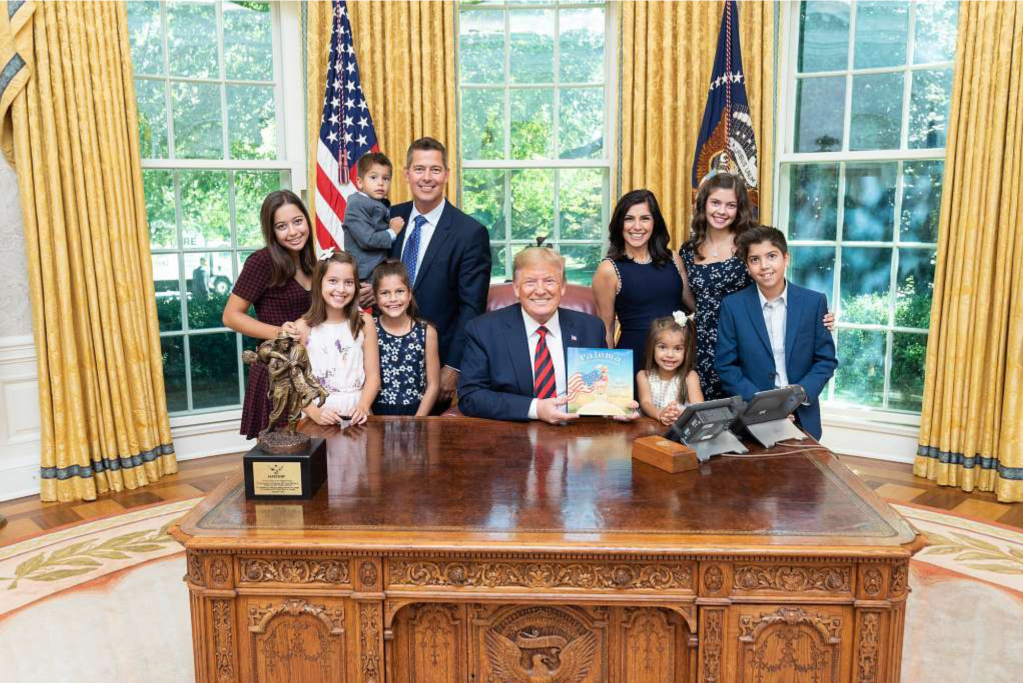
A disturbing order from the U.S. Department of Transportation is ringing alarm bells for sustainable transportation advocates across America — particularly when it comes to a bizarre pledge to grant more money to communities with “marriage and birth rates higher than the national average.”
On Wednesday, newly minted Secretary Sean Duffy mirrored the Trump administration’s larger shock-and-awe approach when he issued a pair of astonishingly broad memos aimed at unraveling the legacy of the Biden administration — which Duffy referred to collectively as “‘Woke’ Policies” — and bringing the department into alignment with the 47th president’s priorities.
Advocates say those memos essentially direct DOT employees to weaponize the entire federal transportation sector in service of the administration’s larger goals, threatening communities with the possibly illegal withdrawal of funding if they impose “vaccine and mask mandates,” don’t assist federal immigration enforcement by “creating sanctuary cities,” or fail to utilize “user-pay models,” among other things.
The last one is particularly curious, given the Trump administration’s threats to shut down New York’s first-in-the-nation congestion pricing program — and the fact that even the gas tax isn’t really a true user fee, because U.S. drivers collectively do not pay the full cost of the roads they use.
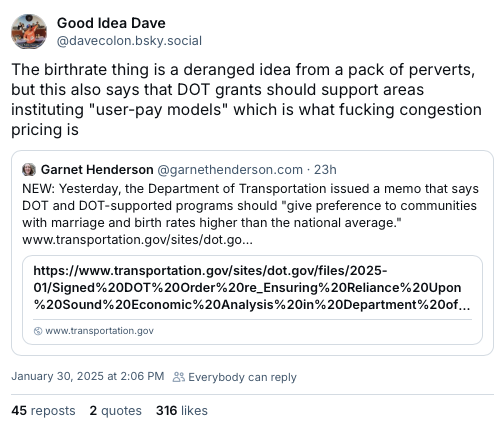
One line in the memo caught many advocates off guard, stating that DOT would prioritize transportation projects in communities with high fertility rates — a list which, at least at the state level, is dominated by Republican voters, as well as heavily auto-centric transportation networks.
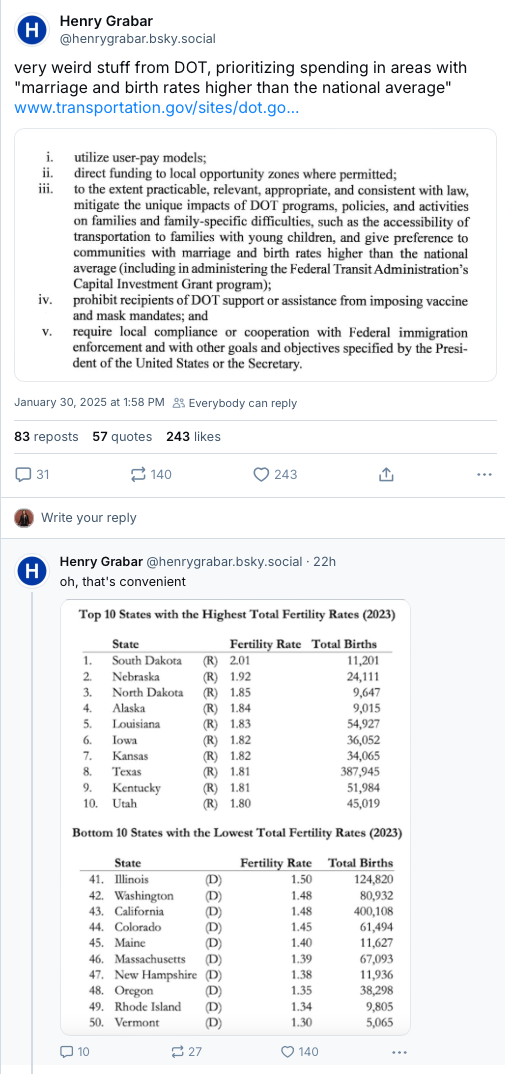
Of course, privileging places with lots of babies for federal funding probably isn’t legal — and it raises the question of how it meets any obvious transportation need, especially considering that many of the most fertile states in America are still losing net population as residents move out and die at earlier average ages.
Putting birth rates first, though, does jibe with a pro-natalist philosophy espoused by many members of the Trump administration, which contends that American dominance is threatened by declining birth rates, and that federal policies should encourage nuclear families to have more kids — particularly if those kids are white, Christian and the product of traditional heterosexual marriages.
Elon Musk, who is the father of 12 children (some of whom are still speaking to him), has publicly embraced the philosophy of pronatalism, as has Vice President J.D. Vance; while Sean Duffy has not been outspoken on issue, he is the father of nine and an active opponent of abortion rights.
On the face of it, the memo’s commitment to “the accessibility of transportation to families with young children” might sounds benign — until you consider that truly doing so would require confronting the devastating cost of universal car dependence on American families, something neither Duffy nor Trump is proposing.
In 2022 alone, 1,129 children under 14 were killed on U.S. roads, the equivalent of more than two full elementary schools and a rate of three deaths every single day, and another 429 daily injuries, many of which are life-altering. And that trend has been ongoing for years: for every child lost to traffic violence in Sweden in 2018, for instance, the U.S. lost more than five, even controlling for population differences.
Duffy has pledged to make safety a cornerstone of his legacy. But even if he somehow succeeds in ending car crash deaths and serious injuries without decentering the automobile from much of American life — which, to be clear, he cannot — we would still be left with communities so sprawling that many children won’t be able to walk to a neighbor’s house or the corner store without a parental chauffeur — and even if they can, their parents might be arrested for it.
Losing their independence to walk, bike, and move in their very own neighborhoods has massive implications for childhood development and health, as well as the stress levels of the caregivers who are responsible for shuttling them around when driving is the only option. It can also cost caregivers their ability to work other jobs and thrive in other aspects of their lives — and those caregivers, needless to say, are overwhelmingly women, people of color, and the low-income.
Also steep are the financial costs of a system that forces more than half of U.S. families into the school drop-off line rather than giving them access to a good sidewalk or a neighborhood bike bus. Tthe average U.S. household pays $13,174 a year for transportation, and low-income families in particular spend more than 30 percent of their after-tax income just on getting around.
Families who can depend on public transportation and forgo vehicle ownership spend a fraction of their take-home pay on basic mobility — but most American families can’t do that.
If Duffy really cared about helping American families get around rather than using them as a cudgel, he’d push to invest more federal resources into local projects like sidewalks, bike lanes, and intracity transit — not discouraging federal investment into “projects and goals that are purely local in nature,” as he wrote elsewhere in the memo. He would act swiftly to implement the Biden-era pedestrian head protection rule, the automatic emergency braking rule, and other walker-friendly vehicle safety standards about which the Trump administration has so far been silent or has promised to delay.
And Duffy would certainly not delete all Biden-era orders that seek to confront climate change and greenhouse gas emissions, which threaten the American nuclear family just as much as every other human being on Earth.
Then again, if Duffy is serious about prioritizing communities with high marriage rates, too, he might end up sending more money to blue states — many of which do understand the importance of giving all U.S. residents the freedom to choose how they move. Given the morass of confusion and self-contradictions that have been his orders so far, though, there’s certainly no guarantee.


Read More:
Streetsblog has migrated to a new comment system. New commenters can register directly in the comments section of any article. Returning commenters: your previous comments and display name have been preserved, but you'll need to reclaim your account by clicking "Forgot your password?" on the sign-in form, entering your email, and following the verification link to set a new password — this is required because passwords could not be carried over during the migration. For questions, contact tips@streetsblog.org.