Opinion: LA Should Pull Plug on Wasteful MicroTransit Pilot

This week the L.A. Times published a piece on Metro’s obscenely costly microtransit pilot. The $1 ride that costs Metro $43. Why some want to keep it going, by Rachel Uranga, highlights numerous issues with the Metro Micro pilot – from cost (“more than four times what it costs to provide a ride on a bus”) to ridership (“lower ridership drives up cost because it’s essentially becoming a personal ride instead of a shared one”).
The both-sides Times piece also gives Metro Micro proponents opportunities to opine optimistically about the pilot, which is scheduled to run out of funding at the end of this month. One chief executive, who heads the company Metro pays to run the ailing pilot, asserts that Metro Micro “is really the future.”
Metro’s recent Metro Micro performance audit and June Metro Micro update try to put a positive spin on the $43 million Metro Micro pilot, but even the agency’s own hagiography highlights flaws too numerous to ignore.
The Metro Micro program is anticipated to come back to the board this month, hat in hand, to request additional millions in additional operations funding.
Below are some reasons that Metro Micro is awful (apologies to folks who read my Metro Micro takedown last March; this retreads some of the same ground):
Cost: Microtransit’s cost to Metro is alarming. The Times says rides cost Metro $43 each. As of March 2023 it was $63. In the past, per-ride subsidies have ranged from $30 to $60. Compare that to ~$8 for a low-performing bus route.
One way to look at this is that, for operations funding, if Metro put a given amount of money towards bus service instead of Metro Micro, Metro could likely serve nearly ten times as many people.
Fare: Metro continues to charge $1 per ride for premium Metro Micro service, which is way less than the $1.75 that Metro charges for bus and rail rides. The $1 ride cost was approved as a temporary promotional rate, but Metro quietly shelved the approved $2.50 rate and extended the cheaper-than-the-bus rate indefinitely.
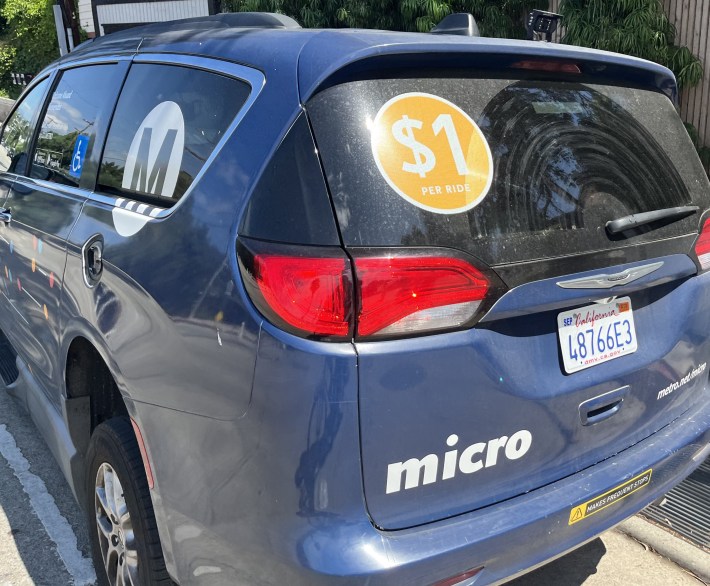
Metro recently plastered large “$1 PER RIDE” stickers on Metro Micro shuttles. Perhaps these could be peeled off and put on Metro buses instead?
Equity: Micro Metro tried to advance equity, but failed. Metro appropriately targeted some service areas in working class communities of color. But Metro’s data shows that, overall, the pilot is not serving underserved populations.
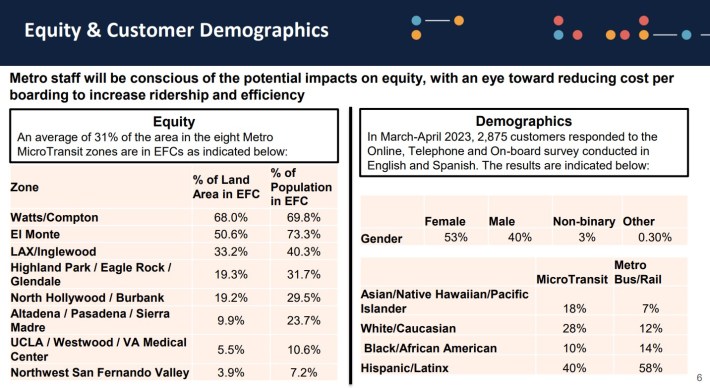
Metro’s published demographics data shows that Metro Micro is being utilized by a population that is whiter than Metro’s transit ridership. Metro Micro riders are forty percent Latino, compared to 58 percent of overall Metro transit ridership. Ten percent of Metro Micro riders are Black, compared with 14 percent on bus/rail. White folks comprise twelve percent of Metro transit riders, but are 28 percent of MicroTransit riders.
Supervisor Hilda Solis’s comments at the Executive Management Committee [video] alluded to Metro Micro ridership being younger than bus ridership due to ease of scheduling using smart-phone apps. Metro survey data shows that over seventy percent of Metro Micro riders are under age 45. Metro transit is basically the opposite, with just over half of transit riders 45 or older.
Why is Metro continuing to harm equity by offering a heavily subsidized, discounted, premium MicroTransit service to a whiter, younger population, while charging full fares for fixed route service for predominantly Latino and Black bus and rail riders? It doesn’t make sense.
Customer satisfaction: Metro notes various kinds of customer satisfaction indicators, from repeatedly touting “High customer experience ratings (averaging 4.8 out of 5 stars for those who ride)” to “About 98 percent of Metro Micro customers rated the vehicle seats as comfortable, but only 59 percent of Metro bus customers view bus seats as comfortable.”
But Metro also reports that for about a third of rides requested (31-36 percent for most recent year of data shown) there were “no rides available.” So, a third of customers don’t get a ride and therefore don’t get to provide input. The rider satisfaction data appears rosy because it only counts the two-thirds of riders who actually got to ride.
Find more criticism of Metro Micro at earlier SBLA coverage.
The post Will the Metro Board Please Pull the Plug on the Wasteful MicroTransit Pilot? appeared first on Streetsblog Los Angeles.

Read More:
Streetsblog has migrated to a new comment system. New commenters can register directly in the comments section of any article. Returning commenters: your previous comments and display name have been preserved, but you'll need to reclaim your account by clicking "Forgot your password?" on the sign-in form, entering your email, and following the verification link to set a new password — this is required because passwords could not be carried over during the migration. For questions, contact tips@streetsblog.org.