What Do Drivers Really Think of Cyclists?

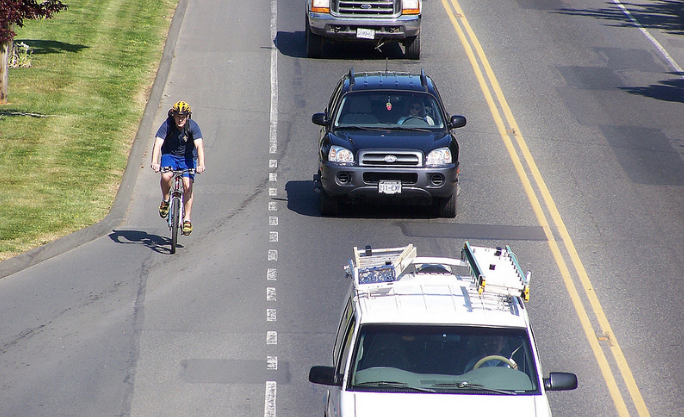
There’s ample research out there backing up the safety benefits of streets with protected bikeways and slow car speeds. But what about the critically important yet less tangible factor of individual attitudes — how does the mind of the person behind the wheel affect driver behavior toward cyclists? A new report from Portland State University looks at the question.
“Driving is one of the most complex tasks that we all engage in. Very few of us are airline pilots or surgeons, but almost all of us can get a drivers license,” says Tara Goddard, who authored the report as part of her PhD dissertation at Portland State’s urban planning program. “Like all aspects of human behavior, we’re not always rational, and we’re not always civil.”
Goddard surveyed 676 frequent drivers from across the country about how they feel when driving near cyclists and about their own cycling behavior. She also asked questions aimed at assessing each respondent’s biases regarding drivers and cyclists.
“We have finite road space and finite transportation dollars, so we create this system of competition. It’s a totally uneven competition… But when you put people in those circumstances, they act like a member of their group and not an individual,” Goddard says. The result is that “there is a complete lack of empathy” among otherwise nice, normal people, she explains. “Do these interactions have an impact on safety, and if so, what can we do about it?”
The survey responses indicate that drivers feel a lot of pressure not to hold up traffic behind them. “That’s relevant to vulnerable road users, because then, potentially, drivers are going to be making closer passes, or engaging in unsafe passing behaviors,” Goddard says. “We know that when people are under stress, they make more errors in their motor skills.”
Goddard found that drivers who live in more densely-settled zip codes, who ride a bike at least once a week, or who ride to commute and do errands, had positive attitudes about bicyclists on the road. But drivers who ride a bike for recreation did not necessarily have a higher opinion of cyclists — even though, unlike all other drivers, they said they were comfortable with their ability to pilot a car around bike riders.
“The type of riding you do matters,” Goddard says. “One-off events like Sunday Parkways might have a lot of benefits, but that may not include making people more empathetic drivers.”
Goddard, who is about to start work as an assistant professor at Texas A&M’s urban planning program, is interested in pursuing more research about the anxiety drivers feel around cyclists. She also asked drivers for the first word that came to mind when they saw three outlines showing different types of cyclists — a racer, an upright commuter, and a backpack-wearing rider doing a track stand. The goal, Goddard says, is to explore how stereotypes inform driver behavior.
“It’s very difficult as a planner or engineer to take on peoples’ biases,” she said. “My research helps shore up the evidence that it’s not fair or safe to put the onus on cyclists to just take the lane… Drivers, whether they mean to or not, are behaving unsafely or badly around cyclists.”
Goddard sees enormous potential for technology to improve road safety, but also big risks in the development of autonomous vehicles. “The algorithms behind them are human creations,” Goddard says. “Are decisions being coded into these decision-making processes that have views about who is a legitimate roadway user? Is the most important thing to get drivers to their destinations on time, or is the most important thing to not hit anyone?”

Read More:
Streetsblog has migrated to a new comment system. New commenters can register directly in the comments section of any article. Returning commenters: your previous comments and display name have been preserved, but you'll need to reclaim your account by clicking "Forgot your password?" on the sign-in form, entering your email, and following the verification link to set a new password — this is required because passwords could not be carried over during the migration. For questions, contact tips@streetsblog.org.