More Election Results: Transit Wins Big

Out of 12 transportation-related measures that were voted on Tuesday, seven represented a victory for transit, three were losses to learn from, and two more aren’t really a win one way or another but are worth noting. According to the Center for Transportation Excellence, these numbers bring the year’s total to an impressive 79 percent win rate for transit. Especially impressive is the fact that most of these measures involved a tax of some sort, and people were willing to pay it if it meant better transit service – even in tough economic times.
Angie has profiled the victory in Durham and the loss in Seattle. Here are the rest of the results:

In Montcalm County, MI, a proposed property tax hike to fund bus service failed 39-61.

A terrible idea failed to catch on in Cincinnati, but the closeness of the final tally showed there’s still work to be done. The proposal to ban any forward movement on building a streetcar system lost, but the vote was 49-51. Still, this loss was a big win for transit.
Bad news for residents of Trumbull County, Ohio: the property tax increase that would have saved their transit system failed 36-64. If the county is to be believed, this means the transit system will shut down entirely, a huge loss, especially for the county’s most vulnerable residents. According to a local paper, “In 2010, the transit provided 64,249 trips: 18,922 for senior citizens, 21,013 for the disabled, 16,131 for students, and 8,183 for other residents.”
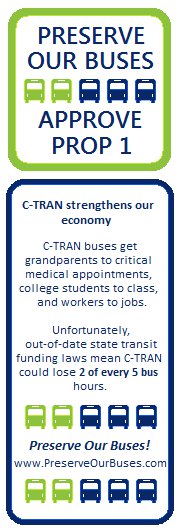
The 54-46 passage of Proposition 1 in Clark County, Washington was a big win for transit. Residents of the Washington-side suburbs of Portland will pay another 0.2 percent sales tax in order to stave off harsh cuts to their transit service. Even the normally anti-tax local paper said the vote was essential to maintaining quality of life in the county.
The counting of the statewide initiative 1125 in Washington went into the next day, but we can say definitively now that this bad idea has lost – at last count, it had 48.44 percent of the vote. The measure would have put serious restrictions on tolling at a time when tolling is one of very few funding mechanisms available to states. Even worse, it would have codified a pro-roads bias by insisting that tolling revenues could only pay for roads. It also singled out light rail, banning it on the I-90 bridge.
* The proposal to increase the Lorain County sales tax failed pretty spectacularly — 32-68. Transit advocates took note of this one but aren’t counting it as a loss, since the primary focus of the campaign – and the primary destination of the tax revenues – was the criminal justice system, not transportation. The loss does, however, mean that the county will cut its contribution to the transit system in half, in order to have more money to pay for prisons.
Here are a few we didn’t mention Tuesday:
* A statewide initiative in Arkansas to levy a $575 million bond to support highway repairs succeeded, 81-19, but is also not counted as a win or a loss for transit. Still, it’s good to see a bill like this fund state of good repair and not expansion.
In the city of Alpena, MI, transit scored another big win: a renewal of the current 0.65 mill levy (that’s 65 cents for every $1,000 of assessed property value) to help fund the Dial-A-Ride service. The tax, which is expected to generate $161,000 in its first year, passed handily, 79-21.
Another landslide win in the city of Corunna, MI: A renewal of a 25 cent property tax will generate $14,000 in first year, to be used to support the transportation agency. It passed 73-27.
Residents of Grand Traverse County and Leelanau County, MI also showed their willingness to tax themselves for better transit: They voted overwhelmingly to renew the 35 cent property tax to support the operations of the Bay Area Transportation Authority. In its first year, the tax is expected to generate $2,305,190. It passed 73-27 in Grand Traverse County and 75-25 in Leelanau County.
CFTE says these election results “continue a decade-long trend of overwhelming voter support for transportation investments with local tax dollars.” They’re counting a 79 percent success rate on transportation ballot measures.
“In spite of deep, continuing economic anxieties, voters continue to support raising local revenue to invest in transit,” said CFTE Director Jason Jordan. “Conventional wisdom says that the public won’t support raising taxes, but when the transportation and economic benefits are clear, as was the case with measures across the country this year, voters strongly choose to invest in transit.”

Streetsblog has migrated to a new comment system. New commenters can register directly in the comments section of any article. Returning commenters: your previous comments and display name have been preserved, but you'll need to reclaim your account by clicking "Forgot your password?" on the sign-in form, entering your email, and following the verification link to set a new password — this is required because passwords could not be carried over during the migration. For questions, contact tips@streetsblog.org.